If you are preparing an EB1A case, you have probably heard the same advice again and again: “Get strong
recommendation letters.” But once you start actually drafting them, a much bigger question appears fast.
Should your EB1A
recommendation letters come from independent experts or from your employer?
This question matters because EB1A reference letters are not just supporting paperwork. They shape how
USCIS understands your impact, your reputation, and your standing in the field. A well-written letter
can elevate evidence that already exists. A poorly positioned letter can make even strong achievements
look routine.
In this blog, we will break down independent vs employer letters for EB1A, explain which ones usually
carry more weight and why, and show you how to build a letter strategy that feels credible, consistent,
and persuasive.
EB1A is not approved because someone is talented or hardworking. USCIS looks for proof of extraordinary
ability through evidence that demonstrates sustained recognition and impact at the top of the field. In
many cases, the most difficult part is not whether your accomplishments are real. It is whether a USCIS
officer can understand them quickly and trust the conclusions.
That is why recommendation letters are powerful. They are one of the few places where your work can be
explained in plain language by a third party who has the authority to evaluate it. A strong EB1A letter
does not just complement you. It clarifies why your contributions are original, why they matter, and why
your influence stands above peers.
At the same time, letters can also backfire if they sound generic, exaggerated, repetitive, or biased.
This is where the “independent vs employer” decision becomes important.
An employer letter typically comes from someone within your organization. This might include your
manager, senior leadership, a department head, a director, a VP, or someone who directly worked with you
and can speak to your role and impact.
Employer letters can be extremely valuable because they provide firsthand detail. They can explain what
you led, what outcomes you drove, and why your role was critical to the organization. In business cases
especially, employer letters often help prove “leading or critical role” because they show why you were
essential to a project, product, platform, or revenue-driving initiative.
However, employer letters also have a built-in weakness. USCIS may view them as interested-party
statements because your employer benefits from your work. Even if the letter is honest, the officer may
question how objective it is. That does not mean employer letters are bad. It simply means they must be
written with more structure and credibility.
4. What Is an Independent Letter in EB1A?
An independent letter is written by someone who is not directly tied to your employer, and ideally not
financially dependent on you or your company. Independent recommenders may include recognized experts in
your field, industry leaders, senior professionals at peer organizations, conference organizers,
editors, judges, collaborators, or respected researchers who understand the importance of your work.
These letters often carry strong persuasive power because they signal external recognition. They help
demonstrate that your reputation exists beyond internal performance reviews or company success.
Independent letters are especially valuable when USCIS needs to see that your influence is not limited
to one employer, one team, or one set of internal stakeholders.
Still, independent letters must be carefully executed. If the recommender does not clearly explain how
they know your work and why they are qualified to evaluate it, the letter may look like a favor letter.
USCIS does not want inflated praise. USCIS wants credible expert analysis.
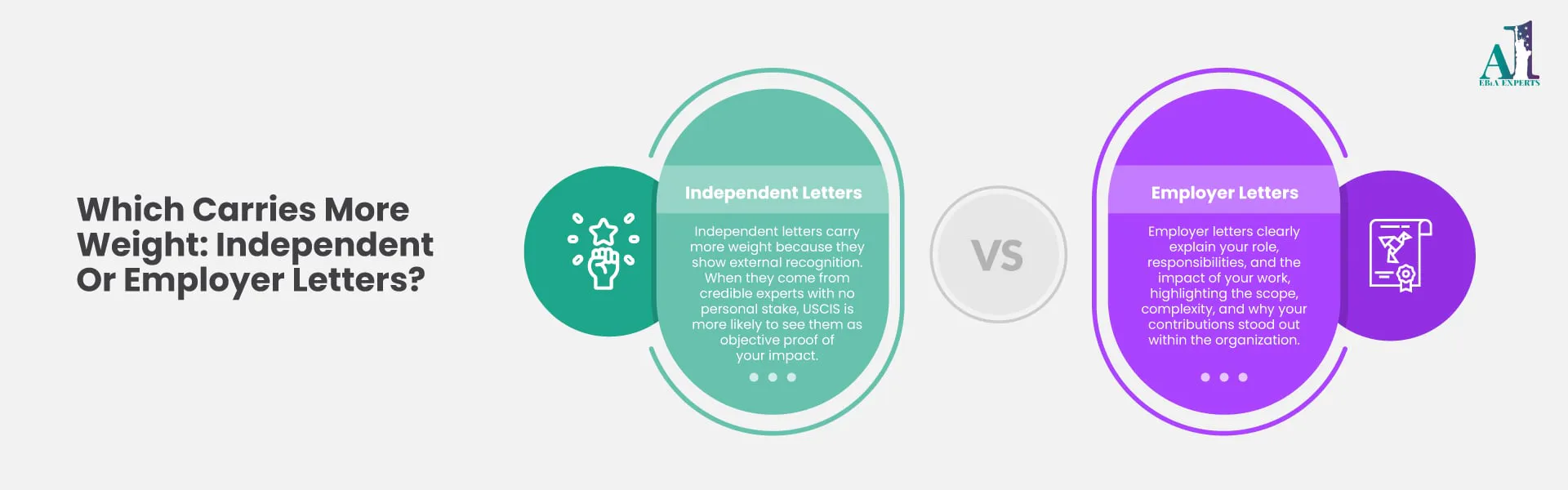
5. Which Carries More Weight: Independent or Employer Letters?
If the goal is to answer this simply, the most accurate answer is: independent letters usually carry
more weight for credibility, while employer letters carry more weight for specific details.
Independent letters often feel more trustworthy because they represent outside recognition. They support
the idea that your work has influence beyond your company and that experts in the field consider it
exceptional. When a letter comes from a person with strong credentials who has no direct benefit from
supporting you, USCIS is more likely to view it as objective.
Employer letters, on the other hand, are often stronger when it comes to explaining exactly what you did
and why it mattered. They can prove scope, complexity, internal selectivity, and business outcomes with
more precision. A manager or executive can describe what made your role critical, what responsibilities
you owned, and why your performance stands out against others within the organization.
So the question is not really which one is “better.” The question is whether your EB1A letter set
creates both credibility and clarity.
6. When Employer Letters are Essential in an EB1A case?
Employer letters become especially important when your case relies heavily on demonstrating that you
played a leading or critical role for distinguished organizations. If you are in a business or industry
role, your work may not be publicly visible in the way a researcher’s publications are. That does not
mean your impact is weaker. It means the impact needs to be explained through verified, role-specific
context.
Employer letters work best when they include concrete details such as project scope, decision authority,
results achieved, and why you were selected. The strongest employer letters also explain why your work
was not routine. They show that your achievements required rare expertise and that your contributions
created measurable outcomes the organization depended on.
The biggest mistake people make with employer letters is making them sound like performance reviews.
EB1A letters must be written as expert assessments, not manager praise.
Independent letters are often the deciding factor when USCIS is unconvinced that your reputation is
external. Many EB1A petitions look strong internally but weak externally, especially for professionals
in product, engineering leadership, strategy, marketing, cybersecurity, and operations.
Independent letters help prove that your influence is recognized outside your company. These letters can
support criteria related to original contributions and recognition in the field by showing that your
work impacted others, shaped practices, influenced adoption, or set standards that peers acknowledge.
Independent letters are also helpful when your employer cannot fully share details due to
confidentiality. In those situations, independent experts can speak to outcomes, market-level influence,
and the value of your contributions without exposing restricted information.
But independent letters must avoid vague praise. They need authority, direct evaluation, and specific
substance.
8. The Strongest EB1A Strategy Is Not Either-Or, It Is Both
In most high-quality EB1A cases, the best approach is a balanced letter mix. Employer letters provide
depth and credibility around the role and internal impact. Independent letters provide external
validation and prove that your recognition extends beyond the workplace.
When USCIS reads a mixed set of letters, the case often feels more complete. The officer can see that
you are exceptional in real work environments and that your expertise is respected beyond your
employer’s boundaries.
A strong recommendation letter set usually feels consistent, not repetitive. Each letter should
contribute something unique, whether it is a new angle of impact, a different type of authority, or a
different proof point tied to your EB1A criteria.
9. What USCIS look for inside any EB1A letter?
Whether a letter is independent or employer-based, its credibility depends on structure. The most
persuasive EB1A recommendation letters clearly establish who the recommender is, why they are qualified
to evaluate you, and how they know your work. They then explain what your contributions were, why they
were original, and what impact they created.
The best letters also help USCIS understand why you are above peers, not just competent. They show
selectivity, influence, and recognition. They do not rely on emotional praise. They rely on professional
judgment supported by evidence.
If a letter could be copied and pasted for someone else, it is not strong enough.
10. FAQs
1) Are independent recommendation letters stronger than employer letters for EB1A?
Independent letters are often viewed as more objective because the recommender has no direct stake in
your case. However, employer letters can provide stronger project-specific details. The best EB1A
strategy usually combines both types for credibility and clarity.
2) How many independent letters should I include in an EB1A case?
There is no fixed USCIS rule, but a balanced set often works best. Many strong cases include a mix of
independent and employer letters so that the petition shows both external recognition and detailed proof
of your critical role and impact.
3) Can EB1A be approved with only employer letters?
Yes, it can be approved, but it may be riskier if your case lacks external validation. USCIS may view
employer letters as less objective. If your achievements have broader influence, adding independent
letters can strengthen credibility significantly.
4) Do independent recommenders need to have worked directly with me?
Not always. Independent experts can write persuasive letters if they can credibly explain how they know
your work, why your contributions matter in the field, and why they are qualified to evaluate you.
Specificity and authority matter more than closeness.
If you are unsure whether your EB1A recommendation letters are persuasive enough, or whether your set is
too employer-heavy or too generic, get a free EB-1A evaluation with EB1A Experts. We will review
your letter strategy, identify gaps, and guide you toward a high-credibility approach that USCIS can
trust.
Was this article helpful?
Sorry, your feedback couldn't be saved. Please try again.






 January 22, 2026
 3 min read