1. The Silent Self-Rejection Problem
If you have a PhD, that’s impressive. But if you don’t, does that make you less eligible for an EB1A
Green Card? The answer is a clear and straightforward no.
The EB1A Green Card process is not a university admissions system or an academic gatekeeping exercise.
It is a legal framework designed to identify individuals with extraordinary
ability who have risen to
the very top of their field. Education alone does not define that standard.
You do not need a PhD to qualify for the EB1A Green Card.
Consider this scenario.
Ms. K is a senior software architect who helped build a global payment infrastructure processing
billions of dollars annually. She is also a startup founder whose proprietary algorithm transformed
logistics optimization. Her profile clearly places her among the undisputed leaders in her field. Yet,
when the topic of the EB1A Green Card comes up, she hesitates.
Why?
Because of the persistent myth that EB1A without PhD is not possible.
There is a silent culture of self-rejection among high-achieving professionals. Many believe that
without a doctorate, US Citizenship and Immigration Services (USCIS) will not consider them
“extraordinary enough.” This fear creates a barrier that does not exist in law.
If you have ever asked yourself, “Does PhD matter for EB1A?”, this
blog is for you.
2. Is a PhD Required for EB1A? Let’s Start With the Law
To understand why a doctorate is not a mandatory criterion, we need to start with the statute itself.
Under the Immigration and Nationality Act (INA) §203(b)(1)(A), the EB1A category is reserved for
individuals with “extraordinary ability in the sciences, arts, education, business, or athletics.”
The statute and its implementing regulations (8 CFR §204.5(h)) do not list any educational degree as
a mandatory requirement. While other visa categories, such as the EB2-NIW, explicitly reference an
“advanced degree,” the EB1A pathway does not. It is entirely merit-based.
In other words, EB1A education requirements do not necessitate a PhD.
What determines success in the EB1A Green Card process is not academic pedigree, but the impact
your work has had on your industry or field.
This is where many applicants misunderstand the category. EB1A is fundamentally different from academic
tenure-track systems. In academia, a PhD is often the minimum credential required to even apply. In EB1A
adjudication, “extraordinary ability” is defined as being “one of the small percentage who have risen to
the very top of the field of endeavor.”
A USCIS officer’s role is to assess evidence of that rise.
A professional without an advanced degree who has won major industry awards, commanded a high salary, or
created technology used by millions can meet EB1A
eligibility more convincingly than a postdoctoral researcher with a PhD but no real-world impact.
Key Takeaway: USCIS does not approve EB1A petitions based on degrees. It approves them based on
evidence
of sustained national or international acclaim.
3. Why the PhD Myth Persists (And Why It’s Misleading)?
If the law is this clear, why does the belief that EB1A requires a PhD still persist? Much of it stems
from the history of the category. In its early years, EB1A applicants were predominantly researchers and
professors. Their evidence, such as publications and citation counts, was easy for USCIS officers to
quantify.
Additionally, many immigration law firms historically marketed to academic applicants because their
profiles were easier to package. Over time, this created a flawed perception that only citation-heavy
scholarly profiles qualify. This misunderstanding is damaging. Industry leaders often undervalue their
own contributions when comparing themselves to academics. Seeing a researcher with 500 citations can
make them feel “lesser,” even though launching a product used by 10 million people may be a far stronger
signal of extraordinary ability.
Key Takeaway: A PhD is not required to qualify for an EB1A Green Card. If you have one, it can
help. If you don’t, you can still qualify if your work demonstrates meaningful industry impact.
4. What USCIS Actually Evaluates in EB1A Cases Today?
When a USCIS officer reviews an EB1A petition, they are not counting degrees. They are evaluating a
narrative of excellence. Modern EB1A evaluation factors emphasize a holistic,
impact-driven analysis rather than a narrow focus on publications or credentials.
Education Is Context, Not a Gatekeeper
USCIS treats education as background information. A bachelor’s or master’s degree explains how you
acquired your skills, but it is not proof of extraordinary ability. In some cases, a PhD can even be a
double-edged sword. If an applicant holds a doctorate but has not produced impactful work beyond their
thesis, USCIS may view their acclaim as stalled. For EB1A without doctorate applicants, the focus
remains squarely on active contributions and real-world influence, where many industry professionals
actually have an advantage.
Influence Over Instruction
There is a fundamental difference between studying a field and shaping it. A PhD candidate may spend
years analyzing market behavior. A non-PhD entrepreneur may introduce a disruptive technology that
permanently changes that market. USCIS prioritizes the latter when it comes to impact. The standard
applied to both PhD and non-PhD applicants is identical: demonstrate industry-wide impact using reliable
evidence.
Recognition by Others in the Field
Independent validation is the cornerstone of a strong EB1A case. Recognition may come through media
coverage, high compensation, critical roles in distinguished organizations, or expert endorsements. In
industry settings, this often includes recommendation letters from independent experts, venture capital
backing, keynote invitations, or recruitment for high-stakes leadership roles. The goal is to show that
your peers, not just your supervisors or professors, recognize your contributions.
5. Real Signals That Carry More Weight Than a PhD
For professionals pursuing EB1A eligibility without PhD, hard evidence of impact is critical.
These indicators often carry more persuasive weight than academic credentials.
Evidence of Original Contributions
You must show that you solved meaningful, high-impact problems. For an engineer, this might involve
developing a framework that reduces latency across an industry. For a business leader, it could be a
proprietary growth methodology adopted by other companies. USCIS focuses on influence and adoption. If
others use your work, your contribution is original.
Leadership in Critical or Essential Roles
USCIS evaluates whether you held leading or critical roles in organizations with a distinguished
reputation. Serving as the lead architect for a Fortune 500 digital transformation, with authority over
major decisions and measurable outcomes, represents extraordinary ability in practice. This level of
responsibility often carries more evidentiary value than academic credentials
Peer Validation and Independent Endorsements
Expert letters are essential in non-PhD cases. These should not be personal recommendations, but
independent expert opinion letters explaining the technical or commercial significance of your work.
Strong letters distinguish reputation from popularity and anchor your achievements in objective impact.
Field-Level Impact at Scale
Finally, USCIS looks at reach.
Does your work produce downstream effects across an industry?
Does it improve security, efficiency, or outcomes for large populations?
This type of field-level impact is exactly what EB1A is designed to reward.
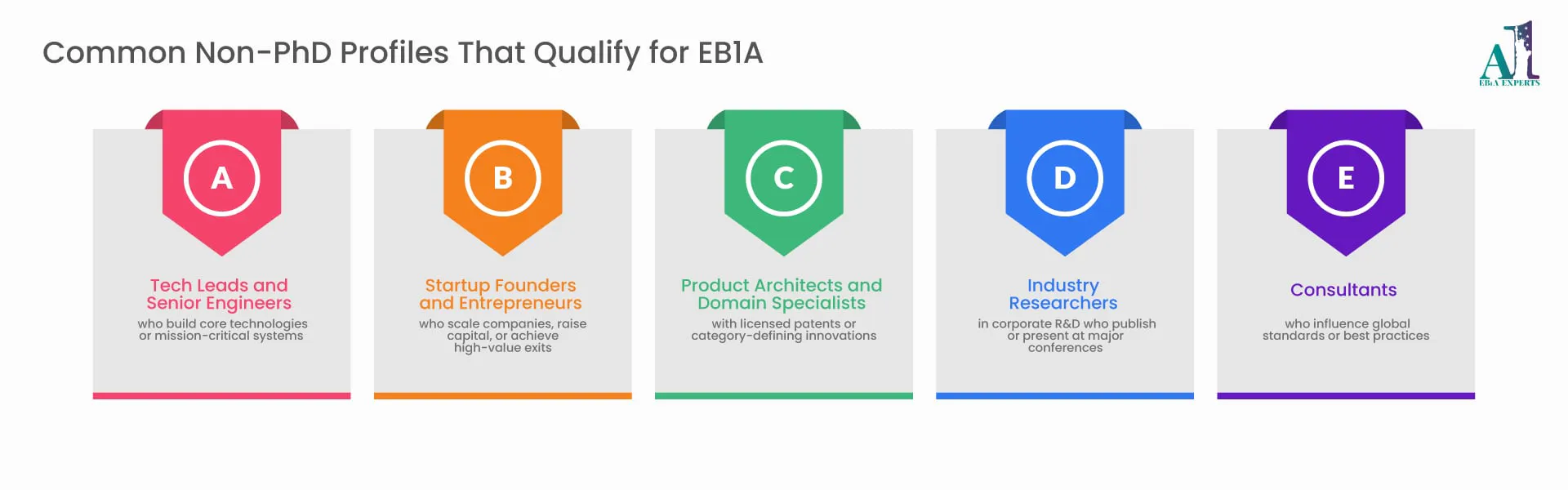
6. Common Non-PhD Profiles That Qualify for EB1A
Many professionals underestimate their eligibility. Common qualifying profiles include:
- Tech Leads and Senior Engineers who build core technologies or mission-critical systems
- Startup Founders and Entrepreneurs who scale companies, raise capital, or achieve high-value
exits
- Product Architects and Domain Specialists with licensed patents or category-defining
innovations
- Industry Researchers in corporate R&D who publish or present at major conferences
- Consultants who influence global standards or best practices
The pattern is clear: USCIS evaluates what you have contributed, not the title you hold.
7. Why Many Strong Non-PhD Cases Still Get RFEs?
Even strong applicants sometimes receive Requests for Evidence (RFEs). Non-PhD
applicants often assume
this happens because they lack a doctorate.
That assumption is incorrect.
Most RFEs stem from:
- The résumé trap, where achievements are listed without a cohesive narrative
- Criterion misalignment, such as mischaracterizing internal awards
- Weak articulation, failing to explain why work mattered at the field level
This is a framing issue, not a qualification issue. A PhD does not fix poor storytelling. Strong
evidence, clearly connected to impact, does.
8. How to Know If You’re EB1A-Ready Without a PhD?
Before applying, ask yourself:
- Has your work influenced others in your field?
- Have independent experts recognized your contributions?
- Can your impact be measured beyond your employer?
If the answer is yes, your EB1A
eligibility without PhD is likely stronger than you think. Uncertainty is normal, but it should
not stop you. Move from feeling to measuring.
9. Conclusion: Extraordinary Ability Isn’t Academic; It’s Evident
The EB1A Green Card is one of the most prestigious immigration pathways in the US, but it is not an
ivory tower. It is designed for builders, innovators, and leaders.
A PhD is not required, and in many cases, it is not the deciding factor.
So, does a PhD matter for EB1A?
It can provide context, especially in academic fields, but it is never mandatory. USCIS rewards impact, not degrees. The greatest risk is not having an advanced education. It is self-rejecting based on a myth. Do not let false assumptions stop you from pursuing recognition you have already earned.
10. FAQs
1. Can I qualify for EB1A without a PhD?
Yes, you can absolutely qualify for the EB-1A extraordinary ability visa without holding a PhD. USCIS
does not require academic degrees for EB1A eligibility. Instead, officers evaluate whether your I-140
petition demonstrates sustained national or international acclaim through credible evidence. Impact,
recognition, original contributions, and influence within your field matter far more than formal
education. Many EB1A approvals come from professionals in business, technology, arts, and
entrepreneurship with no PhD but strong evidence positioning.
2. Does a PhD matter for EB1A approval?
A PhD alone does not determine EB1A approval. While it may provide background context, USCIS does not
treat a doctorate as proof of extraordinary ability. EB-1A adjudication focuses on documented
achievements, independent recognition, and real-world impact. Without strong supporting evidence, even
PhD holders can receive RFEs or denials. A well-structured EB1A petition prioritizes contribution-based
proof over academic credentials, aligning with current USCIS evaluation standards.
3. What carries more weight than a PhD in EB1A cases?
In EB1A cases, original contributions of major significance carry far more weight than a PhD. USCIS
looks for measurable field-level impact, leadership in critical roles, independent expert recognition,
and influence on peers or organizations. Evidence such as citations, revenue impact, media coverage,
judging roles, or adoption of your work strengthens an EB-1A visa petition. Strategic evidence selection
and narrative clarity are key to avoiding RFEs and securing approval.
4. Is EB1A only for researchers and professors?
No, EB1A is not limited to researchers or professors. The EB-1A extraordinary ability category is open
to professionals across business, technology, arts, athletics, and emerging industries. USCIS regularly
approves EB1A petitions for founders, executives, engineers, artists, and consultants when evidence
shows sustained acclaim and impact. A strong I-140 petition demonstrates how the applicant stands out in
their field, regardless of academic affiliation.
5. How do I know if I’m eligible without a PhD?
You may be eligible for EB1A without a PhD if your work has influenced others, earned independent
recognition, and produced measurable outcomes. USCIS evaluates whether your achievements place you among
the small percentage at the top of your field. Indicators include leadership roles, original
contributions, media mentions, expert testimonials, and industry adoption. A professional EB1A
evaluation helps assess evidence strength and readiness before filing or using premium processing.
If you’ve built, led, influenced, or advanced your field but aren’t sure how USCIS would assess it, your
profile deserves a proper EB1A evaluation. A structured review can reveal strengths you may be
overlooking and risks you can address early.
Get a free profile evaluation with EB1A Experts to understand where your
evidence truly stands.





 December 02, 2025
 3 min read