1. The Definition That No Longer Holds for the Extraordinary Ability Visa
The law regarding extraordinary ability remains the same, but its application has changed.
For many years, individuals seeking EB1A extraordinary ability
believed that simply having enough
credentials would only naturally lead to approval for the extraordinary ability visa. That belief is no
longer a valid assumption. Rather than just fewer approvals in volume than before 2026, it is about how
USCIS judges EB1A in practical adjudication.
This evolution began many years ago; it has been happening quietly, one case at a time, since early
2020.
Officers are no longer blindly denying more cases; instead, the way they assess applications has
changed.
Before, profiles of outstanding individuals were inherently complete in their presentation, suggesting
they were
superb; now, they need to be more clearly constructed and supported with a more explicit rationale.
The unfortunate truth is that what could have indicated greatness just five years ago can be interpreted
against
you due to the allocation of the items of evidence back to their contextual and hierarchical position in
relation
to the entire profile being presented.
2. The Legal Definition vs. Living EB1A Criteria Interpretation
Statutorily, EB1A extraordinary ability is based on the sustained national or international
recognition
that a person holds an unusually high position within their field of work. This language remains
unchanged;
however, there have been changes in the EB1A criteria interpretation
status that have been evaluated.
Many applications incorrectly believe that “extraordinary” means:
Having unusual credentials
Having elite institutional associations
Having a high volume of achievements
In practice, officers aren't redefining the law; they are establishing a standard of excellence based on
a much larger and more experienced pool of applicants. As a result, a growing divide between how EB1A
criteria are interpreted based on status versus current EB1A application practices. The way that an
individual applies for a visa may hold as much weight in determining whether or not that application
qualifies for EB1A criteria interpretation as the individual’s qualifications for that visa type.
As defined today, “EB1A extraordinary ability” is defined comparatively rather than absolutely;
therefore, distinction is no longer based on accumulation but growth based on separation from others.
The evolution of EB1A extraordinary ability applications are reviewed has developed over time,
not
through the
development of an official policy announcement.
A history of developing EB1A
approval trends 2026 that remain quietly mapped out in a
timeline:
Year
Pattern of Review
2023
Checklist
2024
Increase in Follow Ups
2025
Narrative Coherence
2026
Comparative Judgements
As applicants have become more proficient in submitting "strong" profiles, the adjudicators have been
adjusting to this new trend. The ability to recognize patterns of applicants' history—what an
adjudicator frequently sees—has overtaken the pure credentialing of an individual applicant as opposed
to a brand new applicant.
The above patterns are the foundation of EB1A approval trends 2026 that many EB1A filers will see
when submitting their applications, even if their applications would be traditionally considered
"strong" based on only the strength of their profile alone.
In order to understand today’s outcomes, applicants need to understand how USCIS judges EB1A
cases
relative to
the performance of other individuals under comparable external circumstances. The purposes and functions
of the
EB1A by the USCIS have, in effect, created a standard under which all applicants are evaluated, although
the USCIS
does not make such a reference.
Ultimately, the USCIS will assess EB1A extraordinary ability by using three separate filters
during the
assessment process:
A. Relative Quality
The assessment isn’t based on “whether this is impressive” but rather “does this set of qualifications
exceed the
level of qualifications that an applicant would typically present for EB1A application?”
B. Functional Importance
The USCIS will evaluate whether an individual has had a significant impact on his/her
field of expertise by evaluating the following issues:
Did thus individual have an influence on the outcome any decision made by a third party?
Did other members in the applicant’s field depend on the work of this individual?
C. Sustained Development
The extent to which the applicant has maintained a continuous presence within the field and is
progressing towards the level of leadership will be considered critical; the USCIS will evaluate the
degree to which an applicant is advancing or has been making equivalent contributions over time. Only
true differentiation will evidence an applicant’s progression toward an eventual level of leadership.
5. Why EB1A Case Strategy Matters More Than Meeting the Criteria?
The baseline of EB1A extraordinary ability has changed from eligibility to strategy. An officer will
judge the logical connection between two things: the level of importance of proof and the impact on an
individual’s life over time. While you have strong evidence, whether it reads as persuasive or only okay
depends entirely on your case strategy. So, a new guiding EB1A
case strategy is: “Criteria is the vocabulary used; strategy is how you express that vocabulary.
6. Narrative Logic and How USCIS Judges EB1A Cases Today
Now, narrative is a central component of the EB1A extraordinary ability, but not in a way that
most
people think.
A narrative does not mean a biography- a narrative describes the cause-and-effect relationship of your
accomplishments.
Actions that result in consequences elicit a response from your field. A lack of organization in
submission will diminish the effect of even the best candidate’s profiles. Therefore, the clarity of the
narrative is vital to how USCIS judges EB1A as it provides context for a quick assessment of the
candidate’s accomplishments under time constraints.
A solidly constructed narrative reduces cognitive friction for USCIS officers. Strong narratives allow
officers to see the value of the evidence submitted without having to create the connection themselves.
7. Common 2026 Misreads Rooted in EB1A Criteria Interpretation
A significant proportion of EB1A extraordinary ability RFE's are due to a mismatch (rather than a
lack
of)
qualifications/qualifying criteria.
Some examples of misinterpretations are:
An overemphasis on awards that did not impact their career.
Substantial numbers of expert letters that reiterated the same achievements without any real
analysis.
Evaluating job titles without demonstrating an element of selection or impact.
Evaluating data metrics without providing context.
Many of these types of issues are often due to using an outdated way of EB1A criteria
interpretation, meaning these individuals are treating the EB1A criteria as box-checking rather
than providing an accurate and meaningful evaluation of someone's extraordinary ability.
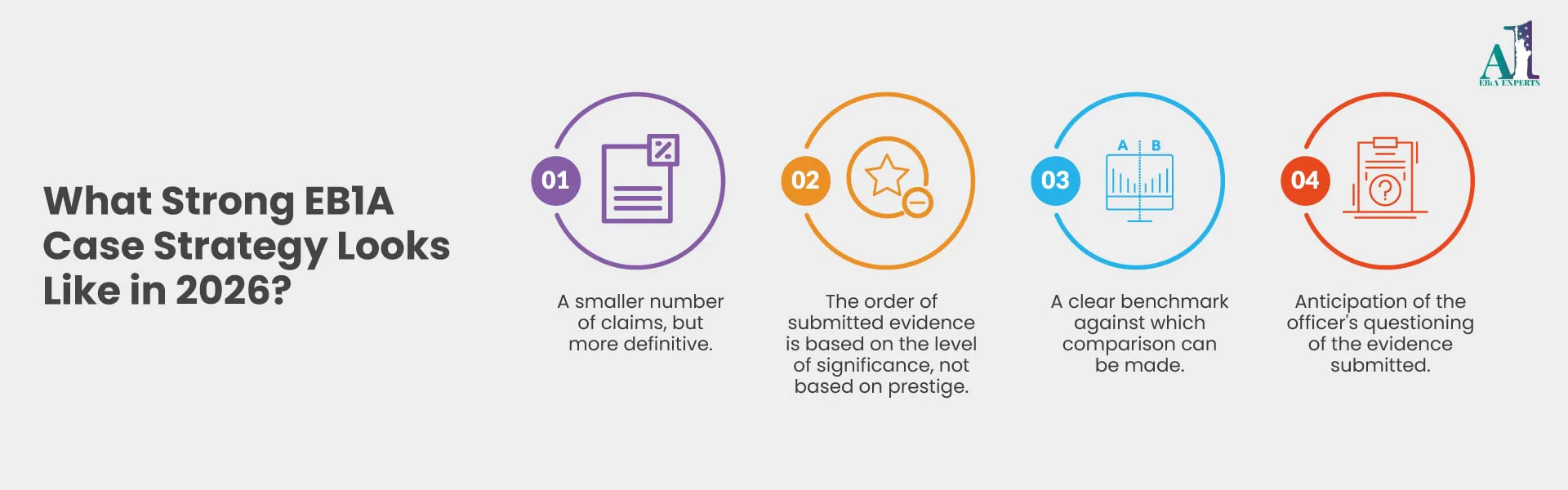
8. What Strong EB1A Case Strategy Looks Like in 2026?
In 2026, successful EB1A filings for extraordinary ability demonstrate that the strategy for building a
strong
EB1A case has been refined. It is about how strong one's case is vs. how many cases one has filed.
Successful EB1A cases in 2026 reflect the following:
A smaller number of claims, but more definitive.
The order of submitted evidence is based on the level of significance, not based on prestige.
A clear benchmark against which comparison can be made.
Anticipation of the officer's questioning of the evidence submitted.
This approach directly aligns with the current EB1A approval trends 2026. Clear evidence leads to more
favorable
determinations than simply amassed evidence.
9. What EB1A Approval Trends 2026 Mean for Filers?
When evaluating the EB1A extraordinary ability visa under the extraordinary ability visa
in 2026,
applicants must
be mindful of the following:
The risks associated with submitting an older EB1A approval and any other approval that may be based
solely on
evidence generated by AI (Artificial Intelligence) or from volume-driven evidence.
Pre-filing evaluation has become a requisite for obtaining an EB1A visa.
The foundation of an EB1A case strategy is no longer optional. It is the cornerstone of preparing
an
extraordinary ability visa application.
10. Extraordinary Ability Hasn’t Shrunk — The Lens Has Sharpened
Although the EB1A extraordinary ability standard has not narrowed, a sharper lens is now required
to assess.
The extraordinary ability visa has a viable future for only top-tier professionals. Winning
approval in 2026 will rely on how the petition is interpreted, its structure, and its clarity rather
than the accumulation of evidence. If an applicant has a strong profile but is not confident of their
strategy, then the uncertainty they are feeling is not a negative point, but rather the point where the
majority of petitions will be approved or denied in 2026.
11. FAQs
1. What does EB1A extraordinary ability mean in 2026?
In 2026, EB1A extraordinary ability refers to sustained excellence evaluated comparatively rather than absolutely. USCIS looks beyond titles and credentials to assess influence, career trajectory, and field-level consequences. The focus is on how an applicant stands relative to peers and contributes meaningfully to their domain.
2. How has EB1A criteria interpretation evolved?
EB1A criteria interpretation has shifted from a checklist-style evaluation to contextual judgment. Officers now prioritize the hierarchy of evidence, independent validation, and comparative distinction. Meeting criteria alone is insufficient; evidence must clearly demonstrate why the applicant’s work carries greater weight and relevance within their professional field.
3. How does USCIS judge EB1A cases today?
How USCIS judges EB1A cases today centers on relative excellence and functional importance. Officers assess whether the applicant plays a leading or critical role, shows sustained momentum, and demonstrates continued influence. The evaluation compares the applicant’s impact against others in the field, not just their personal achievements.
4. What do EB1A approval trends 2026 indicate?
EB1A approval trends 2026 indicate steady demand but heightened scrutiny. Approvals increasingly favor petitions with strong narrative clarity, logical evidence organization, and clear differentiation. Weakly framed cases face more RFEs, while well-positioned applications that explain impact and relevance continue to succeed consistently.
5. What defines an effective EB1A case strategy now?
An effective EB1A case strategy in 2026 emphasizes coherence over volume. Selective evidence, strong contextual framing, and explicit articulation of field impact are critical. The goal is to guide the officer clearly through why the applicant’s work matters, how it compares, and why recognition is sustained.
6. Is the extraordinary ability visa still worth pursuing?
Yes, the extraordinary ability visa remains highly worthwhile when pursued strategically. While standards are more interpretive, strong candidates who present excellence clearly, demonstrate ongoing influence, and align evidence with USCIS expectations continue to achieve successful outcomes without employer sponsorship or labor certification.
If your profile is strong but the strategy feels unclear, that uncertainty is not a weakness.
It is exactly where 2026 cases are won or lost.






 September 10, 2025
 3 min read