USCIS processing time charts look reassuring at first glance. You check the posted I-140
processing
dates, expect a clear roadmap, and assume you now know how long your case will take.
Then weeks pass. Sometimes months. And suddenly the chart feels less like guidance and more like
guesswork.
This disconnect exists because USCIS
processing times are statistical snapshots, not promises. They
describe
averages across thousands of past cases, while your petition is judged individually. That gap explains
why
USCIS processing dates vs real world outcomes often feel so different for EB-1A applicants.
This article breaks down what the charts actually mean, why EB-1A timelines vary so widely, and
how to
set
realistic expectations. Instead of chasing averages, you will learn what really drives I-140
real-world
decisions.
The USCIS posted processing time charts are built using historical case completion data. For
instance, when a service center reports that 80% of I-140 petitions are completed within six months, it
is describing how long past cases took on average. It is not predicting your timeline.
Understanding how to interpret USCIS dates is crucial:
The charts are backward looking.
They combine thousands of cases with different complexity levels.
They vary by form type and service center.
Updates often lag real-time adjudications by weeks or months.
These charts are useful for spotting trends, but they cannot forecast individual timelines. Your EB-1A
petition may fall into a faster or slower batch depending on internal workflow, staffing, and case
complexity. Your timeline will also depend on whether you chose the premium processing pathway or the
usual one.
USCIS Processing Dates vs Real World EB-1A Outcomes
The tension between USCIS processing dates vs real world results comes down to one fact. EB-1A
petitions do not behave like usual data numbers that one usually takes at face value.
It is very important to understand that some cases are approved within weeks using premium processing.
Others stretch into months because of RFEs, transfers, or internal workload changes. These variations
are the reason I-140 real-world decisions frequently fall outside posted ranges.
Those are two completely different processes. As a result, there remains a certain gap that’s hard to
bridge.
This gap often creates anxiety. Applicants watch the charts and wonder why their case is still pending
even though it appears to be “within processing time.” The charts simply cannot capture officer
discretion or case-specific complexity.
EB-1A I-140 Adjudication Delay Reasons
There are several key variables that explain why EB-1A I-140 adjudication delay reasons rarely appear on
public charts:
Service Center Processing Differences
Service center processing differences play a major role in timeline variability. Workloads,
staffing, and internal priorities differ significantly between centers.
A high-volume center may move more slowly simply due to case volume. Transfers between centers, which
happen for load balancing, can also reset expectations without warning.
Officer Assignment and Case Complexity
EB-1A petitions are evidence heavy. Some officers specialize in these cases and move quickly. Others
take more time evaluating technical or niche achievements.
Highly technical petitions involving AI, biotech, or advanced engineering often require deeper review.
More evidence usually means longer review time.
RFE Impact on Timeline
The RFE
impacton timeline is one of the most
significant delay factors.
When an RFE is issued, processing pauses until a response is submitted and reviewed. Strong responses
move cases forward quickly. Weak responses can lead to further delays or additional RFEs.
RFEs commonly add one to three months and sometimes more.
Background and Security Checks
Every case undergoes security screening. If additional verification is needed, delays can occur that are
invisible on public charts.
Petition Quality and Filing Strategy
A well-structured petition helps officers evaluate evidence faster. A scattered filing slows review.
Clear organization and strong narratives can meaningfully reduce adjudication time.
Premium Processing Impact on I-140 Timelines
The premium processing impact on I-140 timelines is often misunderstood. Premium processing
guarantees
action within 45 calendar days, but that action could be an approval, denial, or RFE.
It guarantees movement, not approval.
If an RFE is issued, the clock restarts after the response is submitted. This is why premium processing
should be viewed as a predictability tool rather than a shortcut.
Strong petitions benefit the most from premium processing because they reduce the likelihood of RFEs.
However, premium processing is not a guarantee of I-140 approval.
Priority Date vs Processing Time Chart
Confusion between priority
date vs processing time chart is extremely common.
These are separate timelines:
If you want the complete picture, from I-140 filing through priority date movement to final green
card approval, our full EB1A timeline guide walks through each stage end to
end.
The priority date determines your place in the green card queue.
Even after approval, priority date movement determines when a green card becomes available. Some
applicants experience long I-140 waits but have current priority dates afterward. Others receive quick
approvals but wait years for visa availability.
Tracking both timelines independently is essential.
Real Case Processing Examples and Typical EB-1A Timelines
Looking at real case processing examples helps set expectations.
Typical patterns include:
Premium processing approvals within 15 to 45 days.
Regular processing timelines of roughly 4 to 8 months.
RFE cases adding 2 to 6 months.
Outliers that move much faster or slower.
These ranges highlight the key reality. Variability is normal in EB-1A timelines.
Setting Realistic Expectations Using USCIS Processing Times
The best approach is to treat USCIS processing times as reference points rather than predictions.
Instead of refreshing charts daily, focus on preparation, evidence quality, and strategy. These factors
have far greater influence on outcomes than posted averages.
A strong filing does not eliminate uncertainty, but it significantly reduces avoidable delays caused by
RFEs or denials.
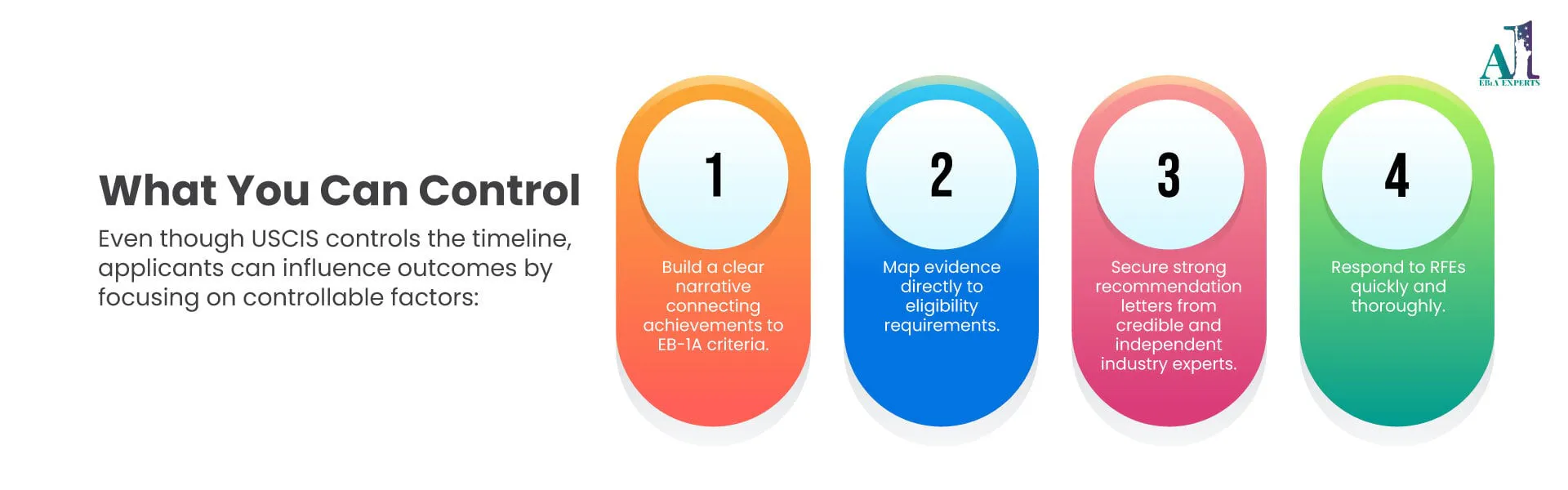
What You Can Control
Even though USCIS controls the timeline, applicants can influence outcomes by focusing on controllable
factors:
Build a clear narrative connecting achievements to EB-1A criteria.
Map evidence directly to eligibility requirements.
Secure strong recommendation letters from credible and independent industry experts.
Respond to RFEs quickly and thoroughly.
These steps improve efficiency and reduce unnecessary delays.
Final Thoughts: Strategy Matters More Than Timelines
USCIS processing charts are useful but imperfect. They describe trends, but don’t provide any
information on individual status.
Your EB-1A timeline will depend far more on preparation, evidence strength, and filing strategy than any
posted average. When strategy leads, timelines become far less intimidating.
Instead of trying to predict the exact day your case will move, focus on building the strongest possible
petition from the start. Applicants who invest time in clear storytelling, strong documentation, and
proactive responses often experience smoother adjudication overall.
The reality is simple. You cannot control USCIS workloads or internal workflows, but you can control how
convincingly your achievements are presented. In the long run, a well-positioned case does more to
reduce stress and uncertainty than any processing time chart ever will.
FAQ
What do USCIS I-140 processing dates mean?
USCIS I-140 processing dates show how long most past cases took. They are historical averages, not
predictions for your case.
USCIS publishes processing times using data from completed petitions at each service center. These
timelines reflect how long it took to finish roughly 80% of cases in the past. They do not account for
individual evidence strength, officer discretion, or case complexity. For EB1A visa petitions, timelines
vary widely because extraordinary ability cases are highly individualized. Processing charts are best
used as trend indicators, not personal forecasts.
Why do USCIS processing times differ from real EB1A decisions?
USCIS processing times differ because charts show averages, while EB1A decisions depend on individual
case factors.
EB1A petitions are evaluated based on extraordinary ability evidence, which varies significantly from
case to case. Officer discretion, service center workload, RFEs, and background checks all influence
real outcomes. USCIS charts cannot reflect these variables in real time. That is why real EB1A timelines
often fall outside posted ranges.
How long does an EB1A I-140 usually take?
EB1A I-140 processing typically takes 15-45 days with premium processing or 4-8 months with regular
processing.
USCIS offers premium processing for EB1A visa petitions, guaranteeing action within 45 days. Regular
processing timelines depend on service center workload and case complexity. RFEs
can extend timelines by
several months. While many petitions fall within common ranges, outliers are normal in extraordinary
ability cases.
Does premium processing guarantee approval?
No, premium processing guarantees a faster decision, not approval.
USCIS premium processing ensures a response within 45 calendar days. That response may be an approval,
denial, or Request for Evidence. Approval depends entirely on the strength of extraordinary ability
evidence submitted. Premium processing only speeds up the adjudication timeline.
How do RFEs affect I-140 timelines?
RFEs pause the USCIS adjudication clock until a response is submitted and reviewed.
When USCIS issues a Request for Evidence on an EB1A petition, processing stops until the applicant
responds. After submission, the review period restarts. Strong RFE responses can resolve concerns
quickly, while weak responses may lead to further delays or denials. RFEs commonly add one to several
months to timelines.
Do service centers process I-140 petitions at different speeds?
Yes, USCIS service centers process I-140 petitions at different speeds due to workload and staffing
differences.
Each USCIS service center manages its own caseload and internal priorities. Employment-based petitions,
including EB1A visa filings, may move faster or slower depending on volume and staffing. USCIS may also
transfer cases between centers to balance workloads. These differences are a major reason processing
timelines vary across applicants.
If you’re unsure whether your achievements meet the EB-1A extraordinary ability standard, a free profile
evaluation from EB1A Experts gives you
honest, criteria-mapped clarity on where
you stand today. Our
experts review your background against USCIS requirements, identify your strongest evidence, and outline
a realistic strategy for strengthening your case so you can move forward with confidence, not guesswork.





 February 16, 2026
 3 min read