The first file is six inches thick, overflowing with hundreds of disorganized patents, "congratulations"
emails, and generic certificates of appreciation. The second file is slim, focused, and begins with a
roadmap that explains exactly how the applicant solved a billion-dollar problem in the US power grid.
Within five minutes, the officer has already mentally approved the second case, while the first is
destined for a grueling RFE.
Why?
Because the second file was successful in explaining the impact of the applicant.
This isn’t about who is more talented; it is about who made the officer’s job easier. In the pursuit of
an EB1A Extraordinary Ability green card, your greatest enemy isn't a lack of evidence; it is the
absence of a coherent narrative that explains why your work should be considered extraordinary.
To secure an EB1A green card, you have to stop thinking like an applicant and start thinking like
a
storyteller.
Approvals don't come from profile dumps or sheer volume of achievements. They come from an
evidence-backed narrative that makes an officer feel confident saying "yes."
2. How USCIS Officers Actually Evaluate EB1A Petitions
To win, you have to understand the person on the other side of the desk. The EB1A adjudication
process
is fast-paced and high-pressure. An officer might be reviewing dozens of EB1A Extraordinary
Ability
cases a week, often across vastly different industries. They aren't experts in your specific sub-field,
whether that’s quantum computing or luxury brand management, so they rely on logic and continuity to
guide their decision.
In a typical EB1A officer review, they are trained to look for a "red thread”, i.e., a theme that
connects your past achievements to the benefit you might offer to the US in the future. When you
understand how USCIS evaluates
EB1A cases, you realize that scattered evidence is your biggest enemy. If
you claim to be a top AI expert but half your evidence is about general project management, it creates a
logical gap that an officer can't bridge.
Clarity, not complexity, is what wins in the race for EB1A Green Card.
The Two-Step Analysis (Kazarian Standard)
Officers follow a strict legal framework known as the Two-Step Analysis:
Step One: Does the beneficiary meet at least 3 of the 10 regulatory criteria?
Step Two (Final Merits): Does the totality of the evidence show that the applicant has
"sustained
national or international acclaim"?
If your narrative doesn't clearly bridge the gap between these two steps, you are inviting an RFE.
3. Evidence Without Narrative Is Just Noise
Think of your evidence as the ingredients and your narrative as the recipe. You can have the best
ingredients in the world, but if you just throw them raw on a plate, it’s not a meal.
In a winning EB1A evidence strategy, raw data like citation counts or award titles don’t speak
for
themselves. As EB1A green card experts, we often see applicants provide hundred pages of EB1A
documentation without explaining why a single page matters.
The difference between a rejection and an approval is often just a few paragraphs of context. Instead of
just listing an achievement, you need to explain the significance.
The Noise: “I received the 2022 Innovator Award from my company.”
The Narrative: “I was one of only two recipients of the 2022 Innovator Award, selected from a
global
workforce of 10,000, for developing a protocol that is now the industry standard for secure digital
payments.”
Without that bridge, your EB1A petition strategy is just noise that the officer might tune out.
4. What Makes an EB1A Case Make Sense to an Officer
When a strong EB1A case lands on an officer's desk, it just clicks. It feels like a natural
progression
of a stellar career rather than a desperate attempt to meet several criteria. There are a few EB1A
approval factors that help create this sense of inevitability:
A Sharp Professional Identity: You need to frame your professional statement in such a way
that
reflects the kind of work you have done and its impact.
Consistent Impact Theme: Every piece of evidence, from your press articles to your
recommendation
letters, points back to the same specific area of excellence.
Logical Career Progression: The officer can see a steady climb in your influence, reflecting
sustained acclaim rather than a one-time fluke or a temporary success.
Independent Validation: Approvals are built on the praise of independent experts who
recognize your
work because its impact reached them, even if they have never met you.
5. The Narrative Framework Officers Respond To
At EB1A Experts, we don't just compile files; we build a strategic EB1A narrative
development plan.
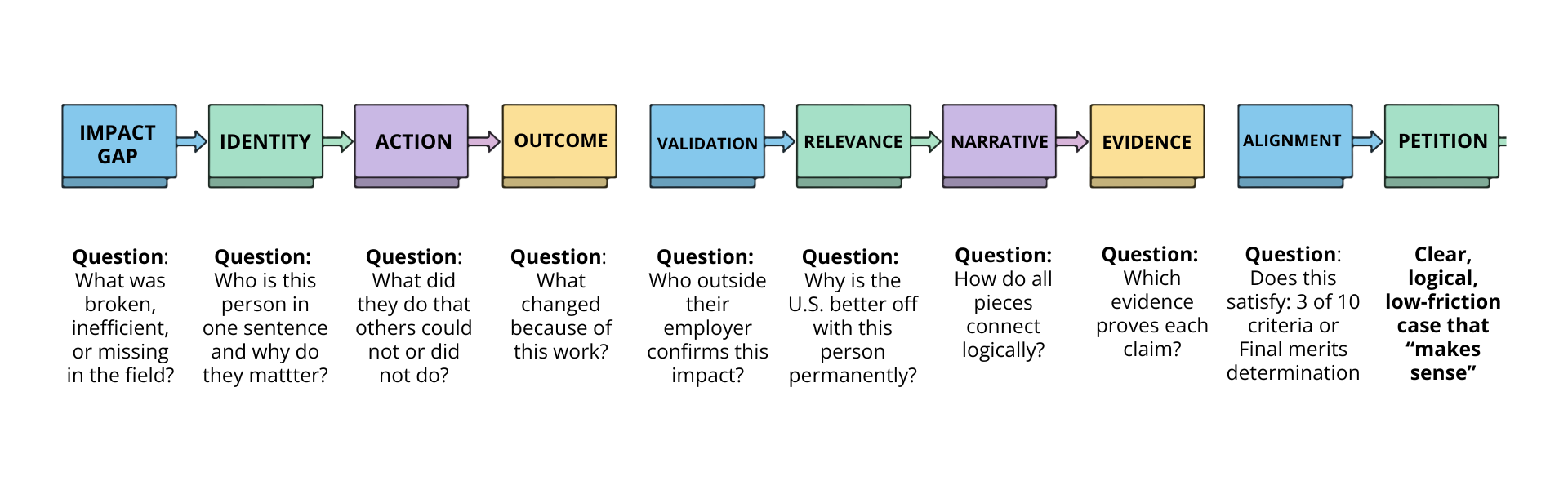
We use a proprietary EB1A case strategy that we call the "Impact Arc." This framework is designed
to
satisfy the legal requirements while appealing to the officer's logic.
The Phase
The Narrative Question
The Gap
What was broken, inefficient, or missing in your field before you arrived?
The Action
What did you uniquely do that others in your field couldn't or didn't do?
The Impact
What was the measurable, extraordinary outcome of that action?
National Relevance
Why is the United States significantly better off with you here permanently?
By following this EB1A petition narrative, we guide you in turning a dry list of facts into a
high-stakes argument for your unique value.
6. Why Many Technically Strong Profiles Still Get RFEs
It is heartbreaking to see so many brilliant profiles get denied because of EB1A common mistakes.
Usually, the issue isn't a lack of talent; it is a lack of external perspective.
Common EB1A RFE reasons and EB1A denial reasons often boil down to internal importance. If
your work was
fantastic for your employer but didn't ripple out into the wider industry, USCIS will argue that it
doesn't meet the extraordinary ability USCIS standard as your work doesn’t show an impact on the
larger
field.
We also see many RFEs triggered by the Final Merits Determination. Even if you meet the three-criteria
threshold, the officer might still say: "Sure, you have awards and publications, but are you really one
of the few at the top?" You have to prove what makes you different from other applicants who too claim
the same.
7. Narrative vs. Resume: The Shift USCIS Has Already Made
The days of winning an EB1A by simply checking three boxes are largely over. Recent EB1A petition
trends
show that EB1A USCIS standards have shifted toward a holistic review.
The officer wants to see that you aren't just a high achiever, but a person of influence. By
prioritizing narrative over a profile dump, you make the officer’s job easier by not forcing him to make
guesses about the impact of your work. In the high-volume world of immigration adjudication, reducing
the cognitive load on the officer is the fastest way to improve your approval odds. They want clarity,
not a puzzle to solve.
8. How EB1A Experts Builds
Officer-Friendly
EB1A Narratives
We believe that every extraordinary career has a powerful story. It is just a matter of finding the
right way to tell it.
At EB1A Experts, our EB1A evaluation process is designed to find that "hook" that will
resonate with an
adjudicator's logic.
We prioritize strategy along with documentation. We don't just ask you for more papers; we ask for the
right papers because quality of evidence matters more than quantity. Our experience with EB1A Green Card
has shown us the same.
Our goal is to map your life’s work directly to the officer’s logic, ensuring your petition is designed
to withstand even the toughest RFE scrutiny. We help you build a narrative that relies on the best
possible evidence of your work and its impact.
9. Final Takeaway: If Your Case Makes Sense, Approval Follows
At the end of the day, an EB1A petition is about building trust between you and a stranger at
USCIS.
When your narrative is clear, your evidence is focused, and your impact is undeniable, you make it easy
for that officer to reach for the "Approved" stamp.
Clarity beats quantity every time. If your case is powered by a compelling narrative and undeniable
evidence of impact, the EB1A approval will
follow as a matter of course.
10. FAQs
Is the EB1A only for Nobel Prize winners or famous celebrities?
No, the EB1A Extraordinary Ability category is open to any individual who can demonstrate they
are among
the small percentage at the top of their professional field. USCIS evaluates applicants based on
10
specific criteria, such as original contributions of major significance, critical roles in distinguished
organizations, and high remuneration. While major international awards like a Nobel Prize guarantee
eligibility, most successful EB1A visa applicants qualify by meeting at least three of the other
criteria. The core requirement is proving sustained national or international acclaim through a clear
EB1A evidence strategy.
2. How many citations do I actually need for an EB1A approval?
There is no specific minimum citation count required by USCIS for an EB1A Extraordinary Ability
approval. The EB1A adjudication process focuses on the influence and significance of an applicant's work
rather than raw numbers. An applicant with a few dozen citations that changed an industry standard may
be more successful than one with thousands of citations in a generalized area. Adjudicators look for
evidence that the work has been widely recognized as "major significance" in the field. A strong EB1A
petition narrative should focus on how the work was used by others rather than the citation count
alone.
3. Can I self-petition for an EB1A green card without a US employer?
Yes, the EB1A visa is one of the few employment-based categories that allows for self-petitioning
without an employer or a job offer. This means the extraordinary ability individual is both the
petitioner and the beneficiary. While you must demonstrate that you intend to continue working in your
area of expertise in the United States, you do not need a Labor Certification or a specific US company
to sponsor you. This provides significant flexibility for founders, independent researchers, and artists
to obtain an EB1A green card based on their own professional merit and national relevance.
Ready to work on the best narrative strategy for your EB1A petition?
Contact EB1A Experts today for an in-depth EB1A free evaluation. Our specialists provide a
forensic EB1A
case review to identify your strongest narrative path.





 January 22, 2026
 3 min read