

If you have spent any time researching U.S. green card options, you have probably run into a strange contradiction. The EB-1A is described as the fastest route to a green card for people with extraordinary ability, and in the same breath, described as one of the hardest categories to get approved. Both things are true. There is no labor certification, no employer sponsor required, and in many cases a shorter wait for a visa number than other employment categories. But the evidence bar is real, the adjudication standard is genuinely two layers deep, and USCIS reads these petitions with more scrutiny than almost any other employment-based filing.
This guide walks through what the EB-1A actually requires, criterion by criterion, how USCIS evaluates the evidence once it is submitted, what the process and costs look like in practice, and where things typically go wrong. It also covers a real, recent legal development that is reshaping how this category gets adjudicated in 2026.
What the EB-1A Actually Is, and Who It's For?
The EB-1A is the first employment-based immigrant visa preference category, reserved for people who can demonstrate extraordinary ability in the sciences, arts, education, business, or athletics. It sits inside 8 CFR 204.5(h), the regulation that spells out exactly what USCIS is looking for.
Two things make it unusual compared to most other green card paths. First, you do not need a U.S. employer to sponsor you. You can self-petition, which is why so many researchers, founders, artists, and specialists file it entirely on their own behalf, without quitting a job or waiting on an HR department. Second, it skips PERM labor certification, the lengthy process where an employer has to prove no qualified U.S. worker is available for the role. The EB-1A assumes that if you are genuinely extraordinary in your field, the labor market test does not apply to you the same way.
Who actually qualifies is a narrower group than most applicants assume walking in. The regulation is written around people who have risen to the very top of their field, not people who are simply good at their jobs or well credentialed. That said, "extraordinary" under USCIS's own definition means a level of expertise indicating the person is one of the small percentage who has risen to the very top of their field of endeavor.
It is a high bar, but it is not limited to Nobel laureates and Olympic medalists. Mid-career researchers with a strong citation record, engineers with patents in active commercial use, founders with real traction and industry recognition, and artists with a documented exhibition and press history all successfully qualify every year. The key is not fame. It is evidence that maps cleanly onto the regulatory criteria.
The Ten Criteria, In Detail
This is the heart of the EB-1A. Under 8 CFR 204.5(h)(3), an applicant who has not received a single major internationally recognized award must satisfy at least three of the following ten criteria. Each one has a specific evidentiary expectation, and each one is a place where DIY applicants commonly go wrong. We will take them in order.
Nationally or internationally recognized prizes or awards for excellence
This covers "lesser" prizes and awards, meaning ones below the one-time major achievement threshold discussed later. Think field-specific awards, competitive research grants judged on merit, industry honors, or juried competition wins. The evidence that works is the award itself, documentation of the selection criteria, and ideally something showing how competitive or exclusive it was. The common mistake here is submitting participation certificates or internal company awards that anyone on the team receives. USCIS wants evidence the award required genuine competition and external judgment, not internal recognition your own employer decided to hand out.
Membership in associations that require outstanding achievement of their members, as judged by recognized experts
The critical phrase is "require outstanding achievement." Many professional associations accept anyone who pays annual dues. Those do not count. What counts are associations with a genuine, judged admissions process, such as fellow-level status in a professional society, or membership tiers that require nomination and peer review. The most common mistake is listing memberships that are functionally open enrollment and hoping the association's name alone will carry weight. It will not. What matters is the admissions process, and you need documentation of that process, not just a membership certificate.
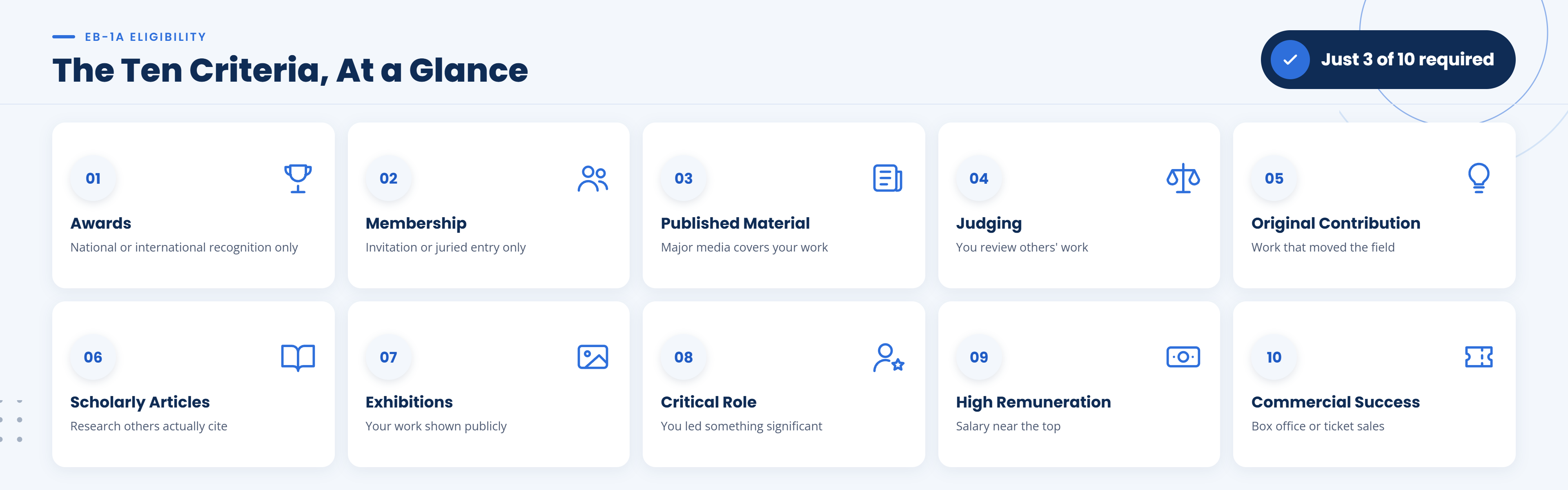
Published material about the applicant, in professional or major trade publications or other major media
This is coverage about you and your work, written by someone else, not coverage you wrote or a byline you hold. A profile in a respected trade publication, a feature article, an interview about your work in a well-known outlet, all of these qualify.
The mistake applicants make constantly is submitting press releases their own company issued, or blog posts they wrote about themselves. Neither counts as independent published material about you. The publication also needs to identify the title, date, and circulation or audience reach, since USCIS wants to see that the venue is genuinely major, not an obscure blog with no readership.
Participation as a judge of the work of others, individually or on a panel
This includes peer reviewing journal submissions, serving on grant review panels, judging competitions, or sitting on a thesis or dissertation committee. The evidence that works is a formal invitation to judge, confirmation of the review completed, and ideally something establishing the standing of the body you judged for. A frequent misstep is treating this criterion as a formality, submitting a single peer review invitation with no other context, when a pattern of ongoing judging activity across multiple instances is far more persuasive than one isolated request.
Original contributions of major significance to the field
This is often the most argued-over criterion, and usually the one that carries the most weight in the final merits stage. It requires showing that your work did not just exist, but that it changed how people in your field operate, moved the state of the art, or was adopted and relied on by others. Patents that are licensed and used commercially, research that is independently cited and applied by other researchers, methodologies or products that other organizations have adopted, all of this can satisfy the criterion. The mistake applicants make is submitting the contribution itself, such as the patent or the paper, without any evidence of its downstream impact. A patent nobody has licensed and a paper nobody has cited does not demonstrate major significance on its own. You need independent corroboration, such as citation counts, expert letters explaining the impact in plain terms, licensing agreements, or adoption by named third parties.
Authorship of scholarly articles in the field, in professional or major trade publications
This one is fairly self-explanatory for people in academic or research fields, but it also applies outside academia to industry white papers, technical reports, and trade publication articles, provided the venue is credible and peer reviewed or editorially vetted. The common mistake is quantity without context. Submitting a long list of publications with no discussion of citation impact, journal ranking, or where they sit relative to others in the field leaves the adjudicator to guess at significance. Pairing the publication list with citation metrics and journal impact data tends to be far more effective.
Display of the applicant's work at artistic exhibitions or showcases
This one applies most directly to visual artists, designers, and performers, but has also been successfully used by applicants whose work has been displayed in less traditional venues, like design showcases, juried exhibitions, or featured technology demos at recognized industry events, depending on how the evidence is framed. The mistake is treating any public display as qualifying. A juried, competitive exhibition at a recognized venue is very different from a local open-call show with no selection process, and USCIS adjudicators generally know the difference.
A leading or critical role for an organization or establishment with a distinguished reputation
This does not require a C-suite title. What it requires is evidence that your role was leading or critical to the organization's success, and that the organization itself has a distinguished reputation, which needs its own separate evidence. A senior individual contributor whose work was central to a company's core product can satisfy this criterion just as well as an executive, provided the petition explains why the role mattered and documents the organization's standing. The mistake is assuming a job title alone proves the point. USCIS wants to understand what you actually did and why it mattered to the organization's outcomes, not just what your business card said.
A high salary or significantly high remuneration relative to others in the field
This is a comparative criterion, meaning your compensation has to be benchmarked against others in the same field and geography, typically using something like Department of Labor wage data or industry compensation surveys. A high salary in absolute terms means nothing without that comparison. The frequent mistake is submitting a pay stub or offer letter with no comparator data at all, leaving the adjudicator with no basis to judge whether the number is actually high for the field.
Commercial success in the performing arts, shown through box office receipts or record sales
This criterion is narrow by design and applies almost exclusively to performing artists, film, music, and similar commercially measurable creative fields. It is rarely used outside that context, and applicants outside the performing arts generally should not try to stretch it to fit their situation.
Meeting three of these ten is the threshold to move forward. It is not the finish line, which is the part that trips up a lot of people filing on their own, and it is the subject of the next section.
The One-Time Achievement Alternative
There is a second, separate path into the EB-1A that bypasses the three-of-ten framework entirely. If you have received a single major, internationally recognized award, comparable in stature to a Nobel Prize, that one achievement alone can satisfy the extraordinary ability threshold without needing to separately document three of the ten criteria.
In practice, very few applicants qualify this way, since the bar for what counts as comparable to a Nobel Prize is set intentionally high. A national award, even a prestigious one, usually will not clear this bar on its own. This path exists for genuine outliers, and for nearly everyone else, the three-criteria route is the realistic one.
The Two-Step Adjudication Process, and Why It Trips Up DIY Applicants
Here is where a lot of self-filed petitions run into trouble, and it is worth understanding clearly before you file anything.
Meeting three of the ten regulatory criteria does not automatically mean USCIS will approve your petition. This comes from Kazarian v. USCIS, 596 F.3d 1115 (9th Cir. 2010), a case that reshaped how USCIS evaluates extraordinary ability petitions. The court laid out a two-step framework.
Step one is a counting exercise, where the adjudicator checks whether the submitted evidence satisfies the plain language of at least three criteria.
Step two, which USCIS calls the final merits determination, asks a different and more subjective question, whether the totality of the evidence, considered together, actually shows the applicant has sustained national or international acclaim and is among the small percentage at the very top of the field.
This is why petitions that technically check three boxes still get denied. An applicant might have a genuine, real membership in a selective association, a handful of press mentions, and some judging experience, satisfying three criteria on paper, while the evidence, viewed as a whole, still reads as competent and accomplished rather than extraordinary. USCIS has room under step two to reach that conclusion even after step one is satisfied, and this is exactly the part of the process that surprises people who assumed hitting three criteria meant they were essentially done.
There is an important and very current wrinkle here. In January 2026, a federal district court in Nebraska, in Mukherji v. Miller, ruled that USCIS's final merits determination step, as USCIS has applied it, was adopted through internal policy guidance rather than formal notice-and-comment rulemaking, and found that unlawful under the Administrative Procedure Act. The court ordered approval of the specific petition at issue.
As of this writing, the ruling's practical reach is limited to that court's jurisdiction, and it is not clear whether USCIS will appeal, treat the ruling as geographically confined, or eventually revise its policy manual nationwide. This is a live, unsettled situation, and applicants filing today should still expect USCIS, outside that one district, to apply the full two-step framework as it currently exists in the USCIS Policy Manual. The safest approach for now is to shape your petition as if the final merits step still fully applies, since that is still the operating reality for the overwhelming majority of filers.
Step-by-Step, The Self-Petition Process and Timeline
Filing an EB-1A generally moves through a few clear stages, though the pace and order can shift depending on whether you are inside the U.S. adjusting status or applying through consular processing abroad.
- 1
The first stage is evaluation, where you map your background against the ten criteria honestly, identify which three or more you can realistically satisfy with strong documentary evidence, and identify gaps early enough to address them, such as securing an additional recommendation letter or gathering citation data you do not yet have organized.
- 2
The second stage is gathering evidence and reference letters. Reference letters should come from recognized experts in your field, in their own words, describing your specific contributions and why they matter, not generic praise. The strongest letters are specific, cite concrete work, and come from people with real standing to judge that work, including some who have no personal or professional relationship with you.
- 3
The third stage is assembling and filing Form I-140, Immigrant Petition for Alien Worker, along with a detailed petition letter that organizes the evidence against each criterion, and all supporting documentation.
- 4
The fourth stage is USCIS adjudication. Processing without premium processing generally runs in the range of six to twelve months, sometimes longer depending on the service center and current workload, so confirm current processing times on the USCIS website before you file since they shift often. Many applicants opt for premium processing to get a decision, an RFE, or a notice of intent to deny within a set number of business days rather than waiting out the standard queue.
- 5
The fifth stage, for applicants already in the U.S., is filing Form I-485 to adjust status once a visa number is available, or consular processing abroad if filing from outside the country. Because EB-1A is in the first preference category, visa numbers are often current for most countries, though backlogs can and do apply for applicants born in certain high-demand countries, so check the monthly Visa Bulletin for your specific situation.
Costs and Fees
Government filing fees for the EB-1A change periodically, so treat the figures below as a snapshot and confirm current amounts on USCIS's fee page before filing.
As of current USCIS fee schedules, Form I-140 carries a base filing fee of $715. Since 2024, USCIS has also applied a separate Asylum Program Fee to most I-140 filings, including individual self-petitioners, at a reduced rate of $300, bringing the typical self-petitioner total to $1,015 in core government fees.
Premium processing, if you choose to use it, is a separate optional fee currently set at $2,965 following a March 2026 fee adjustment, and it buys you a decision, an RFE, or a notice of intent to deny within a defined number of business days rather than the standard queue. It does not buy a favorable outcome, only a faster one.
Beyond government fees, costs vary widely depending on whether you file entirely on your own, work with a consulting firm to identify and organize your evidence, or hire an attorney to handle legal filing, and whether you later need Form I-485 adjustment of status, which carries its own separate fee schedule.
Common Mistakes That Lead to RFEs or Denials
A few patterns show up again and again in petitions that get an RFE or an outright denial, and most of them are avoidable with a clear-eyed read of your own evidence before you file.
The first is treating the three-criteria threshold as the finish line, without accounting for the final merits determination that follows. A petition can satisfy three criteria on paper and still read as merely accomplished rather than extraordinary once the adjudicator looks at the full picture.
The second is generic reference letters. A letter that praises someone in vague, sweeping language, without pointing to specific work, specific impact, or specific comparison to peers in the field, reads as a favor rather than an independent expert assessment. Strong letters come from recommenders who can speak concretely about your actual contributions in their own words.
The third is confusing self-published or company-issued material with independent recognition. Press releases, blog posts you wrote, and internal company awards do not carry the same weight as independent media coverage or externally judged recognition, and adjudicators are quick to notice the difference.
The fourth is thin corroboration on original contributions. Claiming your work had major significance without independent evidence, such as citation data, licensing records, or expert letters explaining the downstream impact in specific terms, leaves the claim unsupported.
The fifth is overreaching on marginal criteria to hit the number three, rather than shaping a petition around the criteria you can genuinely support with strong evidence. Three well-supported criteria beat five thinly supported ones every time, since a weak criterion can undercut credibility across the whole petition.
The sixth is submitting a petition letter that lists documents without connecting them to the regulatory language. Adjudicators are working against a specific legal standard, and a petition that makes the connection between the evidence and each specific criterion explicit is easier to approve than one that leaves the adjudicator to make that connection themselves.
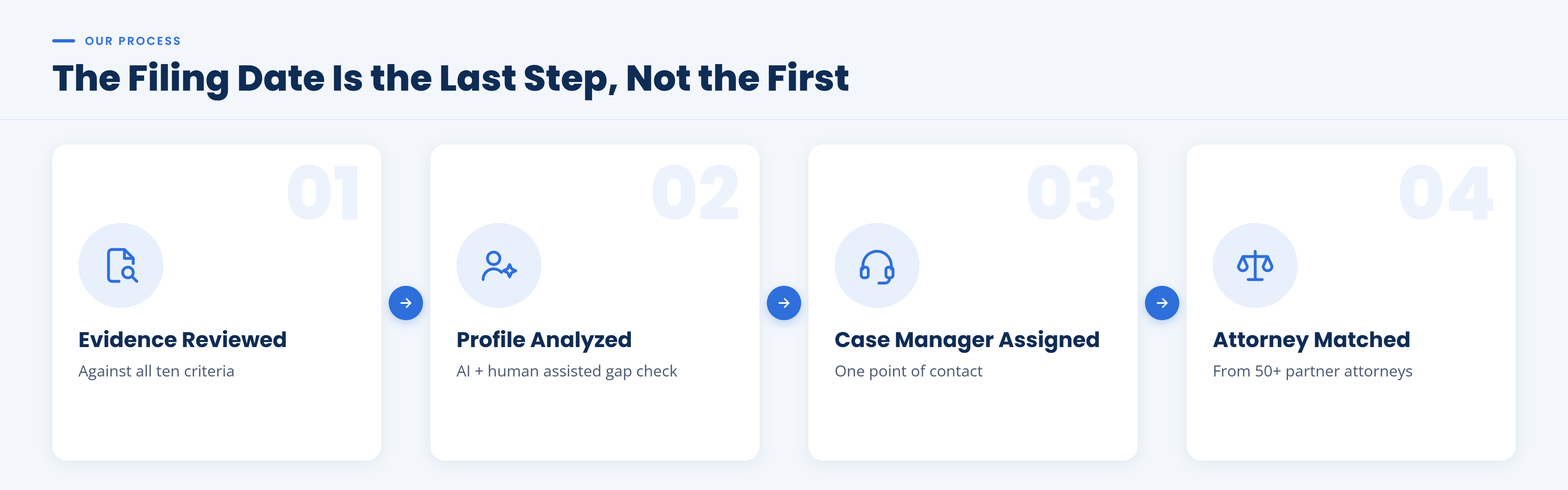
Where a Firm Like EB1A Experts Fits In
Because the EB-1A depends so heavily on how evidence is organized and framed against ten fairly technical regulatory criteria, many applicants choose to work with a consulting firm rather than navigate the framework entirely alone. EB1A Experts is an immigration consulting firm, not a law firm. The team works with applicants to evaluate eligibility, identify which criteria are realistically achievable, map existing evidence to the regulatory language, and guide recommenders on what points to cover in their letters, which recommenders then write themselves, in their own words.
Actual legal filing and representation is handled by independent, licensed partner attorneys from a bench of 50-plus firms EB1A Experts works with, not by EB1A Experts itself. Across the petitions the firm has supported, it reports 330-plus approvals and an 80-85% approval rate, along with a 4.6-star Google rating. If you are early in your evaluation, that kind of structured, criteria-by-criteria review can help you see clearly whether now is the right time to file, or what to shore up first.
Frequently Asked Questions
No. This is one of the defining features of the category. You can self-petition without a U.S. employer sponsor and without PERM labor certification, though you can also be sponsored by an employer if you have one.
At least three, unless you qualify through the one-time major internationally recognized award path, which very few applicants do.
No. USCIS still applies a final merits determination that looks at your evidence as a whole, deciding whether it genuinely shows sustained national or international acclaim, not just three checked boxes. This is the step currently being challenged in limited federal litigation, but it remains the operating standard for most filers today.
Regular I-140 processing generally runs roughly six to twelve months, sometimes longer, and premium processing, if you use it, gets you a decision or RFE within a set number of business days rather than the standard queue. After I-140 approval, adjustment of status or consular processing adds additional time depending on visa number availability for your country of birth.
An RFE is not a denial. It means USCIS wants additional documentation or clarification on specific points before making a decision, and you get a set window to respond with additional evidence. Many approved petitions include an RFE response along the way.
Yes, and many applicants do. The EB-1A is a green card category, not a nonimmigrant work visa, so people commonly hold an H-1B or O-1 while their EB-1A petition and later adjustment of status move through the process.
Because actual legal filing and representation requires a licensed attorney, most self-petitioners end up working with an attorney at the filing stage regardless. Where a consulting firm can add value is earlier, in the evaluation and evidence-organization stage, before legal filing begins.