1. Introduction: Why This Decision Matters in 2025?
Highly skilled professionals are increasingly interested in immigration pathways to the U.S., especially
in technology, healthcare, investigative research, and new company start-up areas, which are continuing
to increase. When an individual is applying to immigrate on their own, self-sponsored immigration
categories such as EB1A and
EB2-NIW are the most effective routes to gain more control over the
immigration experience.
However, as of 2025, there will be much more scrutiny on immigration applications, with modifications in
how these types of applications are adjudicated and an increase in global competition for jobs. Thus,
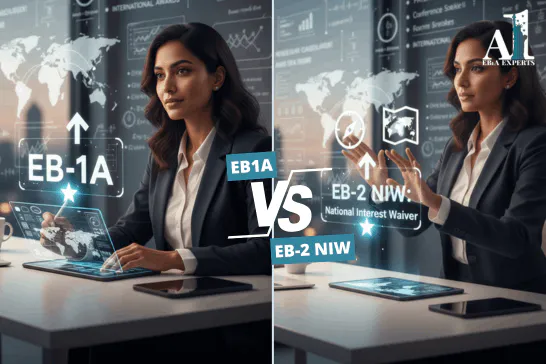
choosing EB1A vs EB2-NIW 2025
It is no longer just a matter of selecting a category but a much larger strategic decision.
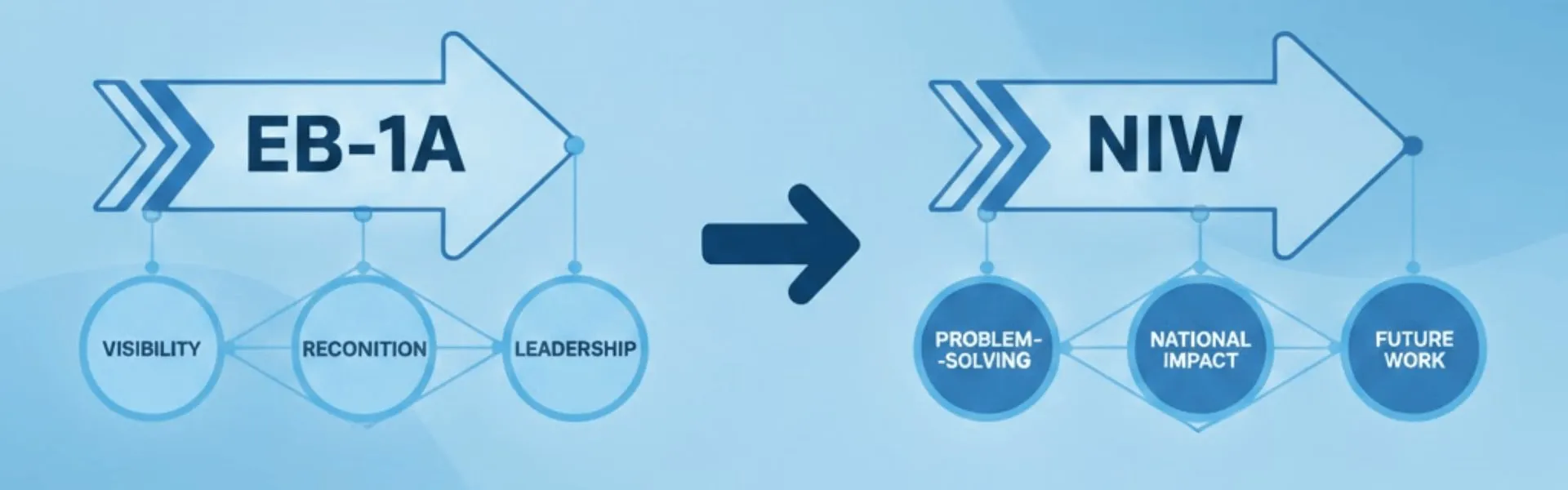
The EB1A is primarily concerned with excellence achieved by the applicant. You must have evidence of the
impact that you have made on others or in the field of expertise and recognition by others in this area
of work. The EB1A category is best suited for individuals who have already made a significant impact in
their field, such as innovators, leaders, and professionals who have established visibility.
The EB2-NIW revolves around the future impact that your work will have, rather than your past
accomplishments. Under the Dhanasar Standard, EB2-NIW asks: How will your work help the USA? Because of
the long-term nature of these types of contributions, this category is appropriate for professionals who
work in technology, health care, research, sustainable energy, and artificial intelligence.
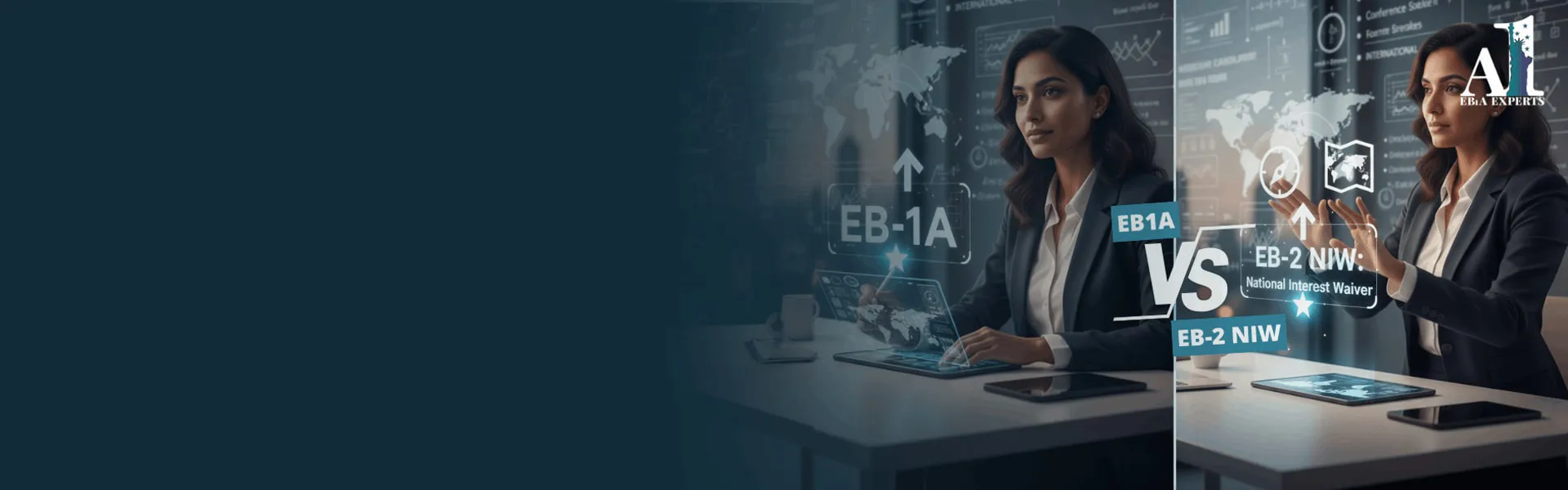
Comparing EB1A and EB2-NIW:
To summarize, the EB1A recognizes past accomplishments of an individual, while the EB2-NIW recognizes
the future contributions of the individual.
3. Eligibility Criteria Breakdown — Side-by-Side
Criterion
EB-1A
EB-2 NIW
Focus
Past achievements and sustained acclaim
Future contributions and national benefit
Evidence Type
Awards, media coverage, leadership roles, publications, judging,
membership
Work's merit, applicant's capability, U.S. benefit justification
Evidence of major impact or innovation in your field
Leadership or critical contributions to projects with measurable outcomes
Industry recognition through awards, media mentions, speaking engagements, or serving as a judge of
others' work
Documentation of influence through recommendation letters emphasizing your standing
B. EB-2 NIW Requirements (Dhanasar Framework)
Substantial merit and national importance : Your work addresses critical U.S. needs
Well-positioned to advance the work : You have the skills, resources, and track record
Waiver benefits the United States : Your contributions justify bypassing normal requirements
C. The Core Difference in 2025
EB-1A = Prove excellence through concrete past achievements.
EB-2 NIW = Prove future value through strategic positioning and potential impact.
4. Who is the Best Fit for Each Category?
Ideal EB-1A Candidate
Product creators and innovators who are having a measurable impact in terms of adoption and revenue.
Founders of companies who have built products with substantial user bases.
Researchers whose research has been proven to advance the body of knowledge in their respective
fields.
Professionals who can demonstrate strong, independent recognition of their work from third parties,
not just from their employers.
Ideal EB-2 NIW Candidate
Early-career professionals on a promising path.
People working in an area that is clearly in the U.S. national interest (e.g., Climate Technology,
Cybersecurity, Public Health Infrastructure, AI Safety).
Although not many awards, articles, or other media publicity, the professional accomplishments of
this person are well documented.
Specialists solving specific problems for American industries/communities.
Asking the question, "Which is easier, EB-1A or NIW?" The answer is completely dependent on an
individual's profile; EB-1A will have a higher burden of proof but quicker processing times, while NIW
has a broader interpretation of eligibility, so you must make a compelling argument for your potential
future contributions.
5. Evidence Expectation for 2025
EB-1A Evidence Practical Expectations
Measurement : You must have some way of measuring your use, adoption, revenues, or research impact.
Third-Party Recognition : Independent validation of your work will always outweigh anything you
receive from your employer.
Clear Narrative : The increased incidence of Requests for Evidence (RFEs)
demonstrates the importance of a clear story about your contributions to the field.
Evidence trends of EB-2 NIW
EB-2 NIW documentation showing the impact on future projects through project descriptions, project
roadmaps, and a plan of how to achieve your research goals.
Proof of professional capacity : The documentation must demonstrate that you can meet those goals.
Justification of National Value : All written correspondence needs to explain how you will benefit the
county.
For either EB-1A or NIW for Indians, it provides relief to the waiting time caused by the backlog of
other employment types.
6. Processing time, Priority dates, and Approval
EB-1A
Premium processing is available (in 15 days) for a fee
Approved cases are typically processed at a faster pace than other categories
Higher requirements for documentation are subject to greater scrutiny
The category is still considered "current" for most countries.
EB2 NIW
Premium processing expected to be offered widely beginning in 2025
Priority dates have moved more slowly for countries with a larger volume of applicants, such as
India and China.
The burden of PROOF is lower than FB-1A
More liberal interpretation of National Interest.
The processing time for both EB-1A and NIW in 2025 will depend on the service center for normalization;
neither EB-1A nor EB-2 NIW will benefit from the previously available premium processing. The speed of
moving through the application process has been slightly quicker for EB1A applications if you are
approved, but someone with average accomplishments and/or experience has a better chance of getting an
approval for the NIW than the EB1A option.
7. Cost, Risk, & Strategy
Costs
The cost of EB-1A generally requires more extensive documentation required
The cost of an NIW would generally be more economical
RISK LEVELS
EB-1A = More risk
NIW = More flexibility in background
STRATEGY FOR 2025
Many applicants (especially engineers, founders, and researchers) are filing in both categories to
increase their chances for approval. This strategy is becoming more common with the discussion now
taking place in 2025 regarding EB-2 NIW vs. EB-1A, which is better.
8. EB-1A vs NIW, a Simple Framework
If you meet the following criteria, choose EB-1A:
Strong measurable impact
Third-party recognition
Clear industry influence
If you meet the following criteria, choose NIW:
A High-Value U.S.-focused Project
After a recent conversation with someone in your industry, you have a good chance of producing (or
continuing to do) a high-value project for at least the next five years.
Solid professional capabilities; fewer accolades.
If you meet the following criteria, choose Both:
Mid-level accomplishments relative to your peers/field
Any national importance of your field
You Want to Maximize Your Chances Strategically
9. Real World Examples
1. Senior ML Engineer (Best for EB1)
A principal engineer who leads AI projects that have been deployed across all of the platforms used by
millions of people. Evidence of this success includes documented product impact, technical leadership
recognitions, and statistical metrics documenting the impact of these products in a real-world
application.
2. Healthcare Data Scientist (Best for NIW)
A researcher focused on developing analytics tools to help public health officials predict when an
outbreak will occur. Evidence of significant progress is the long-term research plans, the published
findings from the healthcare analytics research, and the endorsements by experts who believe in the need
for this work.
3. Startup Founder (Best for Both)
An entrepreneur with a focus on developing new climate technology with an early track record of success.
While the entrepreneur is well-recognized for innovation, the level of recognition continues to evolve.
In addition to being an innovative leader, the entrepreneur has an excellent vision for the way their
products will impact the U.S. market. The simultaneous filing approach will increase the likelihood of
overall success in both categories.
10.Conclusion
Ultimately, which of the EB1A versus EB2 NIW pathways is best for you in 2025 will depend on your own
unique circumstances, on where you are today, and where you want to go. The EB1A allows individuals to
demonstrate extraordinary ability and provide evidence of excellence, with faster processing than the
EB2 NIW pathway.
In making your decision regarding which pathway to pursue, consider the strength of your evidence, your
timeline of urgency, and your future career path. Having a consistent strategy and appropriate
documentation in place will allow you to transform both of these pathways into powerful opportunities to
obtain permanent residency without employer sponsorship.
EB1A Experts specializes in evaluating your
profile against both categories,
identifying your strongest
arguments, and crafting compelling cases that maximize approval odds. Whether you're weighing a single
category or considering parallel filing,
11. FAQs
1. Which category is easier—EB-1A or EB-2 NIW?
NIW is generally easier because the standard focuses on future value rather than extraordinary
achievement.
2. Which one is faster for Indians in 2025?
EB-1A typically moves faster since NIW priority dates for India can be slower.
3. Can I apply for both at the same time?
Yes, many applicants pursue both to maximize approval probability.
4. What profiles fit NIW vs EB-1A?
NIW fits early-career or national-interest fields; EB-1A fits high-achievers with strong impact.
5. How do priority dates compare?
EB-1A usually stays ahead, while the NIW backlog varies by country and demand.
To make the difference between approval and costly delays,

 November 19, 2025
 3 min read