Meera (name changed) had been preparing to apply for an EB1A green card for
months.
She had done the research, reviewed success stories, and believed she was finally on the fastest path to
permanent residency.
Then the latest Visa Bulletin was released. The dates for Indian applicants barely moved.
Suddenly, the pathway that once felt predictable started to feel uncertain, and questions about her
long-term future in the US became urgent.
If this sounds familiar, you are not alone.
For years, EB-1 felt like the fast lane to a green card. Many high-achieving Indian professionals filed
with the expectation that approval would quickly translate into permanent residency.
Then the Visa Bulletin stalled. Dates stopped moving. In some months, they even moved backward.
Suddenly, the assumption that EB-1 India always stays current disappeared.
This shift caught thousands off guard. The EB-1 India backlog became a real conversation, and
applicants
began asking a difficult question:
How long is the EB-1 India green card wait time now?
The reality is simple but uncomfortable. EB-1 is still one of the strongest pathways, but it is no
longer immune to demand.
Strategy, timing, and preparation now matter more than ever for EB-1 India applicants.
2. Quick Snapshot: Where EB-1 India Stands Today
Here is the reality in plain terms. The dates for EB-1 India are no longer consistently current.
Movement in the latestUS
visa bulletin now happens in spurts, followed by long pauses.
Some months bring encouraging forward movement. Others bring complete stagnation.
The February 2026 latest US Visa Bulletin shows EB-1 India with a Final Action Date of
February 1,
2023.
By comparison, EB-2 India sits at July 15, 2013, and EB-3 India at November 15, 2013.
The good news is that the backlog in EB-1 remains significantly smaller than EB-2 and EB-3.
The bad news is that it exists, and applicants must plan around it.
Watching EB-1
priority date movement month to month has become part of the journey.
The takeaway is clear. Understanding the EB-1 priority date india landscape is now essential
before
filing.
3. Why Is EB-1 India Backlogged?
The EB-1 India backlog did not appear overnight. Several forces converged at once.
Per-country caps limit how many green cards each country can receive annually. India’s massive
demand means these limits are reached quickly.
Spillover exhaustion also played a role. For years, unused green cards from other categories
flowed into EB-1, accelerating processing. That surplus has largely disappeared.
Another major factor is the surge in EB-1A filings from India. As EB-2 wait times stretched into
decades, more professionals pivoted toward EB-1. This shift dramatically increased the demand.
Operational realities matter too as consular and USCIS capacity constraints slow adjudications and
visa issuance.
Together, these factors created the perfect storm: rising demand, fixed supply, and a visa
bulletin that
must balance both.
The result is periodic EB-1 India retrogression and slower forward movement.
4. How the US Visa Bulletin Actually Works
The visa bulletin can feel mysterious, but its mechanics are straightforward once you understand
the
basics.
There are two charts:
Final Action Dates determine when green cards can be issued.
Dates for Filing determine when applicants can submit paperwork early.
Movement is not linear. Dates move forward when visa numbers are available and pause when demand exceeds
supply.
This is why EB-1 priority date movement often feels unpredictable.
USCIS also decides each month which chart applicants can use. Sometimes you can file earlier, and other
times, you must wait for the Final Action Date.
Understanding the latest US visa bulletin helps applicants make informed decisions instead of
reacting emotionally to monthly changes.
5. What Does “Priority Date Current” Really Mean?
Seeing your EB-1 priority date India become current might feel like reaching the finish line.
In reality, it means you are eligible to move into the final processing stage.
It does not guarantee immediate approval or instant green card issuance.
Background checks, visa availability, processing queues, and administrative steps still take time. Even
when dates are current, there may be a waiting period before final approval.
Understanding this distinction prevents unrealistic expectations and helps applicants plan more calmly
around EB-1 priority date movement.
6. Can EB-1 India Retrogress Again?
Yes, and it likely will.
EB-1 India retrogression is cyclical. When many applicants become eligible at once, the system
pulls dates backward to manage demand. Once the surge stabilizes, forward movement resumes.
Retrogression can feel discouraging, but it does not mean filing was a mistake. In many cases,
applicants who filed earlier benefit the most once movement resumes.
This cycle is part of the system. Planning around it is far more effective than fearing it.
7. Is EB-1 Still Faster Than EB-2 for India?
Despite the EB-1 India green card wait time, EB-1 generally remains faster than EB-2 for Indian
nationals.
EB-2 India faces a multi-year backlog that can stretch into decades. The surge in EB-2 NIW
filings has only increased demand further, lengthening the EB-2 visa processing time.
Even with occasional EB-1 pauses, the line remains significantly shorter. For many professionals, EB-1 still offers the most realistic
path to permanent residency within a
reasonable timeframe.
The comparison is not about perfection but relative advantage.
8. Why Filing EB1A During Backlog Can Still Make Sense
Many professionals hesitate to file during a backlog. That hesitation can be costly.
Filing early locks your EB-1 priority date India. This single step places you in line ahead of
future surges. Waiting means joining the line later when demand may be even higher.
Early filing also provides flexibility. Applicants can upgrade strategies, explore parallel paths, and
adapt as the immigration landscape evolves.
Organizations like EB1A Experts often emphasize this mindset shift. The goal is not perfect
timing. It is strategic positioning.
For EB-1 India applicants, early action often beats waiting for the perfect moment.
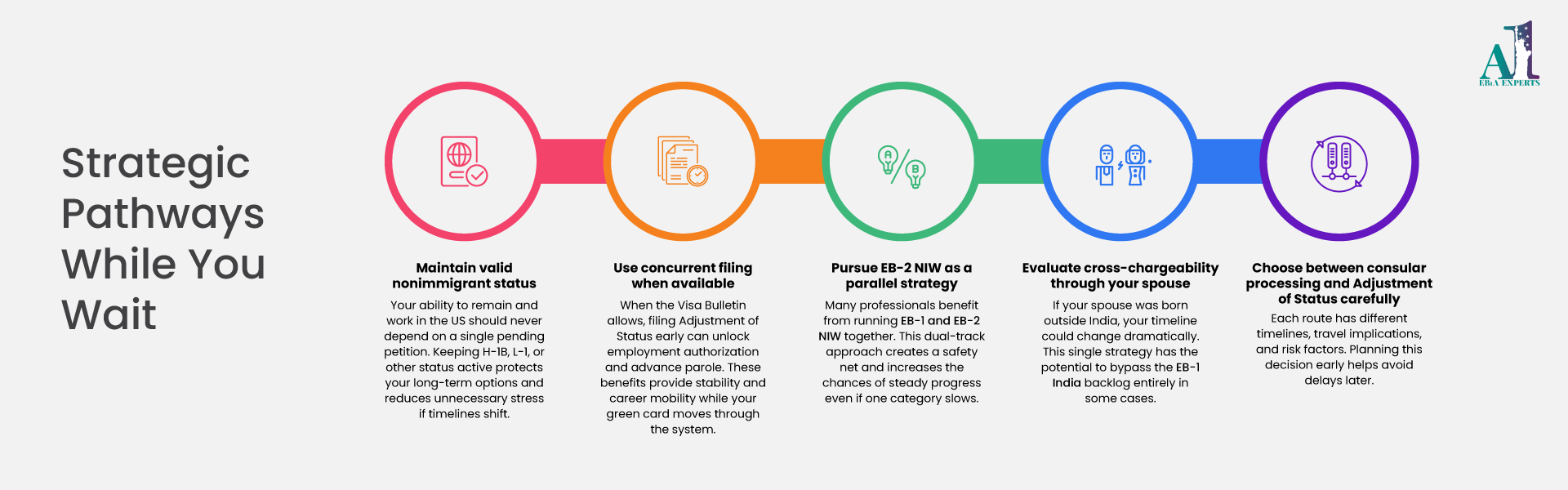
9. Strategic Pathways While You Wait
A waiting period does not have to be passive. The most successful applicants treat this phase as a time
to strengthen flexibility,
protect status, and create multiple paths to the finish line.
Maintain valid nonimmigrant status: Your ability to remain and work in the US should never
depend on a single pending petition. Keeping H-1B, L-1, or other status active protects your long-term
options and reduces unnecessary stress if timelines shift.
Use concurrent filing when available: When the Visa Bulletin allows, filing Adjustment of
Status early can unlock employment authorization and advance parole. These benefits provide stability
and career mobility while your green card moves through the system.
Pursue EB-2 NIW as a parallel strategy: Many professionals benefit from running EB-1 and EB-2
NIW together. This dual-track approach creates a safety net and increases the chances of steady
progress even if one category slows.
Evaluate cross-chargeability through your spouse: If your spouse was born outside India, your
timeline could change dramatically. This single strategy has the potential to bypass the EB-1 India
backlog entirely in some cases.
Choose consular processing vs. Adjustment of Status carefully: Each route has different
timelines, travel implications, and risk factors. Planning this decision early helps avoid delays
later.
The key idea is momentum. A proactive, multi-path strategy turns waiting into forward progress instead
of uncertainty.
10. Cross-Chargeability: The Most Underused Accelerator
Cross-chargeability is one of the most powerful yet underused strategies.
It allows applicants to use a spouse’s country of birth instead of their own when determining visa
availability.
For many Indian applicants, this can dramatically shorten wait times.
This strategy applies when a spouse was born in a country with shorter queues.
It is entirely legal and fully supported by immigration law.
Understanding how country of residence and country of birth interact with EB-1 priority date
India can
unlock opportunities many applicants never realize exist.
11. How PERM Timelines Compare (and Why They Matter)
Employer-sponsored green cards often begin with PERM labor certification. This step involves prevailing
wage determinations, recruitment, and extensive documentation.
The PERM
processing time can stretch well beyond a year before the immigrant petition even begins.
These long front-loaded delays make the PERM timeline significantly slower at the start.
For professionals evaluating options, comparing PERM-based paths with the EB-1 self-petition route
provides important perspective.
12. Common Strategic Mistakes Indians Make
Many delays are not caused by the system alone but by avoidable strategic missteps.
Waiting for the “perfect” moment is the most common mistake. Visa Bulletin movement is unpredictable,
and delaying your filing often means joining a longer line later. Another frequent issue is rushing into
weak EB1A petitions without building strong evidence first, which can lead to denials that slow future
options.
Some professionals assume employer-sponsored paths are automatically safer and postpone self-petition
routes like EB-1 India until it is too late. Others rely on a single strategy instead of
pursuing parallel pathways that create flexibility and protection.
The strongest applicants move early, prepare thoroughly, and keep multiple options open rather than
betting everything on timing alone.
Working with experienced advisors such as EB1A Experts can help applicants avoid these pitfalls
and make more confident decisions.
13. What a Smart EB-1 India Strategy Looks Like in 2026
A strong approach begins with an honest, strength-first evaluation of your profile.
Instead of rushing to file, successful applicants focus on building credible, well-documented evidence
that clearly demonstrates sustained impact and recognition.
Depth now matters more than volume. Carefully curated achievements, strong recommendation letters, and a
clear narrative carry more weight than large but unfocused documentation.
At the same time, smart planning rarely relies on a single path. Parallel options, backup strategies,
and flexibility are essential in a landscape shaped by the EB-1 India backlog.
Most importantly, applicants adopt a long-term mindset. Understanding how the EB-1 priority date
India may move over time helps them plan decisions around career growth, status maintenance, and
future opportunities. In 2026, success comes from preparation, positioning, and patience working
together.
14. Backlog Doesn’t Mean Stop. It Means Plan Better.
The EB-1 India green card wait time is longer than it once was, but EB1 remains one of the most powerful
pathways available to Indian professionals.
The people who succeed are rarely the ones waiting for perfect movement in the EB-1 India visa
bulletin. They are the ones who file early, plan strategically, and stay prepared for every shift in the
system.
Backlog is not a signal to pause.
It is a signal to plan smarter and act sooner.
FAQs
1. Is EB-1 India currently backlogged?
Yes. EB-1 India now experiences periodic backlog and retrogression.
The Visa Bulletin shows increased demand from Indian applicants in recent years. Per-country limits
restrict how many EB-1 visas India can receive annually. When demand exceeds supply, priority dates stop
moving or move backward. This does not mean EB1A or the EB1A visa is unavailable. It means applicants
must wait for visa numbers before USCIS can issue green cards.
2. How long is the EB-1 India green card wait time?
There is no fixed timeline, but EB-1 India is still faster than EB-2 or EB-3.
The wait depends on Visa Bulletin movement, USCIS processing speed, and demand levels. Some applicants
may wait months, while others may wait longer depending on when they file. Even with a backlog, EB1A
remains one of the quickest employment-based options for Indian professionals.
3. Should I delay filing an EB1A petition until dates move forward?
No. Filing early is usually the smarter strategy.
Your priority date is locked when USCIS receives the I-140 petition. Filing earlier places you ahead of
future applicants in the queue. Waiting for the Visa Bulletin to move can result in joining a longer
line later. Early filing also allows applicants to maintain flexibility and pursue parallel immigration
strategies.
4. Can EB-1 India retrogress again in the future?
Yes. EB-1 India retrogression is cyclical and expected.
When many applicants become eligible at the same time, the Department of State moves dates backward to
manage visa usage. This ensures visa numbers last through the fiscal year. Retrogression does not affect
the validity of an approved EB1A petition. It simply means waiting for visa numbers to become available
again.




 January 29, 2026
 3 min read