One topic that’s recurring in the conversations on Green Card applications is EB1A vs. EB-2 NIW.
In 2026, the American Dream isn't just about hard work; it is about smart strategy. If you are a
high-skilled professional, you have likely heard acronyms like EB1A and EB-2 NIW tossed around like
golden tickets. However, with visa backlogs reaching historic levels this year, these aren't just
pathways; they are survival tools for your career.
The debate has shifted. It is no longer a simple question of which one is easier. In the current
climate, the real question is:
Which one gets you a Green Card before the decade is out, and how do you protect
yourself if you
fail?
Let’s pull back the curtain on how to play the immigration game in 2026.
2. What Is EB1A and What Is EB-2 NIW? (Quick Overview)
Think of these two categories as different levels of a prestige club. Both allow you to self-petition,
meaning you don’t need an employer to hold your hand through the process. In an era where tech layoffs
and company restructuring are common, this independence is priceless, and therefore, is making several
people think of applying.
EB1A:
The EB1A
(Extraordinary Ability) is reserved for the best of the best, the 1% who have climbed to the very
top of their field. Whether you are a researcher with groundbreaking patents, a tech professional, an
artist with internationally recognized accolades, or a business leader who has scaled global empires,
the EB1A is your fast track.
EB-2 NIW:
The EB-2 NIW (National Interest Waiver) is for people whose work and contribution can be a valuable asset for the US. You don’t have to be at the top of your field, but you do have to prove that you are a valuable asset for the US. It is designed for professionals whose work solves a specific, significant problem in the areas of national importance. For ex: Fields like cybersecurity, IT, renewable energy, etc.
The biggest hurdle for most is realizing that these two categories speak different languages. One is
about who you are, while the other is about what you are doing.
EB1A: Proving You are at the Top
USCIS evaluates a petition on at least 3 out of 10 specific criteria listed by the USCIS. In
2026, if you are in STEM fields, your petition will most likely succeed if it meets the following
criteria:
Judging the Work of Others: You aren't just doing the work; you are the one invited to
peer-review
journals or judge major hackathons or events related to your field of expertise.
Critical Roles: You occupy a leading/critical role in a distinguished organization. If you
left, the
project would suffer significantly.
High Remuneration: Your paycheck proves you are in the top tier of your profession. In 2026,
USCIS
generally looks for a salary in the 90th percentile for your specific role and location.
Original Contributions: You haven't just followed others; your work has inspired others in
your
field to follow you.
EB-2 NIW: Proving National Importance of Your Work
The NIW is governed by three pronged criteria. To get a Green Card under EB-2NIW and skip the long Labor
Certification (PERM) process, you must satisfy:
Substantial Merit & National Importance: Your project must have weightage. It needs to
benefit the
US economy, healthcare, or security.
Well-Positioned: You have the required certificates in education and a track record to
actually pull
off this important work.
Balance of Interest: It is better for the US to give you a visa now than to make an employer
spend a
year proving they couldn't find a US worker for your specific role.
4. The Art of Reframing Evidence
One of the most dangerous mistakes seen in 2026 is that of ‘Copy-Pasting’ the same claims and evidence
from one category to another. Applicants assume that if their evidence is strong enough for an NIW, it
is automatically strong enough for an EB1A. They are wrong.
For an NIW, your evidence should emphasize: “I am highly competent, and my work is vital for the
US
because of its national importance.”
For an EB1A, your evidence should emphasize: “I am a top-tier professional in my field. I have
already
achieved what 99% of my peers haven’t. Here is the media coverage, the awards, and the massive salary to
prove it.”
Example: If you are a Software Engineer building AI for autonomous vehicles:
NIW Narrative: My work improves road safety and reduces carbon emissions in the US
EB1A Narrative: I am the lead architect of a system used by 5 million cars. I won a Global AI
Innovator award, and I am paid $500k because of my rare expertise.
5. 2026 Processing Times & the Premium Trap
Effective March 1, 2026, USCIS has adjusted Premium Processing fees to account for inflation.
Feature
EB1A
EB-2 NIW
Premium Timeline
15 Business Days
45 Business Days
Premium Fee (2026)
$2,965
$2,965
Regular Timeline
8–12 Months
12–18 Months
The Trap: Many people rush into Premium Processing thinking it speeds up their Green Card.
It doesn't.
It only speeds up the I-140 approval. If your country's priority date isn't currently on the Visa
Bulletin, you are still stuck in the same long line. Use Premium Processing only if you need a quick
decision for an H-1B extension or peace of mind.
6. Priority Dates: The Real 2026 Bottleneck
If you are from India or China, the EB-2 line is currently years long.
According to the January 2026 Visa Bulletin, EB-2 India remains stalled in 2013, while China sits
at early 2022.
This is why the EB1A is the ‘Holy Grail’. The EB-1 line moves much faster. For both India and
China, the January 2026 Bulletin shows a Final Action Date of February 1, 2023. This 3-year wait is a
massive improvement over the decade-plus wait for EB-2.
7. The Dual Filing Masterstroke
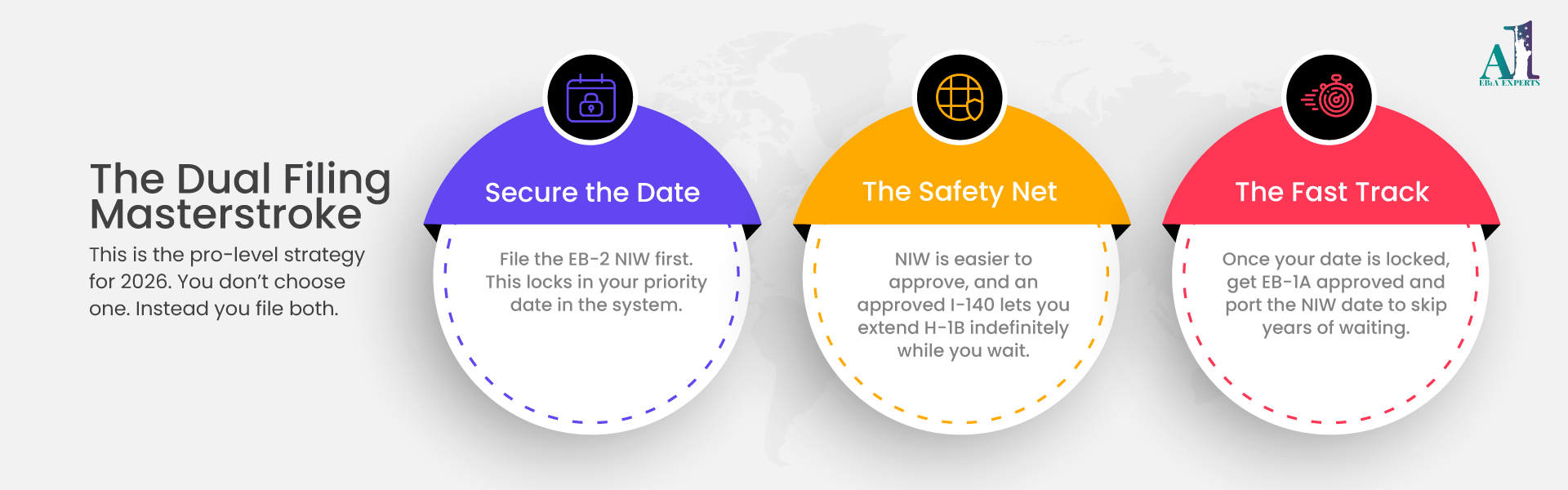
This is the pro-level strategy for 2026. You don’t choose one. Instead you file both.
Secure the Date: File the EB-2 NIW first. This locks in your priority date in the system.
The Safety Net: The NIW is generally more approvable. An approved I-140 allows for indefinite
H-1B
extensions while you wait.
The Fast Track: Once your date is locked, you go for the EB1A. If the EB1A is approved, you
can port
that early NIW priority date over, skipping years of waiting.
If the EB1A gets a tough officer and is denied, it is no big deal. You still have your approved NIW and
your spot in line.
8. Common Mistakes: How to Avoid a 2026 RFE
Weak Recommendation Letters: Letters that simply say "They are a great worker" are useless.
In 2026,
letters must be testimonial: they need to provide specific examples of how you solved a problem of
"major significance” that is backed by concrete data-backed evidence.
Filing Too Early: If you don't have the awards yet, wait. It is better to spend six months
working on your profile by joining associations or judging contests rather than risk getting a denial
on your record.
Ignoring the "Final Merits" Step: Meeting 3 criteria is just the beginning. You need to prove
that you are currently extraordinary and your work not only stands out from the rest but also
has had
a significant impact on the entire field.
9. Conclusion: Play the Long Game
In the high-stakes world of 2026 US immigration, waiting for the system to change is a losing move.
Whether you are the quiet architect behind a nationally vital AI project or a high-visibility innovator
at the top of your field, the difference between a ten-year wait and a three-year path often comes down
to one thing: the courage to build a proactive strategy.
Don’t just aim for a category; aim for the security that comes with having a locked-in priority date and
a high-caliber petition. The 2026 landscape favors the prepared — those who document every win, frame
every achievement with precision, and understand that their expertise is a strategic asset to the United
States.
Your talent has already brought you this far. Now, let a calculated, multi-category approach carry you
across the finish line.
10. FAQs
Can I move from EB-2 NIW to EB-1A later?
Yes. This is one of the most effective long-term strategies in 2026. Many applicants first secure an
EB-2 NIW approval to lock in a priority date, then file for EB-1A once their profile becomes stronger.
If the EB-1A is approved, you can retain your earlier NIW priority date and significantly reduce your
overall wait time.
Does “National Importance” mean I must work for the U.S. government or a public institution?
No. National Importance is about impact, not employer type. Work done in the private sector can
qualify
if it has broad economic, technological, healthcare, or security relevance. For example, professionals
working in cybersecurity, AI, healthcare innovation, climate tech, or financial infrastructure often
meet this standard without any government affiliation.
How is “High Remuneration” evaluated for EB-1A
in 2026?
USCIS looks for objective proof that your total compensation is higher than that of at least 90% of
professionals in comparable roles and locations. This includes base salary, bonuses, and equity.
Evidence commonly includes W-2s, pay slips, tax returns, and authoritative wage data from sources such
as the Bureau of Labor Statistics (OES) or private compensation surveys like Radford.
If I qualify for EB-2 NIW, does that automatically mean I qualify for EB-1A?
No. These categories are evaluated under different standards. EB-2 NIW focuses on the importance of
your
work, while EB-1A focuses on your standing in the field. Evidence that works for NIW often
needs to be
reframed or significantly strengthened to demonstrate sustained national or international recognition
required for EB-1A.
Should I use Premium Processing to speed up my Green Card?
Premium Processing only accelerates the I-140 decision, not your place in the visa queue. If your
priority date is not current, Premium Processing will not shorten your wait for a Green Card. It is most
useful when you need faster certainty for status extensions, travel planning, or strategic
decision-making, not as a shortcut around visa backlogs.




 December 15, 2025
 3 min read