In the context of US
immigration, concurrent filing is the process of submitting both your
immigrant petition
(Form I-140) and your application for permanent residency (Form I-485) at the same time.
Concurrent filing might sound like the perfect move: file everything together and move faster toward
your Green Card.
For many high-achieving professionals, the prospect of an EB1A concurrent filing is the ultimate
“fast track.”
However, for the EB1A category, this path is a double-edged sword. It can either be a brilliant
tactical maneuver
that saves months of waiting or a decision that leads to avoidable expenses, legal complications, and
unnecessary stress.
Typically, these stages are handled sequentially. First, you prove your extraordinary ability to USCIS,
and only after
approval do you apply for your Green Card. On the other
hand, by filing concurrently, you essentially
tell the government,
“I am eligible for this elite category, and I am ready to become a permanent resident immediately.”
While this can drastically shorten the wait for work authorization and travel permits, it requires your
priority date to be
current according to the monthly Visa Bulletin.
In this blog, you’ll learn:
What concurrent filing actually means in the context of EB1A.
When the regulations permit you to file.
The risks that many applicants underestimate.
How to decide with clarity if this strategy fits your specific profile.
To understand the strategy, we must first break down the components. In the world of US immigration, an
EB1A concurrent filing I-485 involves two distinct applications submitted at the same time:
Form
I-140: The Immigrant Petition for Alien Workers (the ‘merit’ part where you prove your
extraordinary ability).
Form I-485: The Application to Register Permanent Residence or Adjust Status (the ‘Green Card’
part).
Simply put, can you file I-140 and I-485 together with EB1A?
Yes, provided you are physically in the US and your priority date is ‘current.’ However, many applicants
confuse being ‘allowed to file’ with it being ‘recommended.’ While the law permits a joint submission,
doing so merges the fate of your residency application with the immediate success of your extraordinary
ability claim.
3. Visa Bulletin Timing Is the Real Gatekeeper
The Visa Bulletin EB1 India and China charts are the ultimate arbiters of your filing strategy.
You cannot file concurrently unless your priority date is currently under the ‘Dates for Filing’ or
‘Final Action Dates’ chart, depending on USCIS guidance for that month.
As we look at the EB1A
processing time 2026 landscape, retrogression remains a significant factor. If your category is
current now, concurrent filing can provide a massive head start. However, if there is an EB1A
priority date backlog for your country of chargeability, the option is off the table entirely. In
a retrogressed environment, filing the I-140 first to ‘lock in’ your priority date is often the only
move. Concurrent filing won’t help you jump a queue that is already closed.
Not sure if concurrent filing is the right move for your situation? Get a free EB1A
evaluation, and we’ll guide your timeline with clarity.
4. When Concurrent Filing Can Be a Smart Strategy
Under the right circumstances, an EB1A adjustment of status filed alongside the I-140 is highly
advantageous. This is a ‘power move’ when:
Your Priority Date is Current: You have a clear window to file without the risk of the door
closing due to retrogression.
You Need Immediate Benefits: Filing the I-485 allows you to apply for an Employment
Authorization Document (EAD) and
Advance Parole (AP), providing work and travel flexibility while the I-140 is pending.
Your Case Strength is Exceptional: If your evidence is robust, well-documented, and clearly
meets the EB1A criteria, the risk of a denial is low.
Timing Optimization: You want to avoid the 6 to 12 month gap that usually occurs between
I-140
approval and I-485 filing.
This works best when your case is decision-ready and your legal narrative is ironclad.
5. When It Becomes a Costly Mistake
Concurrent filing can backfire if used as a rush tactic. The EB1A denial risk concurrent filing
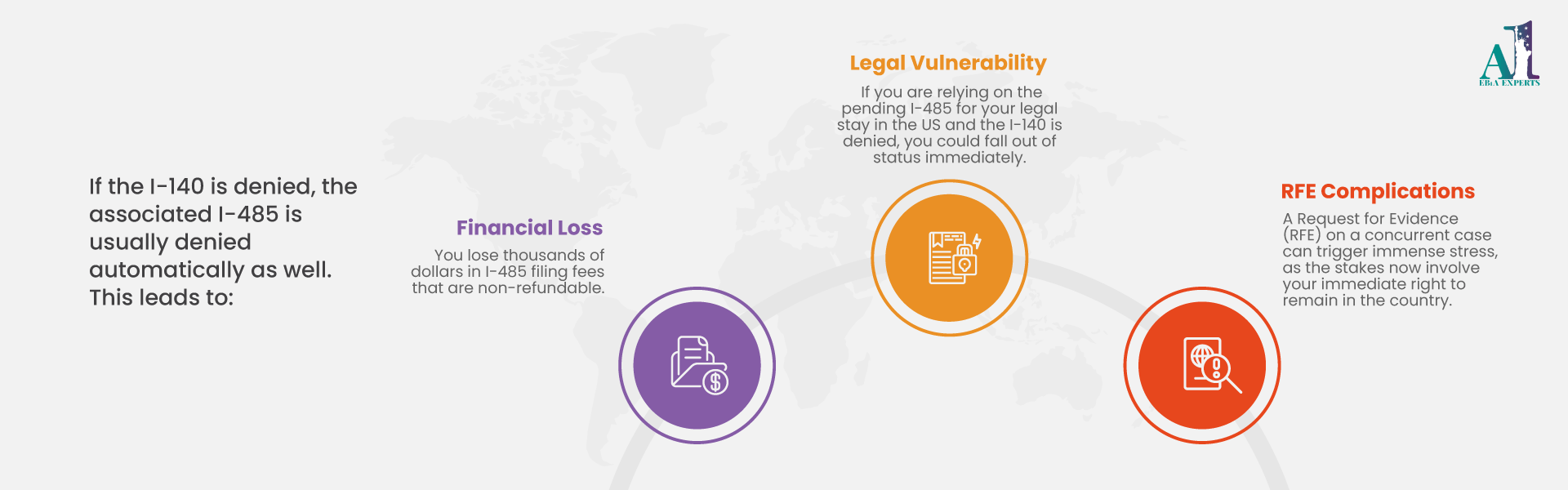
becomes real when an applicant files before their evidence is fully mature. If the I-140 is denied, the
associated I-485 is usually denied automatically as well. This leads to:
Financial Loss: You lose thousands of dollars in I-485 filing fees that are non-refundable.
Legal Vulnerability: If you are relying on the pending I-485 for your legal stay in the US and
the I-140 is denied, you could fall out of status immediately.
RFE Complications: A Request for Evidence (RFE) on a concurrent case can trigger immense
stress, as the stakes now involve your immediate right to remain in the country.
If you are relying on weak interpretations of the criteria, it is often safer to file the I-140 with the
EB1A premium processing timeline (15 days) and wait for approval before committing to the I-485
fees.
6. A Practical Decision Checklist
Before you file, run your situation through this fast decision filter. You should only consider
concurrent filing if you can say ‘Yes’ to all four:
My Visa Bulletin category is current for my country of birth.
My EB1A evidence is strong, peer-reviewed, and clearly explained.
My documentation (medical exams, birth certificates, etc.) is complete and consistent.
I understand my timeline and have the risk tolerance for a potential I-140 denial.
If any answer is unclear, do not rush.
7. FAQs
Can EB1A be filed concurrently with I-485?
Yes, as long as the Visa Bulletin shows your priority date is current and you are filing from within the
United States.
Does concurrent filing speed up approval?
It doesn't speed up the I-140 merit decision, but it allows the I-485 process to begin earlier,
potentially saving months on the total Green Card timeline.
What happens if I-140 gets an RFE after I file I-485?
The I-485 remains held until the I-140 is resolved. If the I-140 is eventually denied, the I-485 is
typically denied as well.
Is premium processing worth it for EB1A?
Absolutely. Given the high stakes of EB1A filing strategy, getting a 15-day decision helps you
pivot
quickly if an RFE or denial occurs.





 October 28, 2025
 3 min read