For many professionals who are high achievers, the EB1A category for Non-immigrant Employment-Based
Immigration is the most prestigious option for US Immigration. It offers an opportunity to become a
permanent resident of the United States, without the need for an Employer
sponsorship, a Labor
Certification, or any location restrictions. However, there is also a downside to this EB1A category; it
does not necessarily represent the least expensive US Immigration option available.
For the most part, EB1A is far more than simply filing out the right forms. EB1A is one of the most
difficult classifications in the U.S. Immigration System, and like every visa category, it has very high
standards for approval and is often subjectively adjudicated. Because of this, two applicants who have
virtually identical experiences could receive totally different outcomes due to the way each person
frames, presents, and supports their respective cases.
This is why knowing how to evaluate an EB1A
Immigration Firm is far more important than
simply looking
at Marketing Claims or Headline Approval Rates. An appropriate EB1A Firm will not simply Sell Hope, but
rather build a Defensible Petition. An inappropriate EB1A Firm will File Quickly or with a Shallow
Representation of the Case, leaving the Applicant Vulnerable to an RFE or even a Denial, which can
linger on the Applicant's Immigration Record for several years.
Think of EB1A as a Legal Argument related to the Applicant's place within the U.S. Talent Ecosystem.
This framework allows for an Evaluation of EB1A Immigration Firms with the same Systematic, Critical
Evaluation and Long-Term Consequences approach used by USCIS when Evaluating Petitions.
Each EB1A applicant will begin with a question; however, not all firms will ask the correct questions.
Each EB1A applicant starts with the same underlying question: “Who can actually help me win this case?”
But the better question is:
“Does this firm help me build a defensible petition—or do they just move me toward filing?”
Does the Firm Start With Eligibility or With Sales?
The start of a credible EB1A Immigration firm will be based on your eligibility first, rather than how
quickly you can get this done. The EB1A process is not future potential, but rather based on your proven
extraordinary ability, which can be supported by documents you already have or can create to support
your claim in a reasonable timeframe.
If your first consultation appears rushed, transactional, or solely focused on "locking in a slot, take
a moment to stop and evaluate. If your evaluation service is analytical rather than promotional, keep
the momentum going.
What Does a REAL Eligibility Evaluation Involve?
A substantive evaluation will usually be based on:
A strengths/weaknesses approach through every criterion and how it compares to USCIS regulatory
requirements
Knowing the difference between primary evidence (core accomplishments) vs. supporting evidence
Identifying gaps/risk and weak criteria
Recommendation of not filing at this time
Many applicants will become aware of the difference between an EB1A lawyer and an EB1A firm at this
point. While lawyers tend to focus on legal sufficiency, strategic EB1A firms address evidentiary
strengths and positioning.
Common Red Flags To Look Out For
Be cautious if you hear phrases such as:
"Almost Everyone Qualifies"
"Normal - Don’t Worry About RFE's"
"We Will Figure It Out During Drafting"
RFEs are not a strategy. They are often a symptom of weak upfront planning. In US Immigration,
especially EB1A, prevention is far more effective than reaction.
A serious firm is willing to tell you uncomfortable truths early—because those truths protect you later.
The differences between “profile building” and “petition drafting” with EB1A immigration is something
that is widely misunderstood.
Drafting organizes what already exists; profile building will help you determine what should exist
before you file your case.
When you build your profile, you will know whether or not the evidence you have for your EB1A case is
adequate. If it’s not, and your firm rushes into drafting the petition without first identifying the
gaps in your evidence, you may end up with a technically complete petition, but one that is
substantially deficient.
When done correctly, effective profile building consists of the following elements:
Creating an evidence acquisition timeline (i.e., obtaining letters of support, accumulating citation
counts, and accumulating letters of leadership).
Organising the achievement evidence into a cohesive narrative about your career and achievements,
not isolating each win.
Sequencing the evidence obtained to demonstrate both field-level impact and national impact.
Here is the point of value that true EB1A experts add to your application. The goal should not be based
on the volume of support letters you submit to USCIS, but rather on the credibility of the letters you
submit to USCIS.
The cost of filing a petition too early is:
Multiple months of back-and-forth with the USCIS regarding your RFE.
Requests for evidence that you are unable to provide because of your unsuccessful RFE.
Negative influence on future attempts at EB1A or EB-2 National Interest Waiver (NIW) petitions.
In the United States immigration process, timing is everything. The best EB1A law firms will explain to
you when is the best time to file a petition and when is the best time to not file.
4. Evidence Strategy and National Impact Framing
Meeting three out of ten regulatory criteria is necessary—but not sufficient.
USCIS does not simply count criteria. It weighs how convincingly those criteria establish sustained
national or international acclaim. This is where evidence strategy separates average filings from
approvals.
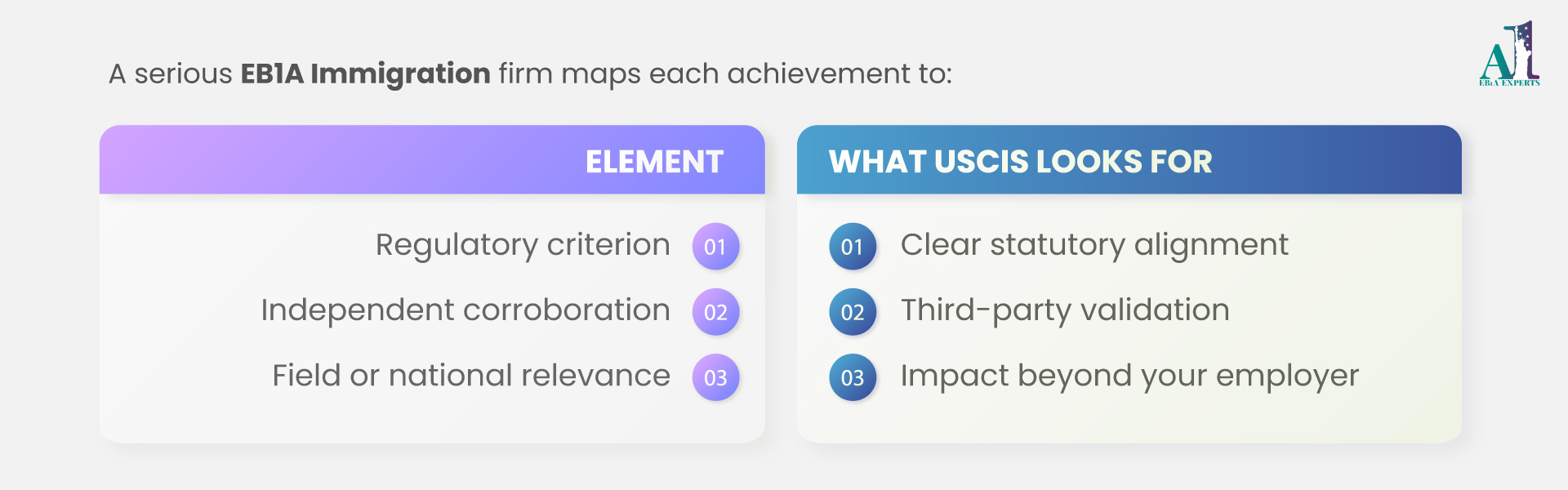
A serious EB1A Immigration firm maps each achievement to:
Element
What USCIS Looks For
Regulatory criterion
Clear statutory alignment
Independent corroboration
Third-party validation
Field or national relevance
Impact beyond your employer
Transforming Success into Influence
Technical Excellence seldom leads to EB1A wins - the interpretation is what ultimately explains the
contribution.
Original Contributions and Job Duties must be clearly described.
Selectivity and influence will be demonstrated in the Judging
Role.
The impact of citations and peer use must be shown by Publications.
Leadership will be linked to outcomes rather than titles.
The most Important Reason for the Firm to develop a justification for the Continued Work in the U.S. is
to create that framework for success in immigration.
The firm that simply lists accomplishments without combining them to create a message is relying on
Quantity instead of Quality to persuade.
5. History, Transparency and Clarity of Processes
"High Success Rate" is used widely in EB1A; however, is not helpful. Numbers by themselves do not
provide context around the meaning.
Questions to Consider
When checking a firm's success rate for EB1A Applications, ask yourself the following questions;
Is the success of the case including those who received RFE?
Are the firm approvals based upon the firm's strategy or by the applicant's words?
Does the data reflect a separation by Industry, Title or Origin of the Profile?
Another important factor of the process is Transparency - the preparation services for EB1A will
document their process in clear language.
What is the definition of a Transparent Process?
In order to build a case for a successful EB1A, a well-established firm would need to
provide the following evidence:
Eligibility evaluation
Strategic planning
Evidence building
Drafting
6. Client Experience and Planning for the Future After an EB1A Approval
Your journey in US Immigration does not end with your EB1A approval, but rather it is just one point on
a longer continuum. As an EB1A Immigration firm, we take into consideration more than just the
submission of an I-140.
The following evaluation criteria may give you insights into your client's overall experience. In
addition to being responsive to your client's inquiries and requests, it is important to evaluate:
Quality of thoroughness and clarity of feedback
Ability and willingness to adjust the strategy based on the facts (client's case) changing over time
Regularity of updates from the firm
Firms that are truly high quality have a collaborative process with their clients when it comes to the
EB1A Application. It is not simply a transaction.
Planning for the future after EB1A Approval
Excellent firms also discuss the following:
Realities of the Priority Dates
Differences between Consular Processing and Adjustment of Status
Back-Up Plans for Additional Visa Options (O-1 or EB-2 NIW Aligned)
7. Conclusion: A Simple Checklist Before You Commit
Many firms that do not offer anything after your approval or treat the EB1A as a "one-time" service will
not have any long-term perspective about immigration. On the contrary, a comprehensive EB1A Approval
Plan integrates the present application with the future's plan.
Prior to selecting an EB1A Immigration Firm, take a moment to reflect on the following questions:
Did the firm assess your eligibility prior to discussing filing?
Were the risks and gaps within your application clearly articulated?
Is the building of your profile broken out from the actual preparation of your petition?
Does the firm outline how it will create an organized and documented evidence/narrative strategy?
Has the firm been able to articulate clearly why you are important for the US?
Is the process of preparing your petition transparent and does the firm provide defined checkpoints?
Will you have access to senior strategists within the firm?
Does the firm discuss realistic post-approval planning?
With US Immigration, and particularly with EB1A, urgency is generally not an ally. Clarity is your ally.
The right firm will not pressure you to file. It will provide you with the information necessary so that
you can make an informed and defensible decision, not only with respect to your application but also to
the scrutiny placed upon it.
7. FAQs
1) What is the most important factor when choosing an EB1A immigration firm?
The most important factor is whether the firm starts with a real eligibility evaluation instead of
sales. A strong firm identifies strengths, gaps, and risk early, and may even recommend waiting instead
of filing prematurely to avoid RFEs or denials.
2) How do I know if an EB1A firm is “selling hope” instead of building a defensible case?
Watch for vague confidence like “almost everyone qualifies” or “RFEs are normal.”
A credible firm explains weaknesses clearly, sets realistic expectations, and builds a structured
strategy.
EB1A isn’t about speed - it’s about proving sustained, validated impact.
3) What is the difference between profile building and petition drafting in EB1A?
Petition drafting organizes your existing evidence into a legal format. Profile building strengthens
what must exist before filing - like recommendation letters, judging roles, and impact proof. Without
profile building, your petition may be complete but still weak and vulnerable.
4) Why does national impact framing matter even if I meet 3 EB1A
criteria?
Meeting three criteria is necessary but not enough. USCIS evaluates whether your evidence proves
sustained acclaim and influence beyond your employer. Strong firms connect achievements to field-level
relevance, third-party validation, and measurable impact, not just accomplishments listed.
5) What should an EB1A firm discuss beyond just filing the I-140 petition?
A high-quality firm also prepares you for the bigger immigration roadmap. This includes priority date
realities, consular processing vs adjustment of status, and backup options like O-1 or EB-2 NIW.
Long-term
planning reduces risk and improves stability.
If you’re serious about pursuing EB-1A, don’t choose a firm based on marketing claims or urgency-driven
promises. Choose a team that evaluates your eligibility deeply, builds your
evidence strategically, and prepares a petition that can stand up to scrutiny. Get a structured EB-1A
evaluation today and know exactly where you stand before you file.





 October 28, 2025
 3 min read