The substantial changes to the EB1A visa
program for tech professionals by the
USCIS since 2025 is a
step from checking into an applicant’s proof of employment/qualifications through additional evidence
about the overall impact of an applicant's work on others (employees) or society. This change includes
substantial upgrades for Indian IT workers seeking EB1A status.
There continues to be a widespread misconception about the EB1A program: that it is only available to
celebrity scientists, headline-grabbing founders, or highly educated individuals in academia. In fact,
the majority of EB1A success stories
2025 are being granted to
individuals who are not widely recognized
as well-known in their fields but who have nonetheless made a substantial impact.
Furthermore, although Indian IT workers have had a significant influence on the technology sector, many
face barriers that prevent them from proving their own value. These obstacles result from cultural and
team-based work environments; many employers expect their employees to produce around the employer's
product outcome, with minimal public exposure, thereby limiting the ability to use this individual
distinction-based documentation.
The following article presents six Indian EB1A case studies that successfully obtained approval
to work
in the United States in 2025; each case study highlights the unique background, strategy, and strengths
of each applicant. These Indian EB1A case studies provide examples of successful EB1A journey
examples,
as well as patterns of decision-making and positioning strategies that led to EB1A success despite a
more challenging EB1A environment.
USCIS's expectations for EB1A applications will be much stricter by 2025. Where previously it was
possible to convince them with a lot of evidence (volume), today they are more focused on providing
clear evidence.
Some key areas that have changed:
A focus on original impact rather than participation in work
Increased emphasis on leadership/decision-making and influence
More attention to the effects of work in the field beyond the applicant's employer
A strong resume alone will not guarantee approval. Many highly qualified applicants are still being
asked for additional evidence or denied because their materials do not clearly demonstrate their
individual contribution.
The primary differentiator between EB1A approvals and delays is not the applicant's background, but
their strategy. The strongest EB1A approved cases India demonstrate connectedness and clarity,
along
with independent validation rather than a list of generic achievements.
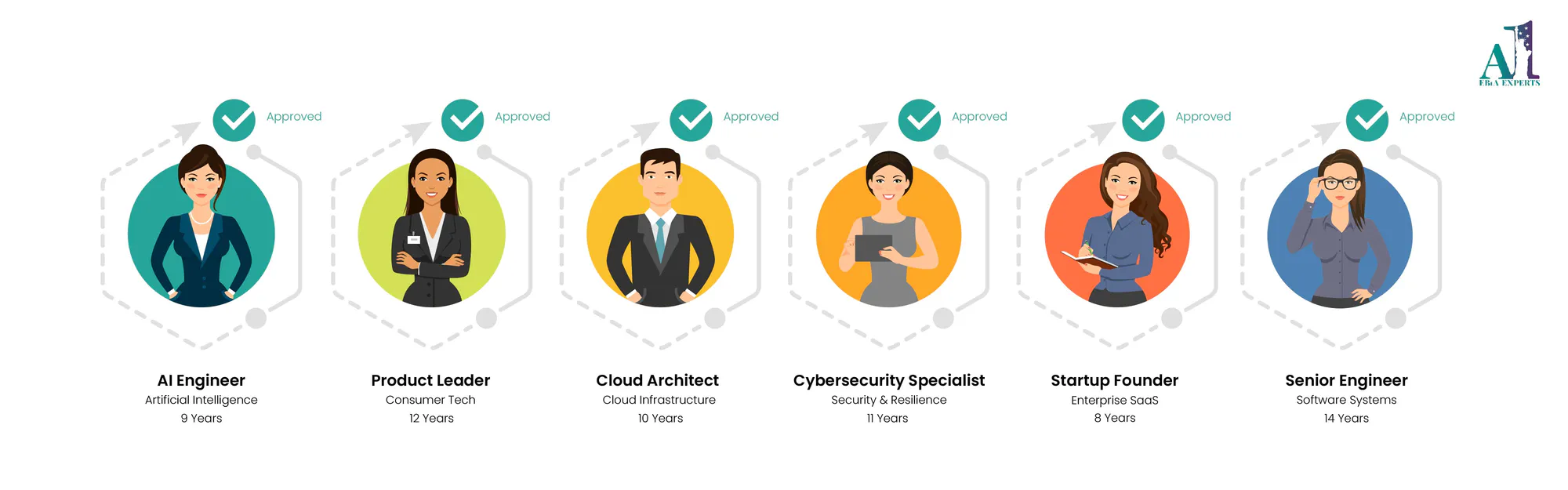
3. Snapshot Overview of the 6 EB1A Success Stories
Profile Focus
Field
Experience
Core Criteria Highlighted
Processing
Outcome
AI Engineer
Artificial Intelligence
9 years
Original contributions, industry recognition
Premium
Clean approval
Product Leader
Consumer Tech
12 years
Leadership, large-scale impact
Regular
Approved
Cloud Architect
Cloud Infrastructure
10 years
High-impact implementations, expert validation
Premium
Approved
Cybersecurity Specialist
Security & Resilience
11 years
National relevance, field influence
Regular
Approved
Startup Founder
Enterprise SaaS
8 years
Innovation, market adoption
Premium
Approved
Senior Engineer
Software Systems
14 years
Thought leadership, judging roles
Regular
Approved
4. Success Story 1 – The AI Engineer Without a PhD
The AI engineer in question had extensive industrial work experience- but he did not hold a Ph.D. Unlike
most academic researchers with advanced degrees, this engineer's expertise included applied ML systems
deployed in production environments.
The engineer demonstrated originality through something other than academic means:
The deployment rate of his work affected the marketplace.
He improved the performance of multiple teams by implementing his own prototype ML solutions.
Competitive recognition of the Technical Solutions he developed
While self-doubt about advocating for the quality of his work based solely on academic credentials posed
the most significant challenge for him, advocating for his work's impact rather than for where he
obtained his academic qualifications proved successful.
The engineer's outcome was received cleanly, with an approximate response time of 3 weeks, reinforcing
the MO that, for tech professionals applying under EB1A, advanced degrees are not required for an
endorsement.
5. Success Story 2 – The Product Leader from a Global Tech Company
Focus: Leadership & Influence in Collaboration
This professional was part of a worldwide product with an international user base numbering in the
thousands. Their primary challenge was to distinguish individual contributions within a multifaceted
organization.
Through meticulous documentation. The professional was able to:
Define their decision-making authority.
Establish how their prioritization of features affected users' behaviors.
Demonstrate their cross-functional leadership influence.
The case did not exaggerate the scope of the responsibility. Still, it appropriately highlighted all
areas of responsibility, accountability, and measurable results, as evidenced by the approach taken in
this case, which was entirely consistent with modern Indian EB1A case studies.
The outcome was a successful application approved via standard processing with no subsequent follow-up
required.
6. Success Story 3 – The Cloud Architect with Limited Publications
Focus: Industry impact over academic visibility
The initial anticipation of limited visibility has been thought of as a potential barrier to success;
however, the strategy was designed to include:
High-volume use cases in system designs.
Adoption metrics among enterprise clients.
Third-party experts validating the applicant's influence/impact.
As a result of the strategy to present relevance to the real world rather than solely on academic
output, the case was successful as a repeat case in EB1A success stories 2025.
As a result, the result was approved through premium processing.
7. Success Story 4 – The Cybersecurity Specialist Strengthening U.S. Infrastructure
Here are the main points of the text you provided, minus any unnecessary/less-important information. The
key points are:
National importance and applicability in the real world.
Focus on the national significance of the work done for the infrastructure resilience systems.
Articulate national importance without exaggerating.
Evidence from other organizations to support the case for national importance
Total: Approved through the regular processing, which validates that the author did a good job of
positioning his/her work on principles of evidence-based and factual assessment.
8. Success Story 5 – The Senior Tech Professional Without a High-Profile Exit
Focus: Influence without headline or exit
This case concerned a senior technology professional at a rapidly growing enterprise. They were not the
founder of the business, nor were they involved in any of the company's acquisitions or publicly traded
successes. What was most relevant in this specific case was the professional's influence at the field
level.
The professional did attribute their success to the overall success of their company; however, the focus
of this particular case was:
The widespread usage of the systems and solutions developed by the professional amongst all of their
clients and within their companies, including several teams and many existing clients.
The development of strategic partnerships with technology organizations, where the individual had a
direct impact on creating and maintaining implementation and/or standard practices.
The sharing of their expertise with both an external audience and their peers by providing time for
invited speaking engagements and by participating in various forums.
The professional's work significantly influenced how many other professionals in the same field approach
similar technical issues. This type of model has been observed in more recent Indian EB1A case studies,
driven by the work of this type of professional.
Result: Approved through premium processing, which shows that continued technical influence—not only
through exits, but also through public attention—impacts of many EB1A success stories 2025.
9. Success Story 6 – The Senior Engineer Transitioning to Thought Leadership
A journey filled with uncertainty, learning experiences, and development; this narrative reflects that
journey.
When a senior software engineer entered the process, he was unsure whether his profile was valid. He had
many questions about which materials to use to support his case and how to document the materials he
submitted properly.
The difference in this case was the level of engagement from the candidate:
Asking pertinent questions
Remaining patient during the modification phase
Working cooperatively and sharing information
By providing a well-structured, ongoing evaluation and strategic positioning of the candidate's
contributions to his field, the candidate successfully answered any questions raised. After months of
persistence, he was granted an EB1A adjustment; this case is just one example of the need for resilience
in pursuing an EB1A application versus achieving perfection.
Through all 6 of these cases, there was the identification of several commonalities that will create the
same success for all Indian tech professionals willing to work under the EB1A category:
The candidates articulated clearly how they contributed to the field.
The candidates provided evidence of how their individual contributions could be measured.
The candidates had letters from qualified independent experts indicating that they had made an
impact in their fields.
The cases were organised using the criteria first, allowing the evaluator to quickly get an idea of
where the evidence supported each criterion.
The best cases had compelling narratives rather than compiling hundreds of documents used as evidence.
For all 6 of the candidates selected during the investigation into successful EB1A cases will show how
all of the above-listed factors will create a competitive advantage for the candidate.
11. What these Stories Mean for Indian Tech Professionals Considering EB1A
These EB1A success stories 2025 show that:
You do not need to be a celebrity.
You need a well-defined strategy rather than relying on the title alone.
You will be at a place of lower cost than you were previously. Lower costs and earlier structuring
of your EB1A petition will significantly reduce the time it takes to complete an EB1A.
Understanding the logical processing of the evaluation criteria is critical, and the best way to do this
is to present the materials using a best-practices approach.
When people ask how
tech professionals get EB1A, the answer is a combination of all the items listed
above to create the best position for you in your EB1A application, rather than doing anything “new” or
“reinventing” anything.
12. Conclusion
Extraordinary ability is often hidden in plain sight. Many professionals featured in these EB1A journey
examples began with uncertainty, not confidence. By focusing on impact, influence, and clarity, rather
than relying solely on credentials, Indian tech professionals continue to succeed in a demanding 2025
environment. Your story may not look extraordinary yet. But with the right lens, it often already is.
13. FAQs
1. What kinds of profiles achieved EB1A in 2025?
Engineers, architects, product leaders, security specialists, and founders with clear field-level
impact.
2. How many citations are enough for EB1A?
There is no fixed number. Officers evaluate relevance and influence rather than counts alone.
3. Do software engineers qualify?
Yes. Many EB1A-approved cases from India in 2025 involved software engineers across domains.
4. How long did approval take?
Timelines ranged from a few weeks to several months, depending on the type of processing and the
clarity of the case.
5. What was the key evidence in each case?
Independent validation, documented impact, and clear explanation of individual influence.
If these EB1A journey examples resonated with you, consider
evaluating your
own work through the lens of impact, influence, and recognition—not titles or assumptions. Many
EB1A-approved cases from India begin with professionals who underestimated the strength of their own
stories.





 September 10, 2025
 3 min read