1. The 10-Minute Reality Most EB1A Applicants Never Hear
Most EB1A
applicants believe their petition will be carefully read, page by page, evidence by evidence.
They imagine an officer slowly working through recommendation letters, publications, citations, media
mentions, and exhibits, eventually arriving at a fair, holistic decision.
That is not how EB1A adjudication actually begins.
In reality, a significant percentage of EB1A
approvals, RFEs, and denials are effectively determined
within the first ten minutes of review.
This is not because USCIS officers are careless, rushed, or biased. It is because EB1A adjudication
operates under strict operational constraints. Officers handle heavy caseloads. They follow standardized
training. And they are trained to perform rapid credibility and plausibility assessments before
investing time in deep evidence review.
The first ten minutes are not about admiration. They are about orientation.
During this initial scan, the officer is asking one core question:
“Does this petition make sense fast enough to justify deeper review?”
If the answer is yes, the petition moves forward with a constructive lens.
If the answer is no, skepticism sets in, and even strong evidence later struggles to recover lost
credibility.
2. What USCIS Officers Are Actually Trained to Do First?
USCIS officers are not trained to evaluate brilliance. They are trained to evaluate eligibility. In the
opening stage of EB1A adjudication, officers focus on three specific tasks:
1. Identify the Petition Framework
The officer first confirms that the petition is properly filed under the EB1A
extraordinary ability classification and follows the expected legal structure.
This includes checking whether the petition:
Clearly identifies the applicant’s field
Claims eligibility under the correct criteria
Presents a recognizable EB1A framework rather than a resume narrative
2. Assess Threshold Plausibility
Before weighing evidence, officers determine whether the claims could logically satisfy EB1A standards.
This is not a merits decision yet. It is a plausibility filter.
3. Decide Whether Deeper Review Is Warranted
Only petitions that pass this initial plausibility scan receive a detailed merits evaluation.
This distinction matters.
There is a difference between:
Eligibility determination (Does this petition logically fit EB1A?)
Final merits evaluation (Does the evidence ultimately support approval?)
Officers rely heavily on precedent decisions, policy guidance, and reasoning patterns shaped by the
Administrative Appeals Office. They are trained to identify inconsistencies, overclaims, and structural
weaknesses early.
3. Minute-by-Minute: What Happens in the First 10 Minutes
Minute 1–2: Petition Framing Check
The officer confirms EB1A classification and immediately scans:
The cover letter
The executive summary
The stated criteria
They look for a clear explanation of why this individual qualifies as extraordinary, not just that they
are successful or senior.
Common red flag: A vague introduction that equates career progression, promotions,
or company success with EB1A eligibility.
Minute 3–5: Narrative Hierarchy Scan
Next, the officer evaluates structure and logic.
They check whether the petition clearly explains:
What is the applicant’s field actually?
What role did the applicant personally play?
Whether the impact is national or merely internal
They look for a hierarchy of importancenot a flat list of accomplishments.
Common red flag: Evidence presented without prioritization forces the officer to
guess what matters most.
Minute 6–8: Credibility Signals
At this stage, the officer evaluates how trustworthy the claims appear.
They ask:
Are claims inflated or absolute?
Is the language generic or copy-pasted?
Do exhibits clearly support the specific claims made?
They assess whether documentation is explainedor merely dumped.
Common red flag: Large volumes of evidence with minimal narrative explanation.
Minute 9–10: The Decision Pivot
By the ten-minute mark, the officer unconsciously adopts one of two mindsets:
Proceed carefully
Proceed skeptically
This posture determines:
How deeply evidence will be reviewed?
How strictly criteria will be interpreted?
Whether the case moves toward approval or RFE
Critical insight: If clarity is not achieved within the first ten minutes, later evidence rarely
recovers credibility.
Most EB1A denials do not happen because the applicant lacks talent. They happen because the petition
lacks clarity.
The most common failures include:
Treating EB1A like a resume submission
Assuming volume equals strength
Confusing recognition with demonstrable impact
Writing for peers instead of immigration officers
USCIS officers are not specialists in your domain. They rely on structured interpretation. When framing
is poor, even strong achievements can be misclassified or discounted.
This is why RFEs often ask for “more proof” of material already submitted. The officer could not clearly
connect claims to evidence.
5. Officer Readability: The Hidden EB1A Success Factor
Officer readability is the ability of an adjudicator to quickly:
Understand your field
Follow your contributions
Verify your impact
High-approval petitions emphasize:
Clear narrative hierarchy
Direct claim-to-evidence mapping
Strategic repetition that reinforces key points
Applicant-centric writing focuses on effort and pride. Officer-centric writing focuses on comprehension
and verification.
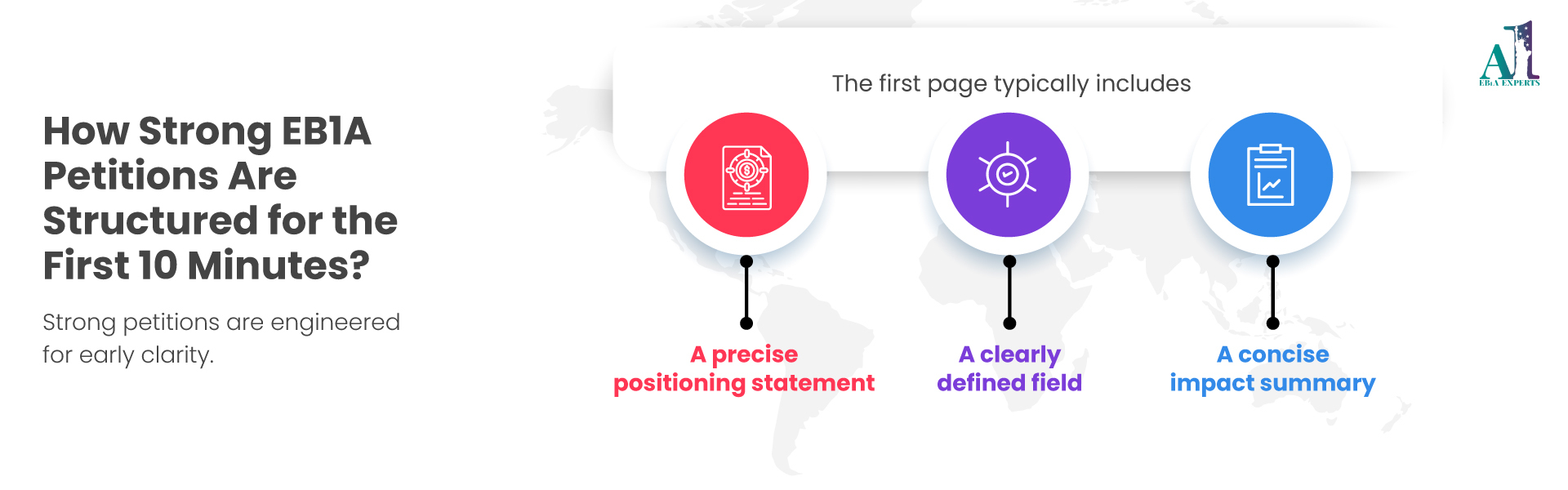
6. How Strong EB1A Petitions Are Structured for the First 10 Minutes?
Strong petitions are engineered for early clarity.
The first page typically includes:
A precise positioning statement
A clearly defined field
A concise impact summary
Criteria are sequenced logically, not emotionally. Evidence is grouped by claims, not document types.
This approach is not manipulation. It is aligned with how adjudication actually works.
7. What This Means for EB1A Applicants?
For early-stage applicants, this means starting with structurenot documentation.
For mid-process filers, it often means rewriting before adding anything new.
For RFE recipients, it explains why adding more evidence rarely solves the problem.
Preventive diagnostics are far more effective than reactive fixes.
8. Frequently Asked Questions
How does USCIS initially review EB1A petitions?
USCIS officers begin with a high-level scan focused on structure, clarity, and credibility. Detailed
evidence review follows only if the petition appears logically coherent and plausibly meets EB1A
eligibility standards.
RFEs often result from unclear framing, not weak achievements. When officers cannot quickly understand
the impact or relevance, they request clarificationeven when evidence was already submitted.
Is submitting more evidence always better for EB1A?
No. Excess evidence without a narrative explanation can weaken credibility. Officers prioritize clarity,
organization, and claim-to-evidence alignment over document volume.
Can rewriting a petition improve EB1A approval chances?
Yes. Strategic rewriting that improves officer readability often has a greater impact than adding new
evidence, particularly for RFEs or borderline cases.
9. A Calm Final Thought Before You File
If your EB1A petition were opened today, would an officer understand your extraordinary ability within
ten minutes?
A focused structural review, centered on officer readability, narrative hierarchy, and first-scan
clarity, can determine whether your petition moves forward with confidence or skepticism before
adjudication truly begins.
If you want to know how your petition performs in those first ten minutes, reviewing the structure early
can make all the difference.





 October 28, 2025
 3 min read