The EB1A green card is often described as the gold standard of employment-based immigration. It is
designed for individuals with extraordinary ability in science, technology, engineering, arts, business,
athletics, and research. Many applicants believe that if they meet three of the ten EB1A criteria, have
strong citations, published work, media coverage, and senior job titles, approval is almost guaranteed.
Yet in 2026, even strong EB1A profiles are receiving RFEs and Notices of Intent to Deny. A NOID is more
serious than a Request for Evidence. It means USCIS believes your EB1A petition does not meet the
standard and plans to deny it unless you provide compelling rebuttal evidence.
This case study explains how a seemingly strong EB1A petition received a NOID, what went wrong, and how
to prevent this outcome before filing your i-140 petition.
Raj, a Senior Cloud Infrastructure Engineer working for a multinational tech company, decided to apply
for the EB1A green card under the employment based first preference category. He had over 12 years of
experience in digital infrastructure, automation, and enterprise systems.
His profile included:
150 plus citations
Peer reviewed publications
Membership in a professional association
Leading critical cloud migration projects
Internal awards from his employer
Conference speaking engagements
On paper, Raj clearly met at least three EB1A criteria under 8 CFR 204.5. His case appeared stronger
than many successful EB1A approvals discussed online. He opted for premium processing to expedite his
i-140 adjudication. Within a few weeks, instead of an approval, he received a Notice of Intent to Deny.
3. What Is a NOID in an EB1A Petition?
A Notice of Intent to Deny means USCIS has completed its review and found substantial deficiencies in
your EB1A petition. Unlike a simple RFE, a NOID outlines why the officer believes you have not
demonstrated extraordinary ability.
Common reasons for EB1A NOID include:
Failure to show sustained national or international acclaim
Weak final merits determination
Evidence that does not demonstrate impact beyond your employer
Letters that are opinion-based instead of evidence-based
Meeting criteria technically, but failing the overall extraordinary ability standard
In Raj’s case, USCIS did not dispute that he met the three criteria. The problem arose in the final
merits determination.
4. The Hidden Weakness: Final Merits Determination Failure
Many EB1A applicants misunderstand how USCIS evaluates petitions. Meeting three out of ten criteria is
only the first step. The second step is the final merits determination.
USCIS examines whether the total evidence proves that the applicant is among the small percentage who
have risen to the very top of their field.
In Raj’s petition, the officer stated:
Citations were moderate but not clearly field-leading
Publications did not demonstrate a transformative influence
Project contributions were significant to his employer but not nationally impactful
This is where many strong EB1A profiles fail. The evidence shows competence and seniority but does not
clearly demonstrate national importance or field-level impact.
Many technology professionals highlight enterprise-level achievements. However, USCIS evaluates whether
your work has influenced the broader industry, not just your company.
If your cloud automation framework improved efficiency for your employer, you must demonstrate how it
changed industry practices, influenced other organizations, or was adopted beyond internal systems.
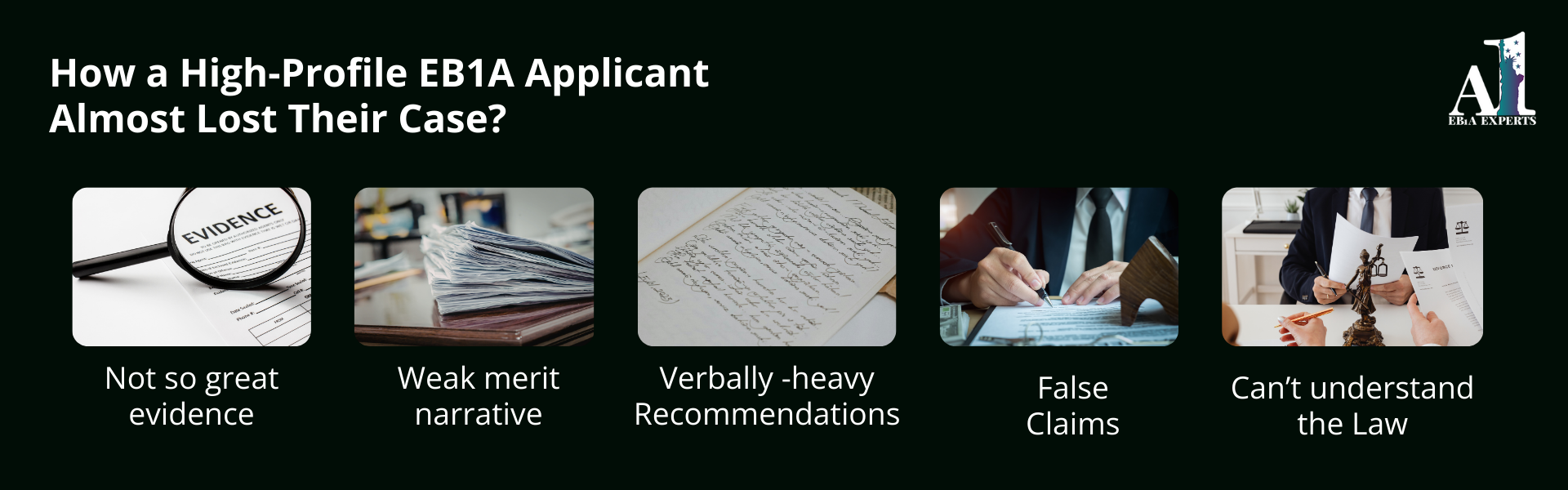
2. Weak Evidence Mapping
Evidence must be mapped clearly to EB1A criteria. Submitting publications without explaining their
significance weakens the petition. Simply attaching Google Scholar screenshots is not enough.
Each citation must be contextualized. Is it independent? Is it from high-impact journals? Is it global?
Officers look for depth, not volume.
3. Generic Recommendation Letters
Reference letters are critical in an EB1A petition. However, many letters repeat the same praise without
quantifiable metrics.
USCIS prefers:
Independent experts with no direct collaboration
Detailed descriptions of measurable impact
Specific examples of influence on the field
Letters that say “He is one of the best engineers” do not prove extraordinary ability.
4. Lack of National Importance Framing
Even though national importance is explicitly discussed more in EB2 NIW cases, EB1A petitions also
benefit from demonstrating how the applicant’s work strengthens U.S. competitiveness, digital
infrastructure, or economic growth.
Raj’s petition described projects but failed to connect them to broader national implications.
6. How the Case Was Rebuilt After the NOID?
After receiving the NOID, Raj worked with experts to restructure his evidence strategy. The approach
focused on narrative development and objective proof.
Step 1: Reframing Impact
Instead of focusing on job responsibilities, the petition reframed contributions as field level
advancements.
For example, his cloud automation framework was shown to:
Reduce deployment time across multiple enterprise clients
Influence open source contributions
Be referenced in external developer communities
Independent data sources were added to prove adoption and recognition.
Step 2: Strengthening Independent Recognition
Additional documentation included:
Invitations to judge technical competitions
Media mentions in industry publications
Detailed analytics of publication influence
Evidence of peer review contributions
This strengthened the judging criteria and scholarly articles criteria.
Step 3: Enhancing Final Merits Argument
The final merits section was rewritten to clearly argue that Raj’s sustained acclaim placed him in the
top tier of cloud infrastructure engineers globally.
The response directly addressed USCIS concerns using structured rebuttals rather than emotional
language.
Within months, the EB1A petition was approved.
7. Preventing a NOID Before Filing Your EB1A I 140
Build an Evidence Strategy First
Before filing your EB1A petition, conduct a comprehensive profile evaluation. Do not rely solely on
meeting three criteria. Assess whether your achievements demonstrate sustained national or international
acclaim.
Focus on Objective Documentation
Quantify everything. Provide numbers, metrics, adoption data, independent recognition, and third-party
validation.
Strengthen Your Narrative
An EB1A petition is not just a document submission. It is a legal argument. Your story must demonstrate:
Field-leading contributions
Influence beyond your employer
Ongoing recognition
Continued work in the area of extraordinary ability
Prepare for Final Merits
The final merits determination is where most denials occur. Anticipate USCIS scrutiny and proactively
address potential weaknesses.
8. FAQs
1. Why do strong EB1A profiles still receive NOIDs?
Strong profiles often meet basic criteria but fail the final merits determination. USCIS looks for
sustained national or international acclaim and field-level impact, not just credentials. If evidence
does not clearly prove top-tier standing, a NOID may be issued.
2. What is the biggest mistake applicants make in EB1A filings?
The biggest mistake is focusing on job duties instead of measurable influence. USCIS expects proof of
original contributions of major significance, independent recognition, and impact beyond one employer,
supported by objective documentation and strong narrative framing.
3. Can a NOID be overcome successfully?
Yes. Many NOIDs are overcome by submitting stronger independent evidence, detailed expert letters, and a
well-structured final merits argument that directly addresses USCIS concerns and clearly demonstrates
extraordinary ability.
Recommendation letters are critical because they explain your impact in plain language. They must come
from independent experts and include specific examples, metrics, and explanations of why your work is
influential at the field level.
5. When should I evaluate my EB1A eligibility?
You should evaluate your eligibility before filing. Early evaluation helps identify evidence gaps,
strengthen weak areas, and build a strategy that reduces the risk of RFEs or NOIDs.
Before you file your EB1A petition, get clarity on where you truly stand. Request a personalized EB1A
profile evaluation and evidence strategy to build a strong, approval-focused case from the start.





 December 22, 2025
 3 min read

