Although many technology professionals achieve great things at work, they may not know how to present
their achievements in a format that meets immigration criteria. It's an interpretation issue, not an
achievement issue. Many technology-related contributions are made in a team environment and cannot be
quantified meaningfully. For EB-1A, job
titles, employer reputation, or
years of experience do not
determine how you will be assessed. A common misconception is that having strong technical outcomes
alone will suffice; however, the reviewer actually looks for clear impact and relevance. This is why
EB1A
for tech professionals requires a structured methodology for presenting your case. A clear
understanding of how technology professionals' contributions are framed, rather than assumed, enables a
better understanding of how and why results vary across similar profiles in Tech Industry Immigration.
2. Understanding the EB-1A Standard Through a Tech Lens
The extraordinary
ability visa evaluates whether you will continue to have a significant, sustained
impact on your field of endeavor and whether you have a long-term effect and original contribution to
it. In technology-related fields, because of the way technology works, the impact of your work can often
be very indirect and spread out through the systems that you have created to do your work. Due to the
varying degrees of technical knowledge that the reviewers may possess, it is necessary to present your
work in such a way that helps the reviewer understand your contributions to your field from a different
perspective, other than just through the technical aspects of your work. The various elements of an EB1A
profile building for tech professionals will focus more on outcome-focused objectives from your
technical work and on how those outcomes have affected organizational practices, technology
adoption/deployment decisions, and organizational decision-making.
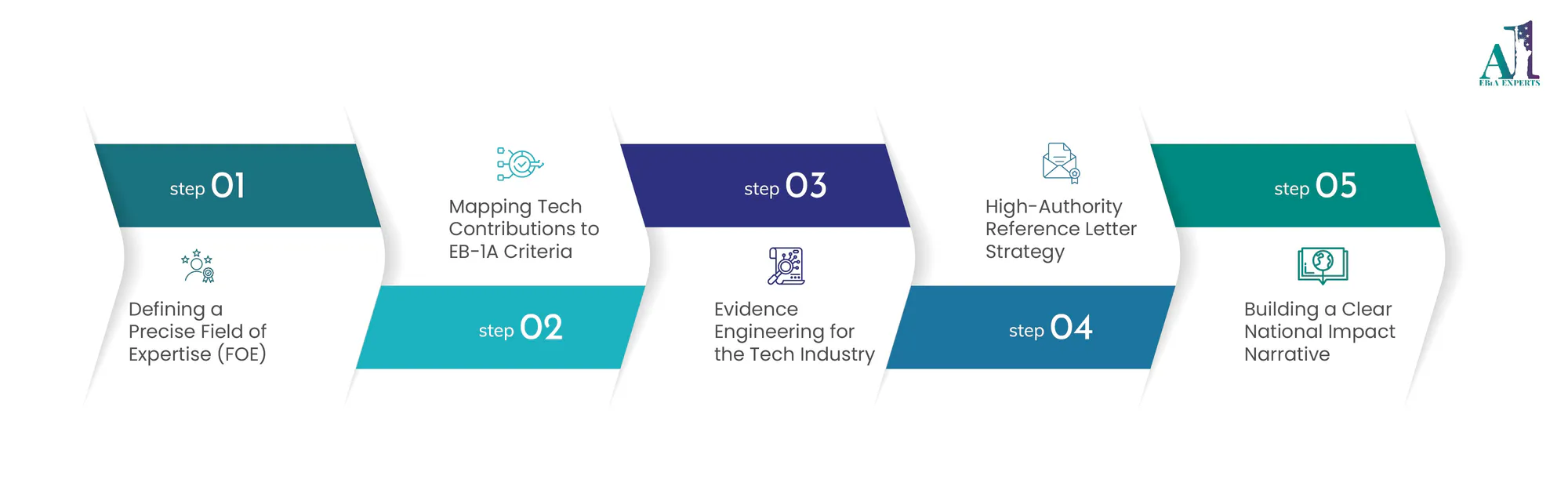
3. Step One: Defining a Precise Field of Expertise (FOE)
Vague descriptions make it hard to know how someone fits into the tech talent Slack or to understand
their impact in the field.
On the other hand, a clearer FOE of the candidate can define why they can be considered an expert.
Example of Clear FOE
Broad Role
Refined Field of Expertise
Software Engineer
Distributed systems supporting highly available financial systems
AI Professional
Use of Applied Machine Learning to Detect Fraud in Financial Systems
Product Leader
Design a scalable SaaS platform for highly regulated industries
This precision anchors EB1A profile building for tech professionals and strengthens the EB1A green card
for tech talent by creating consistency across the record.
4. Step Two: Mapping Tech Contributions to EB-1A Criteria
An accomplishment does not fit every level of recognition, and claiming it too readily will weaken your
credibility. EB1A Experts work from
selective mapping, showing which of the
three criteria actually
applies to you. Employee Impact will now reflect Industry Impact. Team success is clarified through
personal leadership. Product metrics now represent national impact or economic impact. The careful
mapping of these data points is at the core of AI-driven EB1A profile
optimization. Every item presented
can be substantiated, is relevant, and is easy to follow for non-technical reviewers.
5. Step Three: Evidence Engineering for the Tech Industry
The raw data are inadequate. For the data to be persuasive, EB1A Experts must develop the
technology-specific evidence into a complete narrative that presents the progression and impact of the
applicant's work.
The following are examples of common types of documents:
Technical leadership and ownership
Independent evaluations/expert assessments
Adoption metrics and proof of real-world deployments.
EB1A media coverage from third-party sources.
In developing an EB1A, the documents should be ordered to demonstrate a consistent evolution, broad
impact, and sustained relevance to support a positive review of the EB1A.
6. Step Four: High-Authority Reference Letter Strategy
The reference letters are the most essential factor in determining how reviewers will view the technical
body of work. As such, EB1A Experts emphasize the importance of obtaining independent, respected
endorsers to serve as a field validation of the work rather than a supervisor. The reference letters
cite and describe the technical work's complexity in layman's terms. They further support the importance
of the contributions and demonstrate the original nature of the work. Well-written letters provide both
a credible and influential source of support for an EB1A profile building for tech professional.
7. Step Five: Building a Clear National Impact Narrative
Reviewers also want a forward-looking perspective. The success of the past will not be enough to assure
EB1A success in the future. EB1A Experts will help connect the success of the applicant to the economic
competitiveness of the U.S. by demonstrating the value of the contributions to the resilience of the
U.S. infrastructure, the healthcare systems, and the innovation ecosystems. By doing so, tech industry
immigration cases will be tied directly to an extraordinary ability visa pathway established in the EB1A
green card for the tech talent.
8. Conclusion
There are no standard templates for EB-1A outcomes. Clear and comprehensible narrative structure is
essential for you'll be successful in EB-1A for Tech Professionals. You need an exact definition of your
field, a sophisticated selection of any evidence you can provide to back up your narrative, and a
forward looking view of your story as it relates to your current work. If you have strong representation
in an area for which your work is unexplained, you may want to re-evaluate your strategy for applying
for EB1A.
9. FAQs
1. How does EB1A Experts use tailored strategies?
They customize field definition, evidence mapping, and narratives for non-technical reviewers.
2. What makes tech EB1A petitions different from others?
Tech work is often invisible externally and requires structured interpretation.
3. How does personalized evidence mapping improve EB1A approval?
It aligns only with the strongest proof, with relevant standards, avoiding weak claims.
4. Does EB1A Experts help with media coverage and judging roles?
Yes, they guide EB1A media coverage documentation and expert-judging positioning.
5. How do expert-written recommendation letters improve a case?
They translate complex work into credible, plain-language validation from authorities.
Before moving forward, ask yourself: Can someone outside your field clearly explain why your work
matters at a national or industry level? If the answer is unclear, your next step may not be doing more
work but positioning the work you’ve already done more effectively.





 December 12, 2025
 3 min read