Every year, immigration feels different. Some years are hopeful. Some are tense. Some quietly change
lives in ways numbers alone can never explain. 2025 was one of those years, and 2026 has made its
lessons matter even more.
Updated November 2026: This refresh keeps our 2025 year in review and adds what has changed
since, including the November 2026 Visa Bulletin, the latest USCIS approval data and new USCIS rules on
evidence and RFEs. If you searched for the EB1A approval rate 2025, the full year-by-year
breakdown is in EB-1A approval rates 2025: complete statistics, trends and what applicants should
expect.
For EB1A experts, this year was not just
about approvals or timelines. It was about watching uncertainty turn into relief. Stress turns into
confidence. And talented professionals finally see their work recognized at the highest level. This is
our 2025 Year in Review. Not a highlight reel. A reflection of real journeys, real people, and real
outcomes.
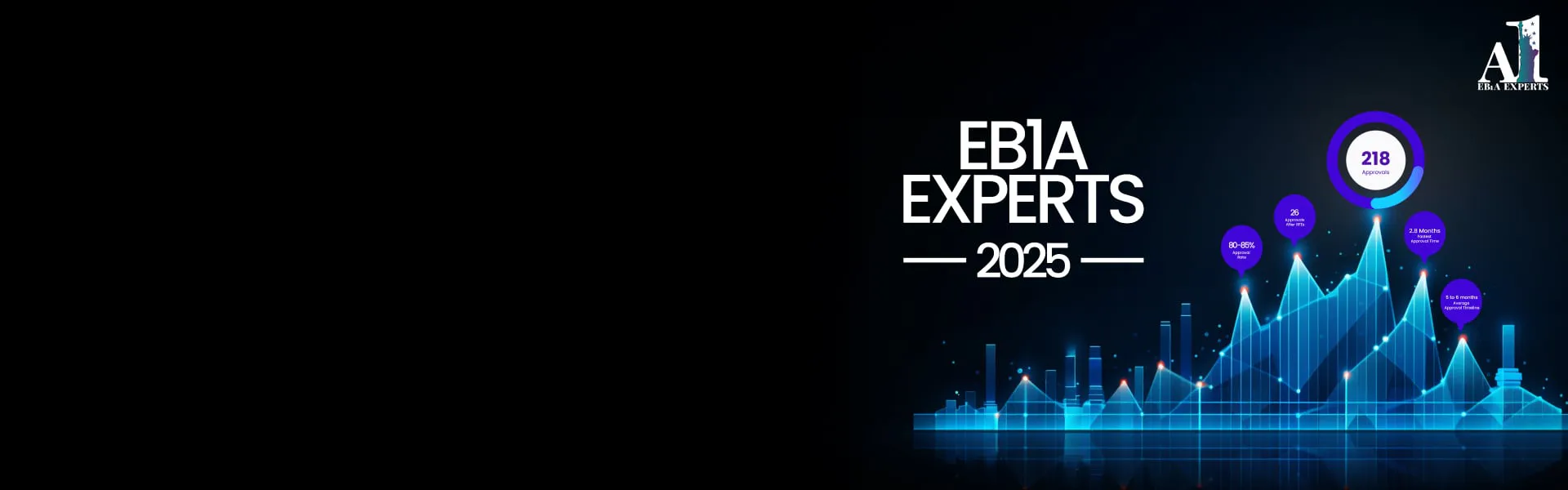
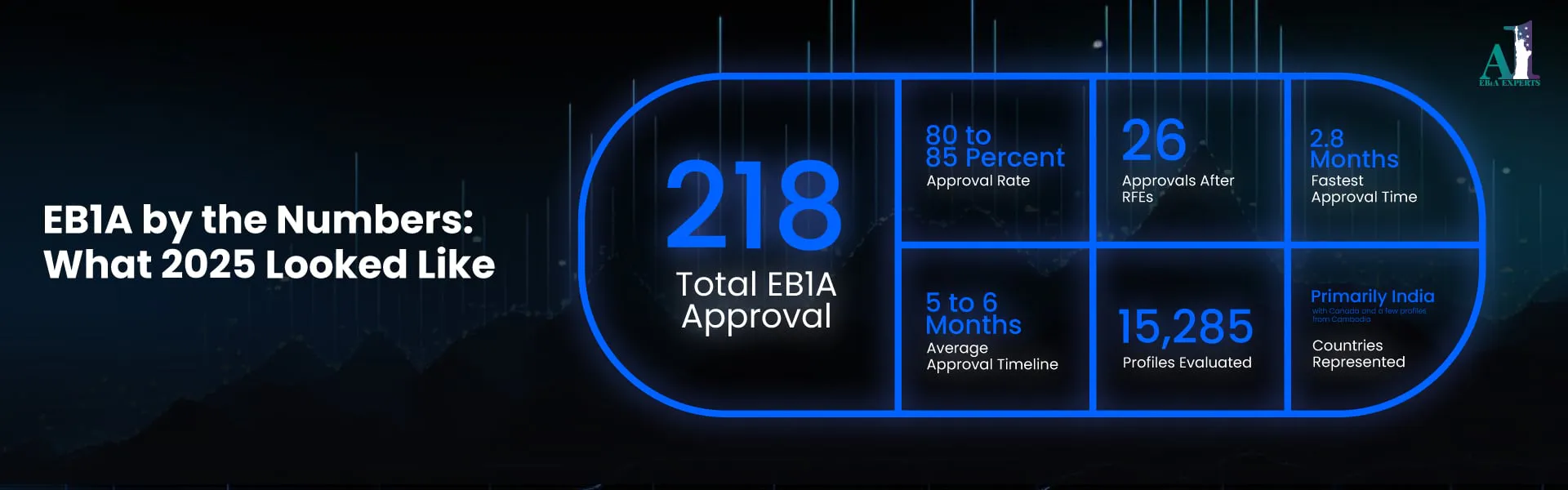
Approval rate: 80 to 85 percent (EB1A Experts petitions)
Approvals after RFEs: 26
Fastest approval time: 2.8 months
Average approval timeline: 5 to 6 months
Profiles evaluated: 15,285
Countries represented: Primarily India, with Canada and a few profiles from Cambodia
What matters most here is not just approvals. It is the scale of evaluation. Over fifteen thousand
profiles were reviewed, many of which were never filed immediately. That credibility matters. Strong
EB1A strategy starts long before filing.
How that compares with the national picture in 2026. The 80 to 85 percent figure above is our
own approval rate on the petitions we file. It is not the USCIS average, and the two should never be
confused. USCIS data shows the national EB-1A approval rate falling for six straight quarters:
Full fiscal year 2025: 66.9 percent
July to September 2025 (Q4 FY2025): 53.4 percent
October to December 2025 (Q1 FY2026): 47.5 percent
January to March 2026 (Q2 FY2026): 41.7 percent
April to June 2026 (Q3 FY2026): 32.2 percent, the lowest quarterly rate on record
In that most recent quarter, USCIS issued 2,832 EB-1A denials against 1,348 approvals, roughly two
denials for every approval. The next quarterly release, covering July to September 2026, will show
whether the trend continues.
This is exactly why the 15,285 evaluations matter. The gap between a national average and a strong
outcome is made before filing, through profile evaluation, criteria mapping and readiness. For the full
year-by-year picture behind the EB1A approval rate 2025 and earlier, see our EB-1A approval rates 2025 guide.
2. The Profiles We Worked With: Not Just the “Perfect Ones”
One of the biggest misconceptions about EB1A is that approvals only come from rare, flawless profiles.
That is not what we saw in 2025. Our applicant mix included:
Mid-career professionals: 480
Senior professionals: 466
Founders: 5
Early-stage or starting professionals: 1,357
Most approvals did not come from people who believed they were extraordinary. They came from people who
learned how to position their impact clearly. Most approvals did not come from perfect profiles. They
came from well-positioned ones.
What changed in 2026. Positioning now matters more, not less. With the national EB-1A approval
rate at 32.2 percent in the April to June 2026 quarter, a profile that is strong but not clearly
documented is more exposed than it was a year ago. Over the same quarter, USCIS approved O-1 petitions
at 91.0 percent and EB-2 NIW petitions at 55.3 percent. That is why a profile evaluation today asks a
broader question than “is this person eligible?” It asks which pathway (EB1A, O-1A or EB-2 NIW) fits
the evidence you have right now, and whether to file now or build further.
Every year, applicants arrive carrying the same fears. In 2025, we broke them one by
one.
You need a PhD or multiple degrees: You do not need a PhD. You need proof of impact.
Education supports your case. It does not define it.
Startups automatically boost EB1A eligibility: A startup helps only if your contribution
genuinely moved the needle. Titles alone do nothing.
Achievements must be US-based: Strong achievements count no matter where in the world they
happened. Impact is global.
You must manage people: You do not need to manage teams. You need to deliver exceptional
results that influence your field.
This year proved something important. EB1A is not about titles. It is about impact.
A new myth for 2026: “If something is missing, I will get an RFE and can fix it.” Not anymore,
at least not reliably. Under USCIS Policy Alert PA-2026-05, issued August 5, 2026, officers may deny a
petition without first sending a Request for Evidence or Notice of Intent to Deny when required initial
evidence is missing or the filing does not establish eligibility. The alert does not end RFEs, and it
applies to requests pending on that date as well as new filings, but RFE response windows can also be
shorter than the 12-week maximum. The lesson: file complete, because the first filing may be the only
one the officer reads.
4. The Moments That Mattered Most
Some approvals stay with you.
The first approval of the year came from a Senior Software Development Engineer in Deep Learning
at Amazon.
The fastest premium approval was a Software Engineer from DoorDash.
One of the toughest RFEs turned into an approval for a Data Engineer at Walmart.
A Lead Technical Program Manager at Visa received an approval that surprised even the
applicant.
These were the emails that made us pause, smile, and take screenshots. Not because of company names, but
because of what they meant to the people behind them.
Since then: In 2026, EB1A Experts passed the milestone of 300+ professionals helped to qualify
for the EB1A green card, with an 80 to 85 percent EB1A approval rate on the petitions we file.
“A whole year of stress gone in one morning update.”
“RFE to Initial Review to Approved in 24 hours.”
“This moment is unforgettable for my family.”
These are not marketing lines. They are messages sent in disbelief, relief, and gratitude. They remind
us why strategy matters so much in EB-1A.
6. The EB1A Experts Method: Why Strategy Beats Speed
Approvals in 2025 did not happen faster because we rushed. They happened because we structured better.
Our approach includes:
Profile evaluation before onboarding: We assess real eligibility before you commit time or
money.
Strategic criteria mapping: Achievements are aligned with the strongest EB1A criteria, not
forced into weak categories.
Evidence reframing, not exaggeration: Your work is shaped into clear, USCIS-ready
documentation without inflating claims. Since August 2026, that documentation also needs to be
complete on the first filing, because USCIS can deny without an RFE.
Readiness-first filing: We file when your profile is ready, not when fear pushes speed.
Attorney matching: We connect you with the attorney best suited to your case type.
Timing guidance: We advise whether to file now or wait for stronger positioning, including
how the monthly Visa Bulletin affects your country of chargeability.
This structure is what protects cases when scrutiny rises. In 2026, it did.
7. What EB1A Taught Us in 2025?
This year reinforced several truths, and 2026 has only sharpened them.
Clear proof of impact beats long lists: Officers respond to clarity, not volume.
Applicants underestimate themselves: Many overlook everyday work that carries exceptional
influence.
Rushed filings fail more often: Weak cases collapse because they were filed fast, not filed
ready. With USCIS denying roughly two EB-1A petitions for every one approved in the April to June 2026
quarter, that lesson now shows up in the national data.
Narrative clarity wins: Fifty documents mean nothing if the story is missing.
Complete beats fast (new in 2026): A filing that needs an RFE to become convincing is now a
riskier filing, because an RFE is no longer guaranteed.
8. EB1A Signals for the Year Ahead
Looking into the next year, patterns are clear.
Filing timing: Early preparation beats luck every time. The November 2026 Visa Bulletin,
released October 22, 2026, keeps EB-1 current on the Final Action Dates chart for applicants
chargeable to the Rest of World, Mexico, and the Philippines. EB-1 China moved forward one month to
August 1, 2023. EB-1 India held at February 1, 2023. That India date matters: it followed a
retrogression announced with the July 2026 Visa Bulletin. It still compares well with EB-2 India
(November 1, 2013) and EB-3 India (January 22, 2014). USCIS has confirmed that employment-based
adjustment applicants may use the Dates for Filing chart in November, so check the USCIS filing chart
before you file.
Premium processing: Premium offers speed, not safety. The I-140 premium processing fee rose
to $2,965 on March 1, 2026, up from $2,805. It buys a faster decision, not a better one.
RFE focus: RFEs target impact and influence, not checklist completion. And since Policy Alert
PA-2026-05, USCIS may deny without issuing one at all.
Industry trends: STEM and tech continue to dominate approvals. Meanwhile the pending I-140
queue keeps growing, reaching 203,204 petitions in the April to June 2026 quarter.
Early evaluation matters more than ever: Early evaluation avoids early denial. The next USCIS
quarterly data release (July to September 2026) is the number to watch.
9. A Note to You
If EB1A crossed your mind this year, that was not random. Most approvals begin with a quiet question,
not a loud decision. Curiosity is often the first step toward clarity. Ready to Unwrap Your Evidence Strategy? The next
year’s review could include your story.
No. EB1A evaluates sustained impact and influence, not just awards.
Can I qualify without US-based achievements?
Yes. International work is valid if it demonstrates national or global impact.
Does premium processing increase approval chances?
No. It only speeds up the decision. The I-140 premium processing fee is $2,965 as of March 1, 2026.
What is the biggest mistake applicants make?
Filing before their profile is strategically ready. Since August 2026, an incomplete filing can also be
denied without an RFE.
When should I start evaluating my EB1A profile?
As early as possible. Early evaluation creates stronger outcomes.
What is the EB1A approval rate in 2026?
USCIS reported a national EB-1A approval rate of 32.2 percent for April to June 2026, down from 66.9
percent across fiscal year 2025. That is a national average across all petitioners. EB1A Experts’ own
approval rate on the petitions we file is 80 to 85 percent.
Is EB-1 current in the November 2026 Visa Bulletin?
For most applicants, yes. The EB-1 Final Action Date is current for the Rest of World, Mexico and the
Philippines. China is August 1, 2023 and India is February 1, 2023.
Book a call with EB1A experts
and understand where you truly stand.
Because approvals do not come from hoping. They come from positioning.
Disclaimer: This article is for general information only and is not legal advice. Every case is different; for advice on your situation, speak with a licensed U.S. immigration attorney.
Written by
Harshal Deshpande
Content Writer, EB1A Experts
Harshal Deshpande is a former journalist and editor who now writes on EB-1A at EB1A Experts. He covers the ten criteria, the Kazarian two-step, and how EB-1A compares with other visa pathways. He has also helped clients shape their Letters of Recommendation, so his writing draws on real petitions as well as research.
Was this article helpful?
Sorry, your feedback couldn't be saved. Please try again.
Thanks for your feedback!
Related Blogs
December 16, 2025
3 min read
Real Success Stories: How 6 Indian Tech Professionals Achieved EB1A in 2025
The substantial changes to the EB1A visa program for tech professionals by the USCIS since 2025 is a
step from checking into an applicant’s proof of employment /qualifications through additional evidence
about the overall...
The EB1A visa remains one of the most distinguished but also one of the most difficult categories for
a U.S. Green card. Now that we are well into 2025, the EB1A approval rate 2025 is currently almost 67%
based on the strength....
Tech professionals are done waiting. EB1A is one of the fastest green card options, but delays,
misaligned profiles, and unclear documentation slow things down even then. That's why EB1A Experts
didn't just plug in generic AI. We built Turing AI — a purpose-built engine that compresses timelines,
....


 December 16, 2025
 3 min read