1. Introduction: Why Priority Dates Matter More than Ever?
EB-1A has been a "fast track" to a green card for Indian professionals for
many years, but
that
assumption is no longer valid. EB-1A priority dates play an essential role in EB-1A planning today, and
timing is as critical as meeting the eligibility requirements.
Currently, Indian professionals in technology, research, and entrepreneurial fields are submitting more
EB-1A applications than ever before. Additionally, EB-1A is used to maintain a continuous flow of
approvals, but there are now cyclical shortages and retrogressions in EB-1A visa availability.
Therefore, how applicants plan, prepare, and respond has changed.
The 2025-2026 window will be an essential time for USCIS to review applicants' statuses, for changes in
the global distribution of visas, and for higher rates of visa approval. In this blog, we will provide a
comprehensive overview of the projected EB-1A priority date predictionsfor India, without speculation
or embellishment, and offer practical guidance on how to prepare for the future.
2. The State of EB-1A India in 2024: How we Reached Today’s Priority Date?
To see the future of EB-1A India, it’s essential to look at its past.
For the past two to three years, EB-1 India has gone from consistently being current to experiencing
repeated pauses and rollbacks. The reasons for this trend are structural rather than random.
Reasons for retrogression:
High volume of filings from India, primarily from senior tech professionals and founders
Inconsistent amounts of spillover from family-sponsored visa categories
USCIS’s
reallocation of available visas per strict country limits
From the current priority date, we can see the classic imbalance of having more approved applicants than
available visa numbers. The imbalance between a high volume of approved applicants and a low number of
visa numbers will continue to be a source of future movement.
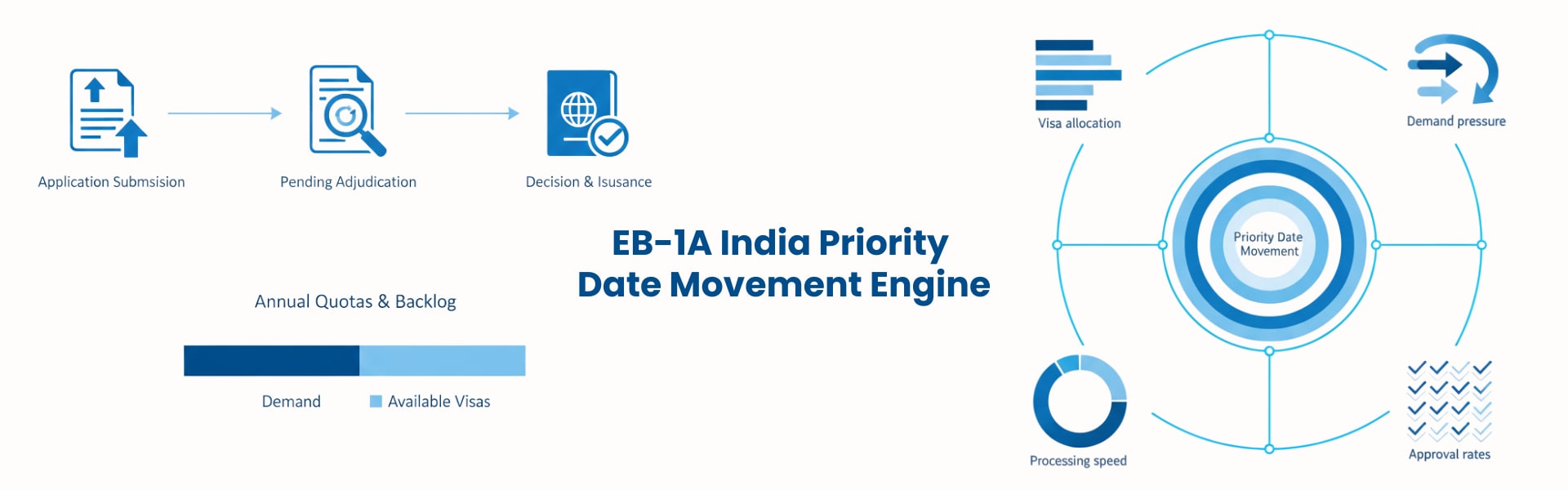
3. Factors that Drive Priority Date Movement in 2025–2026
To understand EB1A retrogression analysis, we must first understand how priority dates move.
Let’s take
a look at four areas that have a great deal of impact on priority date progression:
1) Annual Allocation of Visas and Spillovers
The Employment-based category has an annual allotment of 140,000 visas. This may sound like a large
number, but it's not when the number of applicants is growing faster than current allocations plus
additional applicants from spillovers (unused family-based visas that are subsequently allocated to the
employment-based visa process).
High spillover years = EB-1 priority dates leap ahead to an earlier date
Low spillover years = processing slows to a near standstill
2) Visa Demand from India VS visa demand from the rest of the world
EB-1 Indian applicants are among the largest populations in all employment-based categories. When you
think of your competition in the EB-1
category, it is not just other Indian applicants. It includes other countries where the volume of
applicants exceeds the allowable numbers. However, unused visas will revert to the employment-based
categories.
3) Speed of USCIS Processing
An interesting observation concerning how rapidly USCIS processes applications is that it indirectly
impacts the rate of retrogression. Due to shorter processing times, individuals can join the visa queue
sooner, and more people can obtain available visa numbers, leading to faster exhaustion of those
numbers. Conversely, slower processing creates a false sense of stability in terms of availability;
however, it inadvertently increases the backlog.
Approval rates are spiking, leading to more applicants competing for the same number of available visas.
Currently, USCIS seems to be tightening scrutiny of RFEs (Requests for Evidence). Therefore, if RFEs
continue to be issued and applied to fewer applicants, fewer applicants will get into the queue sooner
or later, which will put less strain on retrogressing individuals.
4. 2025 Priority Date Predictions: What’s Most Likely to Happen?
Base Case (Most Likely Scenario)
Moderate growth with occasional stops and starts.
Steady Progression of Adjudications.
Small or no spillover.
The typical pattern of progression is steady and gradual, with a typical month-to-month level of
caution.
USCIS is pushing to approve cases to meet the congressionally mandated annual quotas (Quota Mandate)
Result: Faster progression with the possibility of "jumping" multiple months forward.
Early Warning Signs:
Accelerated movement through the bulletin at the beginning of the Fiscal Year.
Public Statements Confirming Significant Spillover.
Pessimistic Scenario
Extremely High volumes of Filings From India.
More Rapid Processing of Cases.
Weak Spillover.
Result: Stagnation or retrogression in the middle to the end of 2025.
Early Warning Signs:
Sudden spikes in filings.
Bullets are not moving despite more cases being approved.
5. What 2026 Could Look Like: Stabilization or Pressure?
If the Spillover Does Not Strengthen
A conservative view of EB1A movement prediction for Indian nationals is minimal, with an average of 1-2
months per quarter. Wait times will continue to grow at a pace beyond the quick pace of the 2021-2022
golden period.
If The Spillover Strengthens
Priority dates could quickly regain their current status, enabling the development of a safer place to
file and adjudicate new cases across all EB-1A categories and backlogs.
AI, Technology, Startups, and the Filing of EB-1A Cases
What should we expect to see? AI and ML researchers, startup founders, and technology product managers
are currently filing EB-1A applications at unprecedented levels. These applicants generally have firm
profiles, which will result in significant approvals and movement of priority dates, but it will also
add to the long-term backlog. It is a real double-edged sword.
Possible Changes in Policy by USCIS
USCIS has stated that its future focus will be on transparency and expediting the adjudication cycle for
EB-1A applications, which are suitable for individual applications. However, it may lead to a higher
rate of backward movement (retrogression) across the entire system unless the number of available visas
is increased or the spillover policy is addressed in the future.
6. What Applicants Should Do NOW Based on Predictions?
1. File in early January if you want to file in 2025
Collect your metrics, evidence of media coverage, and proof of your leadership before you submit
your application to the filing window.
Do not file during the peak period.
2. If you have already filed and are currently post-filing
Check your Visa Bulletin every month.
Keep track of your accomplishments up-to-date in case you need them, if they are reviewed, or need
follow-up.
Be prepared to submit if your filing dates become current for a short time.
As lengthy delays in the processing of Employment-Based Immigration sponsored by Employers (EB) mean
applicants will have more time to continue to focus on work and business activities, applicants can use
the creation of the National Interest Waiver (NIW) as a Plan B to remain in the United States and
strengthen their application for EB-1A.
4. If Your Priority Date Becomes Current on Short Notice
Have ready medical examinations, all forms, a complete resume, and letters of recommendation. Even the
slightest delay will result in your case being pushed into the next backlog or time retrogressions.
7. Realistic Applicant Profiles and Their 2025–26 Outlook
Tech Professional with Exceptional Skillsets from Metrics that Remain Consistent
You are well-positioned for the obtainment of a response and approval upon submission of your
application; however, the only limitation will be with the movement of your priority date.
Researchers with Published Articles:
Sustained presence through your research will provide you with a competitive edge when documenting and
demonstrating your current impact.
Startup Owner/Founder with Media Coverage:
You have a positive outlook for obtaining the EB-1A classification, but the priority date wait will be
your greatest limitation. It may be beneficial if you file your application as an NIW in parallel to
your EB-1A.
Those with Limited External Visibility:
You should concentrate on developing your professional presence and profile prior to submitting your
application for EB-1A. Filing as an NIW may be the most immediate pathway to maintain work and business
activity while building your EB-1A application for submission.
8. Month-by-Month Monitoring Framework
Tracking Your Own Progress:
The Visa Bulletin provides two different dates: "Final Action Dates" (when they permit your
application to process) and "Dates for Filing" (when you can file your applications).
Follow movement trends to identify whether dates jump, remain static, or regress each month.
USCIS Process Reportings Track Other Applicants: Monitor Approval Data for Your Service Center via
USCIS’ website.
Monitor for "spillover" announcements, which are typically released posterior to the midpoint of the
fiscal year.
Participate in your community of applicants to identify "trends of approvals."
This framework helps independently decode EB-1A India movement prediction patterns.
9. Conclusion: A Prepared Applicant Always Wins the Timeline
Uncertainty does not equate to no direction. Early preparation combined with trend tracking will lead
to the most success. Regardless of the potential opportunities and pressures of 2025–2026, being
appropriately prepared makes the individual better prepared to succeed than simply being at the right
place at the right time.
10. FAQs
1. Will EB-1A India retrogress further in 2025?
Yes, retrogression is possible if Indian demand stays high and spillover remains limited, especially
later in the year.
2. When will EB-1 India become current?
It could become current if spillover improves and global demand stays low, but gradual movement is more
likely.
3. What’s the difference between Final Action Date and Date for Filing?
Final Action controls green card issuance; Date for Filing allows document submission.
If your priority date is current under the “Dates for Filing” chart and USCIS allows its use, filing
early can be beneficial. However, applicants should be prepared for possible retrogression and
processing delays.
5. How long does it take to prepare an EB-1A profile during backlog periods?
Preparation typically takes several months, depending on documentation readiness.
Whether you’re planning your filing, waiting on a priority date, or
deciding between EB-1A and NIW, EB1A Experts will help you to focus on a data-backed strategy.




 February 08, 2025
 3 min read