There is a famous saying, “People can lie, but numbers don’t.”
That truth in the saying becomes especially urgent when you are preparing for an EB-1A petition, a
category that has emerged as one of the most sought-after routes for STEM professionals, researchers,
and innovation leaders seeking a decisive pathway to the United States.
While the EB-1A offers comparatively swift
adjudication, it demands a far more strategic mindset. In an
immigration environment defined by extreme EB-2 and EB-3 backlogs and rising uncertainty in the H-1B
ecosystem, the EB-1A has become the most strategic, defensible, and future-proof option for exceptional
global talent. This shift is particularly visible among Indian professionals, whose representation in
high-impact fields such as AI, machine learning, big data, and advanced research continues to surge.
When the stakes involve your career freedom and your family’s long-term stability, relying on anecdotal
advice is not just risky; it can derail your entire strategy. What you need is evidence, hard data,
clear trends, and a roadmap that explains how adjudicators think and how standards shift.
This blog offers you exactly that. It breaks down the past several years of EB1A approval patterns and
gives you a precise understanding of how officers evaluate candidates so you can position your profile
with intention and clarity for 2026 and beyond.
A review of USCIS data reveals that EB1A approval rates, though volatile, follow a pattern shaped by
macroeconomic conditions, visa availability, and evolving adjudicatory interpretation.
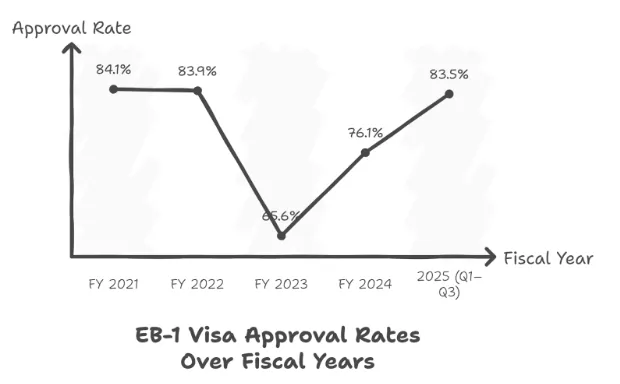
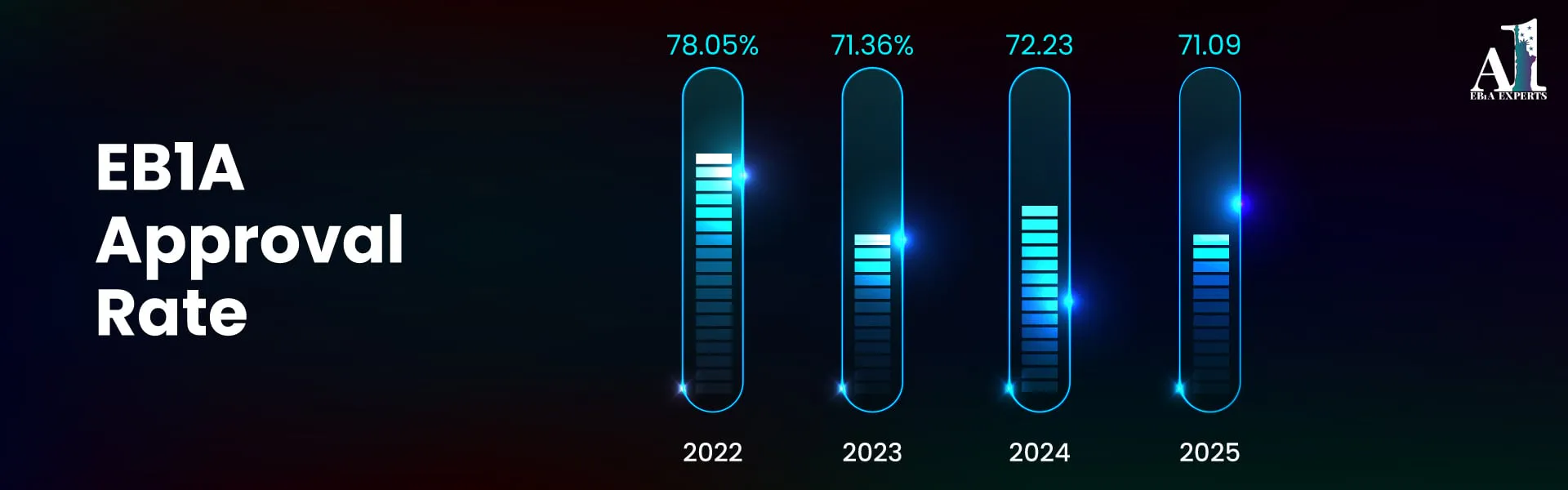
You can check the approval rates for every fiscal year below:
Fiscal Year | Approval Rate (EB-1 Overall) | Key Drivers
FY 2022: The year witnessed a continued visa abundance. The USCIS remained receptive to
modern
evidence forms such as STEM contributions, entrepreneurial impact, and technology leadership, which
benefited applicants with well-documented achievements. As a result, the approval rate stayed around
78.05%.
FY 2023: The approval rate, however, faced a sharp contraction in FY 2023, as visa supply
tightened
and scrutiny increased. The Kazarian two-part test was applied with greater rigor, and many applicants
faced RFEs for insufficient quantification or lack of external validation, pushing the approval rate
to 71.36%.
FY 2024: A partial rebound was observed this year as the USCIS sought to maximize usage of
available
visas. Denials remained steady, yet petitioners with strong dossiers began to outperform the broader
pool, pushing the approval rate to 72.23%.
2025
(Q1–Q3): The demand surged again, particularly from Indian applicants, with filings
increasing
more than 50 percent in some quarters. Well-organized cases with quantifiable outcomes began to see
consistently strong results. The FY witnessed an 71.05% approval rate, back to its 2023 rate.
Which year had the biggest spike? Scroll and see.
The peak surge occurred in FY 2021 and was followed by FY 2022. This surge was driven by exceptional
visa availability. In contrast, FY 2023 exposed the sharpest bottleneck, indicating that officers were
prioritizing high-quality, measurable, and independently validated evidence combined with a sharp
professional trajectory narrative over simple checklist compliance.
These fluctuations reflect shifts in administration policy, the growing influx of talent in emerging technologies, and evolving interpretations of statutory standards. Each dip signals the need for stronger evidence. Each rise creates an opportunity to time your filing strategically.
3. What do the Numbers Reveal About Who Actually Gets Approved?
Across years and administrations, a consistent pattern has emerged. Successful applicants are those who
can prove their impact by providing strong, supportive evidence instead of merely making extraordinary
claims.
Here are the key takeaways we got from the data:
Tech-driven, high-impact profiles dominate approvals.
Applicants in AI, machine learning, cybersecurity, and other deep-tech domains tend to fare better
because their work produces measurable indicators such as user adoption, performance gains, or revenue
impact. USCIS can assess these objectively.
Modern evidence forms carry significant weight.
USCIS increasingly accepts technical blogs, open-source impact, venture-backed innovations, and
high-engagement publications as evidence of Original Contributions or Published Material.
Profiles lacking external metrics face a higher risk.
Many strong professionals struggle because their accomplishments are internal, confidential, or
unquantified. Without national-level visibility, even complex work may fail to meet EB1A standards.
Final merits determination now plays a central role.
Officers evaluate not only whether you satisfy three criteria but also whether your overall
achievements demonstrate extraordinary ability.
Profiles that tend to align with higher approval outcomes include:
Researchers with substantial citation influence or patents, and founders or product leaders who can
point to millions of users, prominent releases, market-shaping outcomes or major funding rounds.
4. What Can We Infer About the USCIS’s Mindset from the Trends?
Each rise or fall in approval rates corresponds directly to how officers interpret the statute during
that period.
You might ask the following questions
Why did the USCIS in FY 2023 demand stronger innovation evidence?
The answer lies in the fact that in the following two years of abundant visa availability,
officers
adopted stricter interpretations. They insisted on national-level impact and specific, quantifiable
contributions to the field.
Why did leadership signals gain prominence in FY 2024 and after?
Here’s the answer: As applicant pools deepened, officers sought to separate true field
influencers from subject-matter experts. They placed greater emphasis on strategic roles,
cross-functional influence, and high-level decision-making authority.
Why did recognition become a tie-breaker in competitive cycles?
When several applicants met the criteria, media coverage and independent third-party publications became
the only key differentiators that demonstrated sustained acclaim.
The recurring theme is straightforward: Officers require clarity.
They are not domain experts, which means metrics, context, and structured narrative matter as much as
the underlying achievement. And most importantly, what matters is reliable third-party evidence to
justify the validity of the claims made by the applicant.
5. How do These Trends Affect Indian Applicants?
For India-born professionals, EB1A is no longer an exception. It has become a deliberate strategy
because of the long-term stagnation in EB-2 and EB-3. Another driver behind Indian professionals
choosing EB1A is the looming threat to the future of the H-1B visa. Given the current administration’s
attitude towards immigration, EB1A is the only viable option that guarantees a green card in a short
time frame.
Key dynamics in the EB1A application process include two forces that heavily shape outcomes: very high
internal competition within similar technical fields, and a rising influx of AI, engineering, and
research-driven applicants that has pushed officers to scrutinize evidence more closely.
Within this environment, Indian applicants bring several distinctive strengths. Many have deep
engineering expertise and innovation-led career paths, and they often operate in workplaces where
measurable outcomes are generated by default, a factor that aligns well with USCIS expectations for
quantifiable impact.
However, these strengths come with corresponding challenges that frequently harm approvals. A
significant portion of contributions remains locked behind NDAs or proprietary systems, limiting what
can be documented externally. In addition, many applicants have minimal public visibility, such as media
features, keynote engagements, or judging roles, which makes it harder to demonstrate national-level
recognition.
Recent retrogression in the Visa Bulletin for India underscores a crucial point. An I-140 approval is
only the first milestone. The quality of your evidence determines how you fare once the dates begin to
move, and that’s the tricky part.
6. Approval Patterns That Repeat Every Year
Despite shifts in adjudication trends, certain evidence patterns consistently correlate with strong EB1A
outcomes. Applicants who present clearly quantified achievements tend to outperform those relying on
narrative-heavy claims, and external validation often provides the objective credibility officers look
for. Demonstrated leadership through mission-critical responsibility remains a powerful signal, while a
coherent, well-structured narrative helps officers understand the significance of the work. Ultimately,
even exceptionally strong candidates risk denial when their evidence is fragmented or poorly organized.
As the old saying goes:
“It all depends on how you present it.”
It is important to understand that having great evidence of your work is as important as presenting it
in alignment with the USCIS criteria. You can’t do away with either - both are the ‘secret
ingredients’
to getting an approval.
7. What does this Data mean for Applicants Preparing in 2025–2026?
Based on the USCIS trends for the past few years, we have categorized applicants into three strategic
readiness groups for better understanding:
1. Applicants who are ‘ready now’ (file within three months):
Metrics, leadership evidence, and external visibility are already in place for these applicants.
2. Applicants who are ready to file in three to six months:
For these applicants, the impact exists, but they need better quantification, consolidation, or better
presentation.
3. Applicants who need profile building:
These applicants lack any sort of third-party validation, have limited metrics, or are heavily reliant
on employer testimonies to prove the impact of their work.
8. How to Use the Trends to Strengthen Your EB1A Profile?
A successful petition requires intentional documentation and external reinforcement. In order to do
that, you need to:
First, build quantifiable metrics into every achievement.
Second, use managerial attestations to validate internal accomplishments.
Third, pursue judging roles, publications, or media opportunities for third-party visibility.
Fourth, frame evidence using transformation-based storytelling: the problem, your solution, and the
industry-level impact that is supported by hard data.
And last but not least, treat your evidence as a portfolio and not a collection of loose documents.
Every claim and narrative strategy you use should have a solid base in the evidence you present.
Similarly, every piece of evidence you present needs to be included in the narrative flow that you
create in your petition and letters, and connect them with the impact of your work to make the
essential point - proving yourself to be a person with extraordinary ability in your field of
expertise.
9. Case Study: A Trend-Aligned EB1A Success Story
Let’s understand it through the case of Mr. Rajkumar M. (name changed), a Senior Product Development
Manager at one of the leading technology companies.
Rajkumar’s work gained him significant accolades and appreciation in his organization. He was confident
that he would be able to get it through. However, he realised that his achievements were substantial but
buried in internal documents (One of the issues that applicants face is that their work and its impact
cannot be retrieved most of the time, as the information is bound by a non-disclosure agreement (NDA)).
He was lucky that he could get access to certain documentary evidence that didn’t fall under the NDA.
With the help of that evidence, he was able to quantify the impact, highlight strategic leadership, and
secure external expert validation. His petition aligned perfectly with current trends. His approval
through Premium Processing arrived within six months.
The lesson here is simple: Excellence must be documented, quantified, and endorsed by credible
third parties.
10. Final Takeaway: Do Not Let Numbers Predict Your Fate; Use Them to Develop Your Own Strategy.
Approval rates do not determine who qualifies. They reveal what USCIS values.
Across every cycle, the same pillars emerge: impact, leadership, and recognition. A quantified,
well-structured profile consistently outperforms lengthy yet vague narratives. Your objective should not
be to hope for a favorable year. It should be to build a petition strong enough to weather even the
strictest adjudication cycle.
That’s where the right guidance can make a real difference. If you’re planning to build or strengthen
your EB1A profile for 2025–2026, consider getting your evidence and narrative evaluated by someone who
understands exactly how these trends play out in real petitions. A short review can often reveal
opportunities, blind spots, or missing validation that applicants don’t notice on their own. If you’d
like that kind of structured guidance, feel free to reach out; we would be glad to help you shape a
petition that genuinely reflects the strength of your work.
Ready to See Where You Stand in the 2025–2026 EB1A Landscape?
Approval trends don’t decide outcomes. Strategy does. Get your profile reviewed by EB1A strategists who
work with real USCIS data, not assumptions. We’ll help you identify strengths, gaps, and the fastest
path to a defensible EB1A petition.



 December 15, 2025
 3 min read