At EB1A Experts, we’ve reviewed hundreds of EB1A, O-1A, and EB-2 NIW cases over the years. Across these
cases,
a clear pattern kept emerging.
On paper, many professionals looked equally strong. They had impressive résumés, meaningful work, and
measurable
impact in their fields. Yet some cases moved forward smoothly, while others stalled, received RFEs, or
were denied
altogether.
What surprised us wasn’t who succeeded and who didn’t.
It was why.
Over time, one truth became impossible to ignore. RFEs, delays, and denials rarely happen because
applicants lack
merit. They happen because the case lacks structure, focus, strategic alignment, and evidence that
clearly speaks
to what USCIS actually evaluates.
We repeatedly saw highly talented individuals with real achievements struggle, not because they weren’t
qualified,
but because they lacked clarity on eligibility, didn’t know which evidence truly mattered, or failed to
tie everything
into a compelling, cohesive narrative.
LevelUp isn’t just another tool. It’s a platform designed to help applicants understand their
eligibility, organize
their evidence, and prepare strong EB1A, O-1A, or EB-2 NIW petitions, without repeating the costly
mistakes we have
seen across hundreds of extraordinary cases.
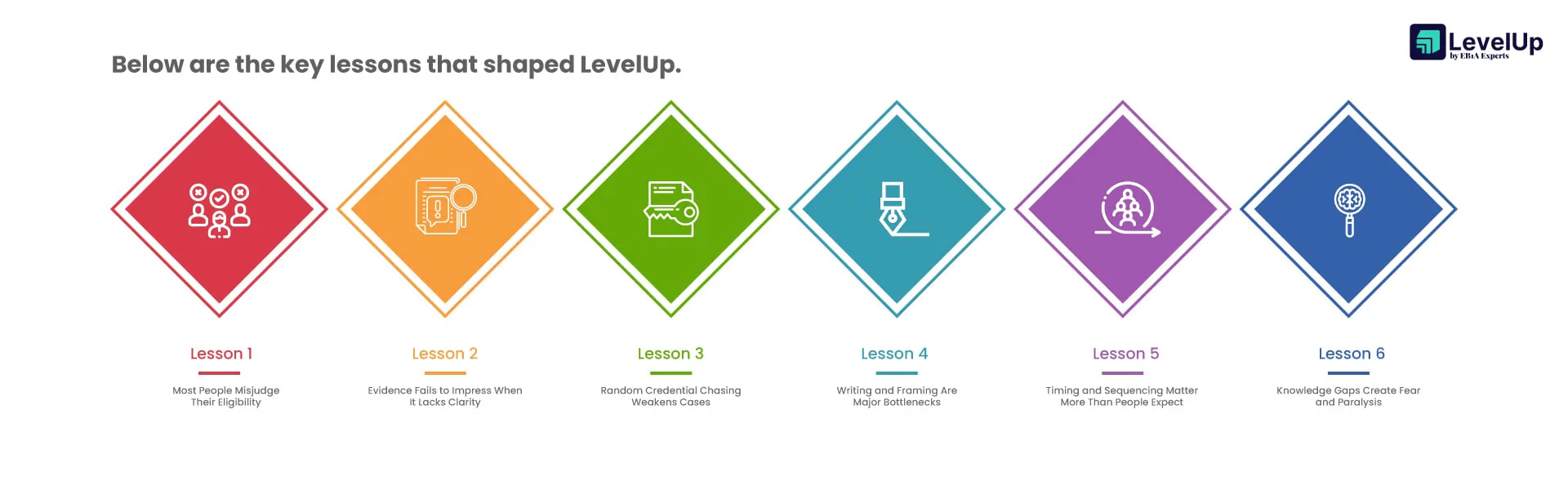
Below are the key lessons that shaped LevelUp.
2. Lesson 1: Most People Misjudge Their Eligibility
If you are an accomplished professional considering EB1A, this might sound familiar.
Many applicants start with doubt:
“I’m not extraordinary enough.”
“This is only for global superstars.”
As a result, they often default to O-1A or delay their plans entirely, without truly understanding how
eligibility works.
In reality, eligibility across EB1A, O-1A, and NIW depends far more on impact, recognition, and
relevance than on fame alone.
We have seen professionals with strong publications, influential projects, patents, and leadership roles
abandon or postpone
their petitions simply because they couldn’t map their work to USCIS criteria. The problem wasn’t a lack
of achievement;
it was a lack of clarity.
LevelUp addresses
this first. Before chasing credentials
or drafting documents, it helps you understand
where you already qualify
and where strategic strengthening actually makes sense.
3. Lesson 2: Evidence Fails to Impress When It Lacks Clarity
One of the most frustrating patterns we observed was this –
applicants had evidence, but it didn’t land because it didn’t prove the impact of their work on the
larger field.
Key achievements were buried inside unrelated documents, evidence wasn’t clearly mapped to specific
USCIS criteria,
and adjudicators were left to infer impact rather than see it clearly presented.
Strong evidence doesn’t speak for itself.
This insight directly shaped LevelUp’s Evidence Hub, where evidence is organized against official
USCIS
criteria.
The goal isn’t just storage; it’s clarity, visibility, impact, and readiness for review.
4. Lesson 3: Random Credential Chasing Weakens Cases
Another common misconception is that more credentials automatically mean a stronger case.
In practice, that’s rarely true.
We have seen applicants spend months chasing low-impact awards, joining irrelevant memberships, or
accumulating recognitions
without a cohesive strategy. Instead of strengthening their case, this approach dilutes focus and
weakens positioning.
That’s why we built LevelUp’s
Opportunities feature. It helps users prioritize high-impact, relevant
actions aligned with their
Field of Expertise, so effort goes into building signals, not noise.
5. Lesson 4: Writing and Framing Are Major Bottlenecks
Highly accomplished professionals often struggle with immigration writing, not because they lack
intelligence,
but because objectively explaining their own impact is hard.
We reviewed many cases where the work was strong and the evidence was real, yet the narrative was
unclear,
overly technical, inconsistent, or too modest.
Immigration writing isn’t about exaggeration. It’s not about drowning the reader in jargon either.
It’s about clarity, persuasive framing, and consistency.
LevelUp’s AI
Content Creator was built to address
this bottleneck. It doesn’t replace judgment or
automate decisions.
Instead, it supports structured, profile-driven drafting, helping users overcome blank-page anxiety
while staying fully in control
of their narrative.
6. Lesson 5: Timing and Sequencing Matter More Than People Expect
Some of the most avoidable mistakes come from doing the right things in the wrong order.
We saw applicants drafting recommendation letters before defining their expertise, collecting evidence
without knowing which criteria
they were targeting, or pursuing opportunities too late to matter strategically.
Strong cases don’t come together randomly. They evolve step by step. They start with clarity, build
alignment, develop content,
back it with evidence, and refine at the right time.
LevelUp is designed to guide users through this sequence, helping them focus not just on what matters
most, but when it matters.
7. Lesson 6: Knowledge Gaps Create Fear and Paralysis
Uncertainty is one of the biggest hidden barriers in immigration.
Fear of RFEs, fear of missing something critical, or pressure to hire expensive services “just to feel
safe” often leads
to paralysis or overdependence.
LevelUp addresses this head-on through deep expert learning, including a 7-hour course led by Raghu
Suram that explains
how adjudicators actually evaluate EB1A cases.
When people understand the logic behind decisions, fear gives way to confidence.
Every feature in LevelUp exists because of a real failure pattern we have seen repeatedly. Together,
they create a single source of truth,
a structured preparation system, and a workflow designed to build confidence, not confusion.
This isn’t about shortcuts.
It’s about reducing avoidable mistakes.
9. The Bigger Shift We’re Enabling
We believe extraordinary and high-skill professionals deserve transparency, structure, access to real
expertise,
and ownership of their immigration journey.
LevelUp represents a shift away from opaque, fear-driven processes and toward clarity-driven
preparation.
10. Final Thought
After reviewing hundreds of extraordinary ability cases, one truth stands out:
Success doesn’t come from doing more.
It comes from doing the right things, with intention, clarity, and in the right sequence.
Most setbacks in high-skill immigration aren’t caused by a lack of talent. They are caused by
misalignment, unclear positioning,
scattered evidence, and decisions made without understanding how cases are actually evaluated.
LevelUp was built to remove that guesswork.
It’s designed to help you see your case clearly, prepare with purpose, and move forward with confidence,
step by step,
without unnecessary detours.
If you are ready to stop second-guessing and start building with clarity, LevelUp is where that journey
begins.
Start your EB1A, O-1A, or NIW preparation with clarity.