The H-1B visa
previously served as the primary option for engineers, product leaders, and researchers to
establish
their careers in the United States, but this assumption is now starting to break down due to lottery
chances being unpredictable, increasing costs associated with compliance, and changing priorities by
employers.
As a result, high-impact professionals are re-evaluating their options.Outsourcing companies have
reported a steep decline in the number of H-1B applications submitted recently, while interest in
merit-based visas has grown substantially among experienced technology employees.
What appears to be occurring instead is an increase in the use of EB-1A vs H-1B, and of O1A
for tech workers seeking to control timing, movement, and long-term goals. This is not simply an
attempt at taking a "shortcut" but rather an alignment- that is, selecting U.S. technology immigration
avenues that are more reflective of actual impact versus luck.
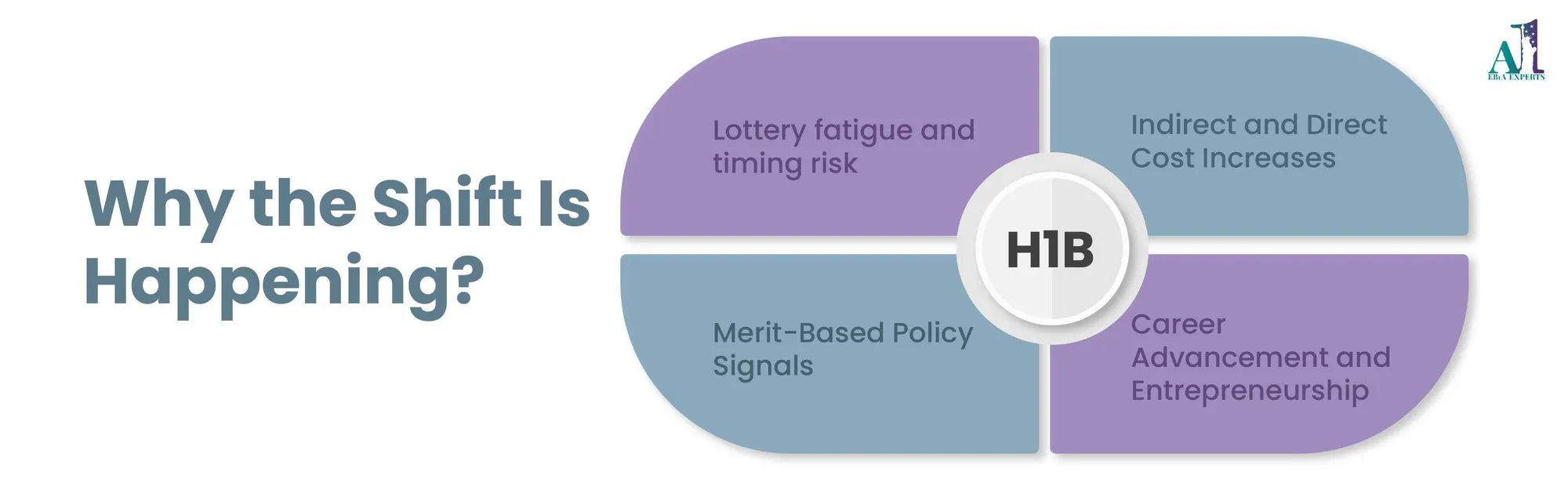
Although the H-1 B cap has remained stable for many years, demand for H-1B visas has increased
dramatically. Not winning the lottery may result in a year-long delay, disrupting the product roadmap
and necessitating a stopgap solution outside the country. Fast-moving teams are finding it unacceptable
to live with that risk.
Indirect and direct cost increases
Employers face many costs beyond the filing fee, including compliance and overhead costs, legal
coordination costs, and internal risk reviews. Sponsorship is becoming increasingly selective based on
these costs. Many companies will reserve H-1B slots for early-career roles while pursuing H-1B
alternatives for engineers.
Merit-based policy signals
In the last few years, USCIS guidance has clarified the importance of using "comparable evidence" to
demonstrate
impact for professionals in fields outside academia. This has opened doors for non-traditional
innovators, such as
builders, operators, and leaders, whose influence across multiple companies can be demonstrated.
Career advancement and entrepreneurship
The flexibility of O-1A and EB-1A allows greater mobility and provides more opportunities for people who
offer consulting services, start businesses, and manage international teams as remote leaders. These
types of visas have become a key component of a strategic career for U.S. tech immigration
options.
Best for:
Those in technology occupations who have a significant profile within their field based on factors such
as employer sponsorship, the media's reporting of their work, and receiving public speaking
opportunities at industry events; most people in this category will have received a letter of
recommendation from an influential individual in their field and be unable to wait long for employment.
Why: Because O-1A visas have no maximum quota of visas per year, process quickly, can change
jobs, and are utilized by many people as a way of obtaining professional work experience while they wait
for their permanent resident status.
Best for:
Those individuals who can provide proof of their influence on the field of software engineering over a
sustained period of time (e.g., creating software products that are used/received by many other
companies; establishing processes for accepting best practices across multiple organizations).
Why: The O-1A visa allows someone without an employer-sponsored employment offer to obtain
permanent residency immediately upon obtaining sufficient verification (e.g., EB-1A green card
eligibility). The current guidance from USCIS has expanded the acceptable evidence verification types
that are to be considered in favor of industry practitioners.
H-1B Visas
In cases where an employer is committed to continuing to sponsor an employee for the duration of the
employee's employment, employers may still find H-1B visas to be a practical solution.
Quick decision flow
If you need speed and flexibility, consider O-1A
If your impact is already national or international, consider EB-1A
If you need employer stability and are early-career, H-1B may fit
4. What Evidence Matters
The evidence presented for Technology Professionals focuses on the impact their work creates rather than
simply being given a title. A successful case shows how someone's day-to-day duties were translated into
large-scale results.
The most common forms of evidence associated with technology professionals are:
Original Contributions + Measurable Results: inclusive of but not limited to revenue
increases,
increased performance of systems, user adoption rates, or increases in scale of a platform.
Authorship/Leadership in Thought: technical white papers, influential blog series,
contributions to
standards organizations, and creation of an internal framework that was adopted outside of the
organization.
Awards/Recognition from a Competitor: Industry Awards, Innovation Challenge Competitions,
Selective
Grants, etc.
Press/Media Coverage for a product: Being covered by a Trade Publication, being interviewed
by a
Publication about a Product or launch, etc.
High-value reference letters: A letter explaining the what, why, and who of an individual’s
contributions, with numbers where available.
Example of evidence mapping template
Achievement- Measurable Outcome.
Attach Supporting Documents.
Use the letter to explain broader relevance.
By structuring evidence in this manner, one’s profile can align more precisely with pathways, such as
the Extraordinary Ability Visa for tech, without relying on academic credentials.
5. Case Studies / Micro-Stories
Case 1: AI engineer at a growth-stage company
Timeline: 4 months
Key proof: production-level system improvements, industry speaking, peer endorsements
Outcome: Approved for O-1A, later transitioned roles without re-filing.
Case 2: Senior product manager in fintech
Timeline: 9 months
Key proof: cross-border product launches, vendor testimonials, trade media coverage
Outcome: Direct move to EB-1A based on market-level influence.
Case 3: Startup founder
Timeline: O-1A to EB-1A in 18 months
Key proof: platform adoption metrics, accelerator recognition, global customer base
Outcome: Used O-1A as a bridge, then secured permanent status.
6. Timelines and Costs
A successful O-1A or EB-1A application requires a plan, not just documents. Here’s how we assist in
winning these cases:
Evidence audit & strength analysis
We assess your profile against USCIS criteria as we identify gaps and suggest alternate means (other
than traditional academic credentials) to demonstrate the breadth of your technical capabilities in your
work.
Letter of recommendation strategy
We provide detailed outlines for each letter writer, including metrics and technical context for each
letter writer. Our templates help convert letters of endorsement (which are often general in nature) to
impactful statements, including unique numbers and results.
Building a narrative
We combine your experience at multiple companies into a single, cohesive story that highlights the
sustained impact you have had on a national level by connecting your individual accomplishments with the
overall impact on your industry.
Filing & legal coordination
We work with immigration professionals who help align evidentiary packages with legal arguments to
create cases that satisfy both evidentiary and legal requirements.
Strategic pathway planning
We provide guidance on which of the three available strategies is best for your situation, i.e., begin
with the O-1A for quick results, file for EB-1A if you're ready for it, or pursue an incremental
strategy where you amass evidence over time.
7. Conclusion
For years, the H-1B dominated conversations around working in the U.S. tech ecosystem. But as careers
become more global, nonlinear, and impact-driven, many professionals are questioning whether a
lottery-based system still aligns with how they work and grow. The rise of merit-focused pathways
reflects a broader shift: tech workers want immigration options that recognize what they build, lead,
and influence—not just where they’re employed.
Whether it’s O-1A for tech workers seeking flexibility or EB-1A for software engineers aiming for
long-term stability, the right choice depends on timing, evidence, and career intent.
Understanding EB-1A vs H-1B is no longer just an immigration decision—it’s a strategic career
move within evolving U.S. tech immigration options.
8. FAQs
1. Can a junior developer realistically pursue EB-1A?
Usually, EB-1A expects sustained, outsized impact. Early-career professionals often need more time to
build that record.
2. Is O-1A a direct path to permanent residence?
O-1A is temporary, but many professionals use it as a bridge before moving to EB-1A.
3. Do I need publications to qualify?
No. Product impact, industry recognition, and market influence can serve as comparable proof.
4. What’s the most important step?
Building a narrative that links your work to measurable, field-level outcomes.
5. How long does evidence gathering take?
Typically 4–8 weeks, depending on availability of documents and recommenders.
6. Will EB1A Experts file for me?
We prepare the full dossier and coordinate with immigration counsel for filing.
The path to working in the U.S. is changing. The question isn't whether
you're qualified, it's
whether you know how to prove it. Let's find out together. Not sure where you stand?





 December 17, 2025
 3 min read