1. Introduction
To put it plainly: even excellent CVs will not assure you receive approval for an EB-1A that will
allow you into the USA on a permanent basis. Every year, individuals who have made remarkable
contributions to their field of expertise, such as scientists, entrepreneurs, physicians and artists,
receive an eb1a notice of intent to deny, often with complete surprise.
Why? USCIS (United States Citizenship and Immigration Services) does not evaluate CVs; it considers
the legal narrative and supporting evidence. As the number of EB-1A cases grows, the adjudicating
officer will tend to apply time-consuming and rigorous final merits reviews, resulting in many
instances where even very talented practitioners receive notices of intent to deny for filing an EB-1A
visa (NOID).
The good news is that the vast majority of NOIDs are not due to a practitioner's talent level, but
rather to how the case was properly positioned. If you follow a prevention-first approach, you may
avoid a substantial number of NOID EB1A results with the USCIS.
Read More:
How to Evaluate an EB1A Immigration Firm?: A Practical Framework for High-Stakes Talent Petitions
2. What Is a NOID in EB-1A?
A NOID (Notice of Intent to Deny) is a written notification from the USCIS regarding your EB-1A
petition. It
specifically states that, considering all of the documentation on file with the application, the USCIS
officer is
not able to find that you have satisfied the legal standard for eligibility for an EB-1A visa.
An EB-1A NOID typically comes into play at the time of final merits review. During the final merits
review the
USCIS officer will decide whether a petition for an EB-1A visa meets the requirements for being
approved as a
matter of law, and will usually indicate that the evidence in support of the petition does not
establish
eligibility under the law.
3. NOID vs RFE —
What’s the Difference?
Understanding the NOID vs RFE difference matters.
| Factor |
RFE |
NOID |
| Stage |
Early or mid-review |
Final merits review |
| Tone |
Requesting |
Adversarial |
| Risk |
Moderate |
High |
An RFE means USCIS wants more information. A NOID means USCIS plans to deny
unless persuaded
otherwise.
Still, a NOID is not the end - it’s a chance to correct strategic failures before denial.
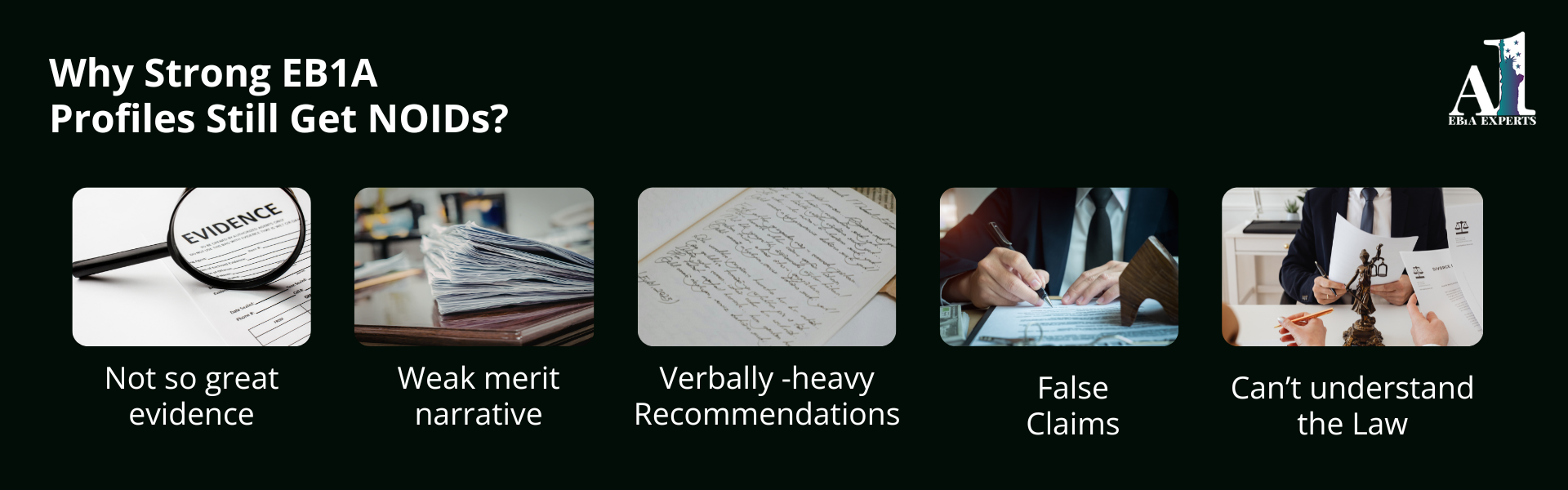
4. Why Strong EB-1A
Profiles Still Get NOIDs
Most EB-1A denials have nothing to do with the achievements themselves but with how they are
presented.
First, your Evidence Is Great — But Doesn’t Meet The Requirements.
Filing based on the resume often does not truly connect the evidence provided to the actual regulatory
criteria and thus leads to an insufficient evidence finding.
Second, Your Final Merits Narrative Is Weak
Listing your achievements is just the beginning. USCIS wants to see why your evidence proves you are
at the very top of your field.
Third, You Have Over-Reliance On Recommendation Letters
Using a generic immigration recommendation letter or immigration reference letter that repeatedly
lists your resume without offering independent analysis creates issues related to the credibility of
the EB-1A petition.
Fourth, You Are Making Claims That Lack Specificity And Are Inflated
Using unverifiable metrics, broad industry statements, or unsupported "global impact" claims decrease
the credibility of the claimant.
Fifth, You Do Not Understand The Law
Merely meeting three criteria will not guarantee approval. The last merit review controls the overall
determination and is where most EB-1A petitions are denied.
5. The Most Common NOID Triggers in EB-1A Petitions
Even a well-qualified candidate could have their EB-1A petition challenged (NOID) because of evidence
quality
concerns/aspects:
- The original contribution narrative is weak or generic
- The publication does not demonstrate real-world evidence of impact.
- Citation information lacks context and/or comparative measurements
- The award does not communicate how it was awarded (clear criteria).
- The judge cannot prove that (and how) their role was selective/influential.
- The press coverage is promotional instead of independent.
- The letters are not truly from independent experts.
Each of these will be related to how the evidence is presented and not based on the strength of the
petitioner's profile.
6. Can a NOID Be Avoided?
Yes — often!
The most effective techniques used to prevent a NOID from occurring are to:
- Create the evidence before submitting for an EB-1A
- Map your evidence based on the specific criterion being used
- Create an effective narrative that captures all of the above information
- Find experts who are independent and have qualifications that support their claims
Prevention is not due to luck, it is a choice made during the design of the EB-1A application.
7. How EB-1A Experts Prevent NOIDs Before Filing
The risk of losing your EB-1A case increases for those who receive a NOID; however, many EB-1A cases
are approved
after they provide a response to a NOID as long as the response meets quality standards.
When do I have to respond to a NOID?
Typically 30–33 days. You must act quickly, there is not enough time to start over.
What if I was denied an EB-1A?
There are many options when your EB-1A has been denied:
- Refiling based on a new strategy rather than using previously submitted evidence.
- Addressing the reasons your EB-1A was denied in the previous submittal.
- Filing a motion or appeal (case-specific).
8. Prevention Is Cheaper Than Repair
- A NOID signals structural weakness, not lack of talent.
- Strong profiles still need strong legal framing.
- Front-loaded strategy saves time, stress, and money.
-
A careful evaluation helps you understand risk before filing — and before checking USCIS
case status
in panic.
9. FAQs
1. What is a NOID in EB1A?
A Notice of Intent to Deny (NOID) is a formal warning from USCIS stating your EB1A petition
will be
denied unless
you successfully resolve identified deficiencies within a strict deadline.
2. Is a NOID worse than an RFE?
Yes. A NOID means USCIS has already concluded you fail the final merits test, while an RFE simply
requests
additional evidence before a final decision is reached.
3. Why does USCIS issue NOIDs in EB1A cases?
NOIDs are commonly issued due to weak final merits arguments, poor evidence-to-criteria linkage,
credibility
concerns, or failure to clearly demonstrate sustained national or international acclaim.
4. Can a NOID be avoided?
Often, yes. Strong upfront case strategy, precise criteria mapping, expert-led narratives, and
anticipatory final
merits framing significantly reduce the risk of a NOID being issued.
5. How do you respond to a NOID?
A NOID requires a meticulous, point-by-point legal response that rebuts USCIS conclusions,
restructures the final
merits argument, and clearly proves extraordinary ability with authority and clarity.
6. Does a NOID mean EB1A denial?
No. A NOID is not a denial, but approval depends entirely on the strength, precision, and legal
reasoning of your
response. There is no room for generic explanations.
7. How long do I have to reply to a NOID?
Most NOIDs allow 30 to 33 calendar days from the notice date. Missing the deadline or submitting a
weak response almost guarantees denial.
If you’ve received a NOID or want to ensure you never do, this is not the time for guesswork. EB1A
outcomes hinge on strategy, structure, and final merits mastery. A properly handled response can
reverse denial intent and secure approval. Get expert eyes on your case before the clock runs out.





 January 07, 2026
 3 min read