1. Introduction: The EB1A Timing Question Everyone Asks Too Late
If you are considering applying for an EB1A
Green Card and have wondered when the correct time is to
seek
professional guidance, you have landed on the right page. Most high-skill professionals treat the EB1A
“Extraordinary Ability” visa as a “finish-line” activity. They believe guidance is only necessary
after
they have
completed their profile. This is perhaps the most common strategic error in the immigration journey.
While impressive credentials are the foundation of any case, many strong profiles fail because they lack
a
cohesive narrative that connects achievements to the specific legal standards USCIS uses. The EB1A is
not just a
form you file; it is a narrative you build over time, backed by objective evidence. Waiting until you
are ready to
file often means you are trying to fix a story that has already been written. Clarity before you commit
to a legal
path is often the missing piece.
2. The Common Timing Myth: “I’ll Get Help When I’m Ready”
To most applicants, “ready” means reaching a self-imposed milestone: three more publications, a specific
industry
award, or a promotion to “Director.” They assume a stronger resume makes approval automatic.
That assumption is faulty. Here is why:
USCIS does not evaluate readiness by the prestige of your title or publication count alone. They look
for specific types of evidence, such as "original contributions of major significance" and the
industry-wide impact of your work.
Petition success comes when you can explain the impact of your role within your organization. Waiting
for a senior promotion may waste valuable time that could be used to tighten your narrative.
Furthermore, you might spend years focusing on achievements that impress a boss but carry little weight
with an immigration officer. Conversely, you might overlook small, highly relevant opportunities that
satisfy specific EB1A criteria.
3. How USCIS Actually Thinks About EB1A Readiness?
To succeed, you must look beyond the EB1A ten criteria checklist. Since the landmark Kazarian
v. USCIS case, officers use a two-step review.
First, they count your evidence to ensure you meet at least three criteria.
Second, they perform a Final Merits Determination.
In this second step, they evaluate the "totality of the evidence." They aren't just asking if your work
is "impressive"; they are looking for a sustained trajectory of influence rather than isolated wins.
Most denials or RFEs (Requests for Evidence) occur not because of missing achievements, but because
those achievements were not positioned to showcase sustained impact. This is where early guidance helps;
it allows you to interpret evidence through this specific lens before it is too late to adjust.
4. Three EB1A Applicant Stages: Where Timing Goes Wrong
It is essential to understand how to avoid judgment errors while building your profile. Here are the
three stages:
Stage 1: Early High-Skill Professionals
You have a strong trajectory but limited independent recognition. You likely think it is “too early” for
guidance.
The misjudgment here is waiting for a big break instead of strategically choosing projects that satisfy
“critical
role” or “authorship” criteria.
Stage 2: Mid-Career Professionals
You have solid credentials and leadership experience. The error here lies in assuming a senior title
automatically
proves extraordinary ability. You often need guidance on how to transition from “successful employee” to
“influential expert” in the eyes of USCIS.
Stage 3: Senior Professionals & Founders
You have a significant number of achievements. The mistake here is thinking that more documentation
equals a
better case. Without a clear, evidence-backed narrative, 500 pages of evidence can look like “noise” to
an officer,
leading to a denial based on a lack of focus.
5. The Hidden Cost of Getting EB1A Guidance “Late”
Late-stage guidance is often like bringing a patient, who needs an immediate ICU admission, to an
outpatient clinic.
As funny as that sounds, the point is serious:
If you wait until you are ready to file, you may realize your most significant work was never documented
with the specific evidence, reference letters, or impact data that USCIS requires.
The financial cost of an RFE or a denial is high, but the emotional cost is higher. Rushing to fix a
narrative under pressure leads to mistakes. Early clarity acts as a preventive measure, reducing the
risk of rejection by identifying gaps while you still have months, or even years, to fill them
naturally.
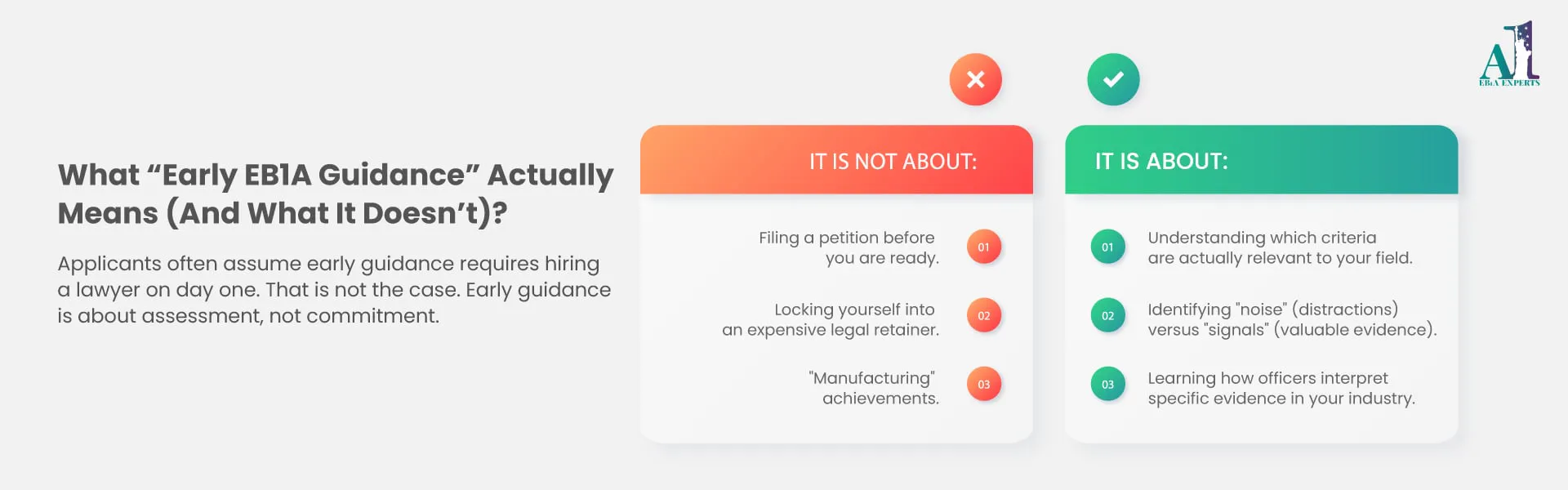
Applicants often assume early guidance requires hiring a lawyer on day one. That is not the case. Early
guidance
is about assessment, not commitment.
It is NOT about:
Filing a petition before you are ready.
Locking yourself into an expensive legal retainer.
“Manufacturing” achievements.
It IS about:
Understanding which criteria are actually relevant to your field.
Identifying “noise” (distractions) versus “signals” (valuable evidence).
Learning how officers interpret specific evidence in your industry.
7. Why Self-Assessment Alone Is Usually Not Enough?
Many professionals rely on Reddit, forums, or generic blogs for guidance. While these seem helpful, they
cannot
help you contextualize your unique achievements within your specific field.
It is incredibly difficult to judge “comparative distinction” in your own career. Applicants often
suffer from
humility bias, underestimating their impact, or insider bias, assuming a niche award is
famous just
because their
colleagues recognize it. You don’t just need a list of rules; you need a framework to evaluate your
profile
accurately.
It is helpful to frame your EB1A journey as a four-part progression: Awareness,
Assessment,
Preparation, and Filing.
The right time for guidance is during the Assessment phase. This should happen the moment you decide an
EB1A is a future goal. By the time you reach the Preparation phase, your narrative should be clear and
your evidence should already be organized.
9. Where Guided Platforms Fit Into This Journey?
Modern professionals need a middle ground between “doing it alone” and “hiring a law firm.” There is a
growing
need for structured, self-paced environments where you can evaluate your readiness without sales
pressure.
That is where our upcoming guided platform may come to your rescue.
Platforms like ours allow you to organize evidence systematically, helping you understand if you are
truly “ready”
to hire a lawyer or if you should spend six more months building specific impact data. This empowers you
to make
decisions based on data, not guesswork.
10. Conclusion: Start With Clarity, Not Commitments
Success in the EB1A category depends on the strength of your evidence, but it is equally about the
timing of your
strategy. The smartest applicants don't rush into filing, nor do they delay their planning blindly.
They start by getting an objective view of where they stand today. Early clarity is the key to confident
decisions
and a higher chance of approval.
If you are ready to move beyond the checklist and seek structured guidance to assess your path with
precision, you
can book a free consultation with EB1A
Experts.
11. FAQs
Q. How many achievements do I need to start getting guidance?
There is no minimum threshold. Early guidance helps you identify which ongoing projects, recognitions,
or roles can become EB1A evidence, even if you currently have only one or two strong achievements to
build upon strategically with future-focused planning and clarity.
Q. Does “narrative” mean I can get approved without meeting 3 criteria?
No. You must still satisfy at least three of the ten objective criteria. Narrative strength matters in
the final merits stage, where you explain why those criteria together demonstrate sustained national or
international extraordinary ability, recognized professional impact, and leadership.
Q. Is it better to wait until I have a “major award”?
Not necessarily. Most successful EB1A cases rely on three to five so-called lesser criteria. Waiting for
a major award can delay years, while existing work may already qualify when positioned, documented, and
contextualized correctly through expert guidance, structured review, and early.
Q. Can I use a guided platform if I already have a lawyer?
Yes. Guided platforms complement legal teams by helping you organize evidence, clarify positioning, and
map criteria early. This preparation often results in clearer case narratives, fewer revisions, and more
efficient collaboration with your attorney before filing, reducing risk and stress.
Q. When should I start EB1A strategy planning?
You should start strategy planning as soon as you see a consistent impact in your field. Early planning
aligns future work with EB1A criteria, prevents evidence gaps, and reduces rushed filings later when
timelines or visas become urgent, stressful, and costly.
Not sure where you stand today? Start with a structured EB1A profile review and see how
your current work can be positioned strategically—before time becomes the biggest risk.





 December 24, 2025
 3 min read