Many top professionals believe that applying for an EB1A visa will be a
straightforward, if not
guaranteed,
process. As a top performer, you have undoubtedly built teams, developed your field of study, and had
significant
accomplishments attributed to you—as well as other leaders—in your industry.
Unfortunately, you aren't alone in the number of times you received: strong EB1A profile denied.
This is not to say that your accomplishments are any less important or that no one can recognise your
work; it is simply that EB1A Denials are a matter of EB1A case
positioning mistakes. Most applications are denied for this reason, and therefore, the
information above is meant to show you where those mistakes were made so you can avoid them in the
future.
2. The Dangerous Assumption: “My Work Speaks for Itself”
The first problem with the EB1A process is the assumption that "my work speaks for itself." As a
successful
individual, you may have been raised to believe this idea of professional success, while in reality,
this
statement is completely incorrect; when applying for an EB1A visa, it is far more likely that the
Immigration
Officer reviewing your application does not have experience in your field of work.
As such, it is very difficult for them to be able to gauge whether you have made an impact through your
work.
Therefore, the immigration officer must rely on how you present your application, which ultimately
determines if
you will have a successful EB1A
visa application.
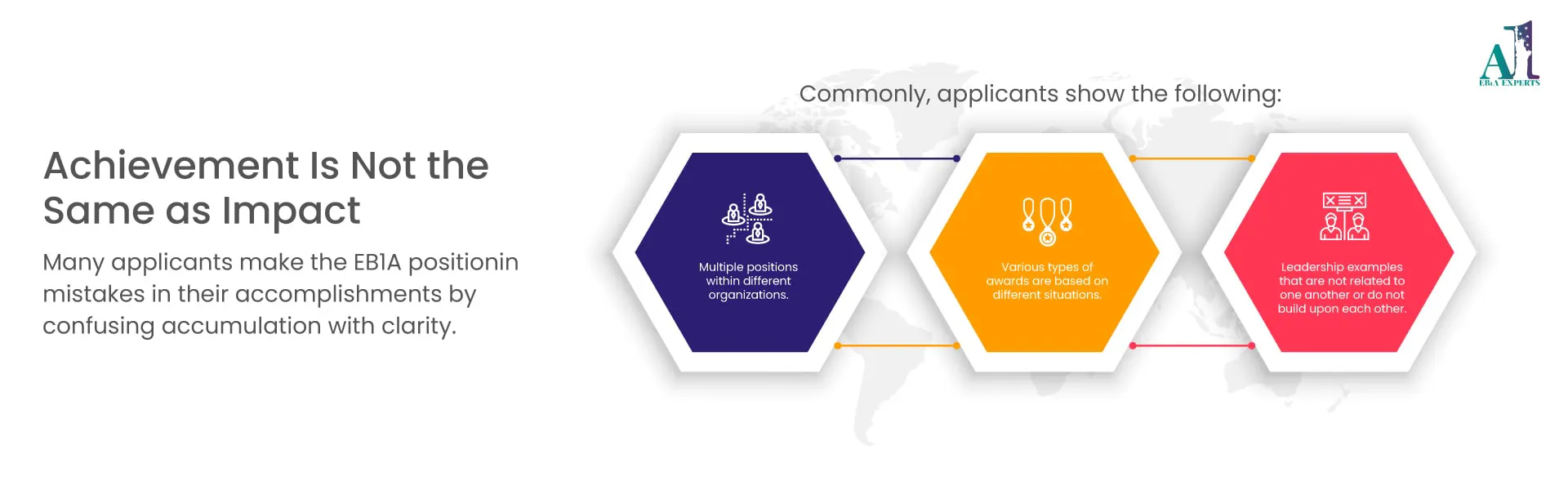
3. Achievement Is Not the Same as Impact
Many applicants make the EB1A positioning mistakes in their accomplishments by confusing
accumulation with clarity.
Commonly, applicants show the following:
Multiple positions within different organizations.
Various types of awards are based on different situations.
Leadership examples that are not related to one another or do not build upon each other.
The only thing missing is not the quality of work performed but the impact of the work performed.
The evaluating officer does not evaluate a candidate based upon quantity of achievement. He or she
evaluates
whether an applicant has created an impact through their contributions, whether the impact they have
created was
of a sustained and differentiating nature, and whether or not the contributions can be associated with
one
another or are cohesive.
Without a cohesive link among their accomplishments, applicants create a situation in which their
achievements
compete rather than support one another. This is one of the common EB1A denial reasons.
4. Why EB1A Case Positioning Matters More Than Most Realize?
At its most basic level, EB1A is not a résumé review of your past accomplishments. EB1A is a comparative
analysis
of the relative value of your contributions based upon your stage in the career progression of your
chosen
vocation, and it is done by comparison with individuals in similar stages of their respective careers.
The EB1A officer is evaluating your accomplishments through the lens of whether or not the applicant has
created sufficient impact to rise above others who are applying at the same stage in their respective
careers. This is where EB1A case positioning distinguishes between an approval and adenial. A
strong candidate will often not be able to clearly and unequivocally respond to one important question:
“What am I known for, and why does this matter nationally or globally?” When this question is left
implicit, the officer must infer. And inference, under time pressure, rarely works in the applicant’s
favor.
These make significant theme errors outside the guidelines, which enables the evaluation of otherwise
strong
cases.
1. Qualified versus Impactful — Many resumes reflect an individual's qualifications; however,
they do not provide any concrete evidence of their impact, such as "accomplished leaders" vs. "impactful
leaders". Resumes typically include the job title, but fail to provide any context as to how this title
produced a result at a level beyond the job description. Officers will typically look at fields of
experience and confirm the size of the organization in relation to the applicant's accomplishments to
determine relevance to the EB1A process.
When an officer is not able to determine how the applicant's accomplishments were relevant to the
applicant's
field of study, the officer is likely to identify EB1A strategy errors very quickly.
2. Giving Prestige Instead of Explanation — Employers will often provide examples of employers
and organizations that are globally recognized and famous. However, this is just context for the officer
without any type of narrative that describes how these entities produced value. Prestige alone does not
necessarily infer increased value; without a narrative that supports the prestige, the applicant's
achievements will not be viewed as exceptional; hence, EB1A cases fail through the classification
process.
3. Disparate Professional Themes across All EB1A Criteria — Many applicants demonstrate many of
the EB1A criteria as separate items.
An example of this is:
Leadership "Here"
Recognition "There"
Published/Original Contribution: "Somewhere."
This results in an applicant who has many professional accomplishments but fails to create a coherent
professional theme; thus, the eventual outcome is an applicant who has an overly contributing appearance
rather than a strong, distinctive profile, resulting in an EB1A positioning mistake.
6. Why Officers Struggle With “Impressive but Unclear” Cases?
Most people think that officers will deny a case because an applicant’s profile does not reach the level
of
achievement that has created doubt in the officer’s mind. Officers don’t deny because of doubt; they
deny because
they are faced with uncertainty.
If an applicant's profile requires a large amount of interpretation, comparison, or reconstruction, then
confusion
or doubt will become heightened. Under these circumstances, denials will logically become the “safest”
option for
the officer to pursue. As you can see, many EB1A denial reasons remain vague subjectivities that are
explained by
this dynamic.
By effective EB1A case positioning, you will reduce the effects of cognitive friction on the
applicant's
ability
to produce notable cases. Clear and easily understood positions create a very strong influence and are
much harder
to refute than weakly positioned but strongly proven cases.
7. What Do Strong Cases Clearly Answer?
Many applicants place a large amount of their focus on proving how strong they are.
Successful cases provide evidence of the clarity of one's identity.
Rather than asking if the profile is strong enough, applicants are implicitly answering a critical question: “What are the things that I will be broadly (or very) well known for, and how does the way that I do my job impact the world outside of my organization?”
This re-framed thinking will eliminate many EB1A strategy errors. The strong position of the
evidence, the clarity of the story, and the comparative importance are the basis for the establishment
of successful EB1A case positioning.
8. When Evidence Exists Without Narrative Gravity?
Evidence does not inherently compel belief. In strong cases, there is a defined center to the
professional
accomplishments presented by applicants. The various items reinforce a singular theme. For officers
reviewing the
cases, there is a feeling of clarity instead of overwhelming amounts of information.
In weak cases, evidence is presented in a disconnected manner, that is, a side-by-side presentation of
evidence without any relationship to one another. Consequently, when applicants receive a strong EB1A
profile denied, they are often stunned, as they incorrectly believe that the sheer volume of
evidence they submitted will lead to a successful application. These disconnected presentations are
characteristic of the EB1A positioning mistakes that detrimentally impact even the strongest
credentials.
9. The Comparative Lens Applicants Often Miss
The evaluation of the EB1A will always be comparative. The officers review a comparative lens by asking
themselves:
Does this person produce direction or merely function under it?
Does this person influence other people and situations beyond the immediate influence of their work?
Does this person's contribution cause others to follow them?
If an applicant fails to respond to these implicit questions directly, the officer develops his or her
own conclusion based on the information provided and may possibly form an unfavorable assumption as to
the applicant's qualifications. It is this misunderstanding of their application that leads most
applicants not to recognize the EB1A denial reasons until after
their applications are denied.
10. Strong Profile vs. Strategically Positioned Profile
Strong Profile
Strategically Positioned Profile
Lists accomplishments
Explains why accomplishments matter
Multiple impressive roles
Coherent professional identity
Relies on prestige
Translates significance
Evidence-heavy
Meaning-driven
Assumes clarity
Engineers clarity
The difference is not merit. It is an EB1A case positioning.
11. Why Refilling Without Repositioning Often Fails?
After receiving a denial, many people will have the urge to provide more of everything.
An extended list of achievements, honors, and awards,
An extended list of documents that validate the information above.
When extra evidence is submitted without addressing the original EB1A positioning mistakes, there
is usually no change from the initial decision. In most cases, additional confusion is created about the
EB1A application. This cycle of submissions with no change in position occurs more often than any other
EB1A strategy error, and it is the most common reason EB1A applications are denied or abandoned.
An EB1A application that is poorly positioned reflects not only in delays and lost potential but also in
the
psychological aspects of a career or profession. Professionally, the individual made significant
contributions and
had a positive impact on society. However, after receiving a denial, the EB1A candidate has little, if
anything,
indicating that the individual has positively impacted their given profession. In the majority of cases,
a strong
EB1A profile denial is not a verdict on worth. It is feedback on positioning.
13. Rethinking EB1A as a Positioning Exercise
The most effective EB1A applications do not simply focus on impressiveness; they focus on clarity. The
strongest EB1A applications are able to combine the individual's identity, evidence Listing, and
influence into a cohesive story that allows the immigration officer to quickly and confidently assess
the application. They view EB1A application positioning as part of a strategic exercise rather than
simply a procedural step.
By adopting a positional approach to EB1A applications, applicants can address many of the reasons for
an EB1A denial before they arise.
14. Conclusion: Excellence Needs to be Interpretable to Be Recognized
While obtaining an EB1A approval is not an event based on exceptional performance, rather it is about an
applicant making their exceptional work unmistakable through how the immigration officer evaluates it.
Many of the reasons for denials of an EB1A application result from poor positioning of the applicant’s
excellence, as opposed to sheer lack of achievement. When excellence is positioned clearly, many strong
profiles will not be denied. Merit opens the door to EB1A, but it is the position of an EB1A application
that will determine if that door remains open or shuts.
15. FAQs
1. If my profile is strong, why would my EB1A case still be denied?
A strong profile can still face EB1A denial when achievements are not clearly interpreted through
USCIS’s evaluative
lens. Officers deny cases when impact, relevance, or field-level significance is implied rather than
explicitly
demonstrated and connected.
2. What is the most common EB1A positioning mistake applicants make?
The most common EB1A positioning mistake is assuming accomplishments speak for themselves. USCIS
officers require
applicants to clearly explain why their work matters beyond internal success and how it influences the
broader
field or industry.
3. Can meeting multiple EB1A criteria guarantee approval?
No. Meeting multiple EB1A criteria does not guarantee approval if the evidence lacks coherence. USCIS
evaluates how
achievements collectively demonstrate comparative distinction and sustained impact, not how many
individual criteria
boxes are checked.
4. Does employer-driven evidence weaken an EB1A case?
Employer-driven evidence can weaken an EB1A case if framed narrowly. When achievements appear valuable
only within
one organization, officers may struggle to see independent influence, broader recognition, or
field-level
importance required for approval.
5. Are recommendation letters enough to establish extraordinary ability?
No. Recommendation letters support an EB1A case but cannot establish extraordinary ability on their own.
Without
objective evidence and clear positioning that demonstrates influence and significance, letters are
treated as
supplementary rather than determinative.
6. Can a poor case strategy hurt future EB1A attempts?
Yes. Repeating the same EB1A positioning mistakes can lead to repeat denials, even with stronger
credentials. Prior
denials create a record, making it critical to correct narrative gaps rather than resubmit similar
evidence.
7. How do I know if my EB1A issue is positioning rather than credentials?
If your accomplishments are strong but USCIS feedback cites lack of clarity, significance, or impact,
the issue is
likely EB1A case positioning. This indicates narrative misalignment rather than insufficient merit or
qualifications.
A strong EB1A profile deserves a strategy that explains why it matters, not just what you’ve done.Before
you file or refile - get clarity on whether your case issue is positioning, narrative, or evidence
hierarchy.





 December 17, 2025
 3 min read