You documented your achievements, crafted a compelling narrative, and filed with
confidence.
Then USCIS responded.
Not with an approval, but with a Request for Evidence (RFE).
If this feels like your story, do not worry.
While an EB1A RFE may feel like a serious setback and leave you disappointed or anxious, it is better
understood as a predictable checkpoint in the EB1A process.
EB1A green card RFEs are not issued randomly. They follow clear, repeatable patterns tied to how USCIS
officers currently assess credibility, impact, and sustained acclaim. Applicants who understand these
patterns can design petitions that anticipate scrutiny rather than react to it.
This blog will help you understand the most common reasons behind USCIS EB1A RFEs,
using data-driven
insights, and will clarify what steps you should take if you receive one.
2. What the Data Shows: EB1A RFE Distribution by Criterion
Recent EB1A 2025 adjudication trends indicate that EB1A RFE rates now fall between 40 and 50 percent. At
the same time, overall approval rates remain relatively steady at around 67 percent.
This means that many successful cases now require a second round of review.
Yes, you read that right.
Even if you file an EB1A petition that thoroughly and effectively addresses USCIS criteria, you may
still
receive an RFE if adjudicators believe certain aspects of your case require further clarification or
substantiation.
Here is what the data reveals.
A quantitative review of case data, aligned with publicly observable USCIS trends, shows that RFEs are
unevenly distributed across the ten regulatory criteria.
Nearly 72 percent of RFEs concentrate on just five categories. Two criteria consistently receive the
highest level of scrutiny:
Original Contributions of Major Significance
Leading or Critical Role for a Distinguished Organization
Secondary RFE triggers include scholarly publications, judging or peer review, and awards or prizes.
The implication is straightforward. While it may be relatively easy to claim a criterion, it is
increasingly difficult to prove its impact with reliable evidence in a way that satisfies a skeptical
adjudicator.
3. Why Certain Criteria Trigger More RFEs?
The increase in RFE rates does not signal a decline in applicant quality. Instead, it reflects a shift
in adjudication philosophy. USCIS officers are no longer satisfied with a checklist-style review. They
are applying an EB1A Final Merits Determination approach, evaluating whether the totality of the
evidence demonstrates sustained national or international acclaim.
Because the EB1A green card is merit-based, adjudicating officers take additional care to ensure that
merit is convincingly established in every petition they review.
Below are the criteria most likely to trigger an RFE.
1. Original Contributions: The “Major Significance” Gap
This is the most common RFE trigger and frequently appears as an EB1A original contributions RFE.
Applicants often submit patents, software products, or technical innovations without independent
validation or clear evidence of their impact on the field.
From the officer’s perspective, the core questions are simple: Does the field actually use this work?
And what makes it genuinely original?
Without corroboration from independent experts, evidence of adoption, or measurable downstream impact,
even impressive technical achievements remain vulnerable to challenge.
Key takeaway: Evidence of adoption and measurable impact on the broader field is essential to
establishing original contributions of major significance.
2. Leading or Critical Role: The Title Trap
Another frequent pressure point is the EB1A leading or critical role RFE. Senior job titles alone
are no longer persuasive. RFEs in this category often question whether the organization itself qualifies
as “distinguished” on a national or international scale.
If that threshold is not clearly established, the applicant’s role, regardless of seniority, may be
dismissed as internally important but externally insignificant.
Key takeaway: What matters is not just your title, but the stature and reputation of the
organization you work for.
3. Publications: Influence Over Volume
In 2025, quantity has lost much of its persuasive power. A long list of publications with low citation
counts is more likely to raise concerns than a smaller number of highly influential papers.
Adjudicating officers are trained to identify predatory journals and low-impact outlets. Their focus is
on how your work has shaped subsequent research or professional practice.
Key takeaway: The emphasis is not on how many articles you have published, but on how often they
are cited and the influence they have had on your field.
4. RFE Outcomes: What Happens After You Respond
Receiving an RFE can trigger panic and self-doubt. However, it is important to remember that an RFE is
not a signal of impending denial, nor does it mean your profile is insufficient.
Data shows that roughly 60 percent of EB1A cases receiving an RFE result in EB1A approval
after
RFE, provided the response is handled strategically and includes meaningful revisions.
The difference lies in approach. Many applicants respond by submitting additional documents similar to
those already questioned. Successful responses take a different path. They reposition existing evidence,
reframing it through third-party metrics, independent validation, and clearer causal links between the
applicant’s work and its broader impact.
Strong RFE responses are not merely additive. They are structural and significantly enhance the
presentation of your achievements.
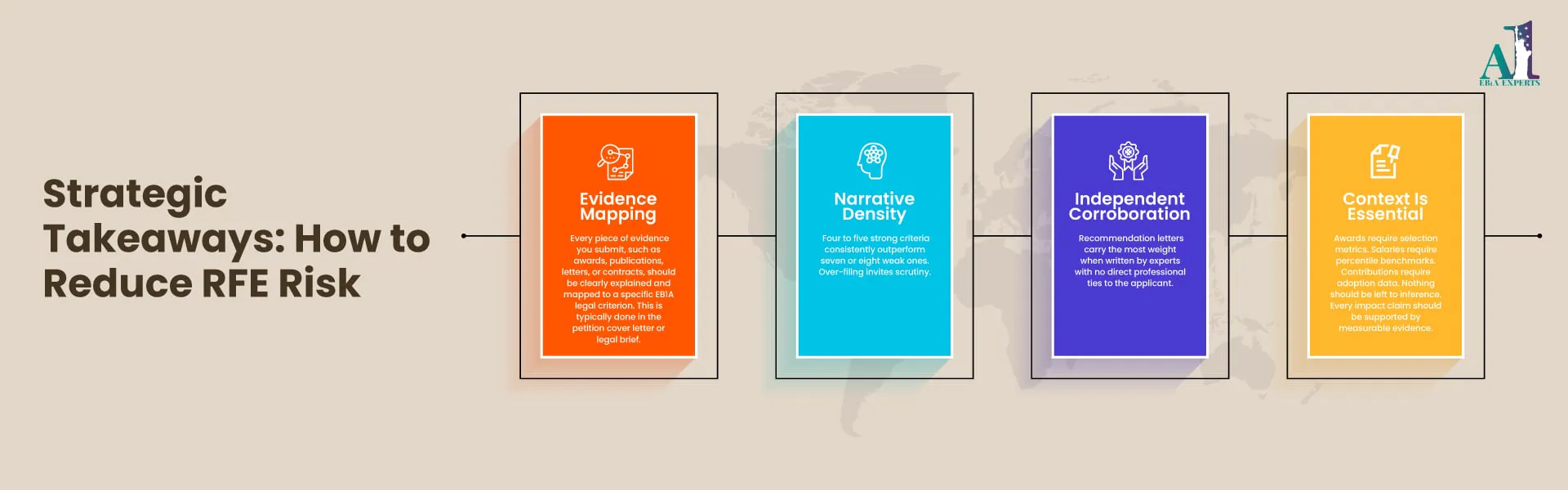
5. Strategic Takeaways: How to Reduce RFE Risk
The most effective EB1A petitions are built as if an RFE is inevitable. This defensive filing mindset
significantly increases the likelihood of a straight approval.
Evidence Mapping: Every piece of evidence you submit, such as awards, publications, letters, or
contracts, should be clearly explained and mapped to a specific EB1A legal criterion. This is
typically done in the petition cover letter or legal brief.
Narrative Density: Four to five strong criteria consistently outperform seven or eight weak
ones. Over-filing invites scrutiny.
Independent Corroboration: Recommendation letters carry the most weight when written by experts
with no direct professional ties to the applicant.
Context Is Essential: Awards require selection metrics. Salaries require percentile benchmarks.
Contributions require adoption data. Nothing should be left to inference. Every impact claim should be
supported by measurable evidence.
When evidence is properly contextualized, the petition reads less like a résumé and more like a coherent
legal argument.
6. An RFE Is Not the End: A Case That Ended in Approval
Kartik (name changed), a senior software development manager at IBM, applied for the EB1A green card
with
a strong professional profile. His credentials clearly reflected extraordinary ability, and his evidence
was substantial. Confident in his preparation, Kartik expected an approval in the first round.
Instead, he received a Request for Evidence (RFE).
The RFE focused on one familiar pressure point: Original
Contributions of Major Significance.
While Kartik had documented his work thoroughly, USCIS sought clearer proof of impact beyond his
organization, along with stronger validation of how his contributions influenced the broader field.
Naturally, the RFE was disappointing. But rather than viewing it as a rejection, Kartik treated it as a
roadmap.
He revisited his petition with a critical lens, addressing every gap highlighted by USCIS. The response
strengthened the narrative, clarified the originality of his work, and introduced concrete impact
metrics
and independent validation. No assumption was left unexplained. No claim was left unsupported.
The result was decisive. Kartik’s I-140
petition was approved.
Moral of the Story: An RFE is not a dead end. It is an opportunity to tighten the narrative,
reinforce impact, and present your case in a way that aligns precisely with USCIS expectations. When
handled strategically, an RFE can be the step that turns a strong profile into an approved petition.
7. Conclusion
The question is no longer whether you meet the EB1A standard, but whether your petition proves it
convincingly under current USCIS scrutiny. RFEs expose gaps in narrative, evidence, context, and
validation, not necessarily gaps in ability.
A structured, expert-led assessment can identify these vulnerabilities early and help you address them
before they become procedural obstacles. For applicants seeking predictability in an increasingly
exacting process, preparation remains the single most valuable advantage.
If you want to understand where your profile is strong, where it may be vulnerable, and how USCIS is
likely to evaluate it, a structured assessment can make the difference between delay and approval.
8. FAQs
Does an RFE mean my case is likely to be denied?
No. Approximately 60% of EB1A RFEs result in approvals when the response is handled with
strategic, high-quality evidence.
Which EB1A category is the hardest to prove?
Original Contributions of Major Significance is statistically the most difficult, as it
requires proof of external impact beyond your employer.
Can I use the same evidence for NIW and EB1A?
While the evidence may overlap, the legal standards differ. EB1A requires sustained acclaim,
which is a much higher bar than the NIW's national importance.
Would you like a professional assessment of your EB1A profile?
Schedule a structured profile audit with EB1A experts to identify and address potential RFE triggers
before you file.





 December 17, 2025
 3 min read