You built a strong career, earned trust inside your organization, and became the person teams rely on
when things actually matter.
Yet when it comes to U.S. permanent residency, your future still feels fragile. One policy shift, one
missed lottery and everything you have built feels suddenly conditional.
For senior engineers, researchers, product leaders, and specialists operating at the top of their
fields, this uncertainty is exhausting. You are valuable, visible, and in demand, but your immigration
status remains tethered to an employer, a PERM timeline, or pure chance. Over time, that dependency
quietly convinces you of something even more limiting: that this is just how the system works for
someone like you.
Most professionals in this position dismiss the idea of a self-petitioned green card almost instantly.
“That’s for Nobel Prize winners.”
“That’s for famous founders.”
“That’s not me.”
And what not.
But in practice, the obstacle is rarely a lack of qualification. It’s a lack of translation. USCIS
doesn’t measure brilliance the way resumes or performance reviews do.
The real gap isn’t between you and the green card. It’s between your actual impact and how that impact
is framed, documented, and argued.
The term "Extraordinary Ability" is often misinterpreted as a requirement for celebrity status or
academic fame.
In a professional context, however, USCIS uses it as a technical benchmark for sustained impact.
They aren't looking for famous faces; they are looking for professionals whose work has influenced their
field beyond the walls of a single company.
Adjudicators look for independent validation, which is evidence that your peers or other organizations
rely on your contributions to move the needle. Many professionals meet these standards without realizing
it because their resumes are designed to get them hired, not to prove their industry-wide standing. The
EB-1A green card is not about your personal fame or social media following. It’s about the measurable
change your work has created in your specific field of expertise.
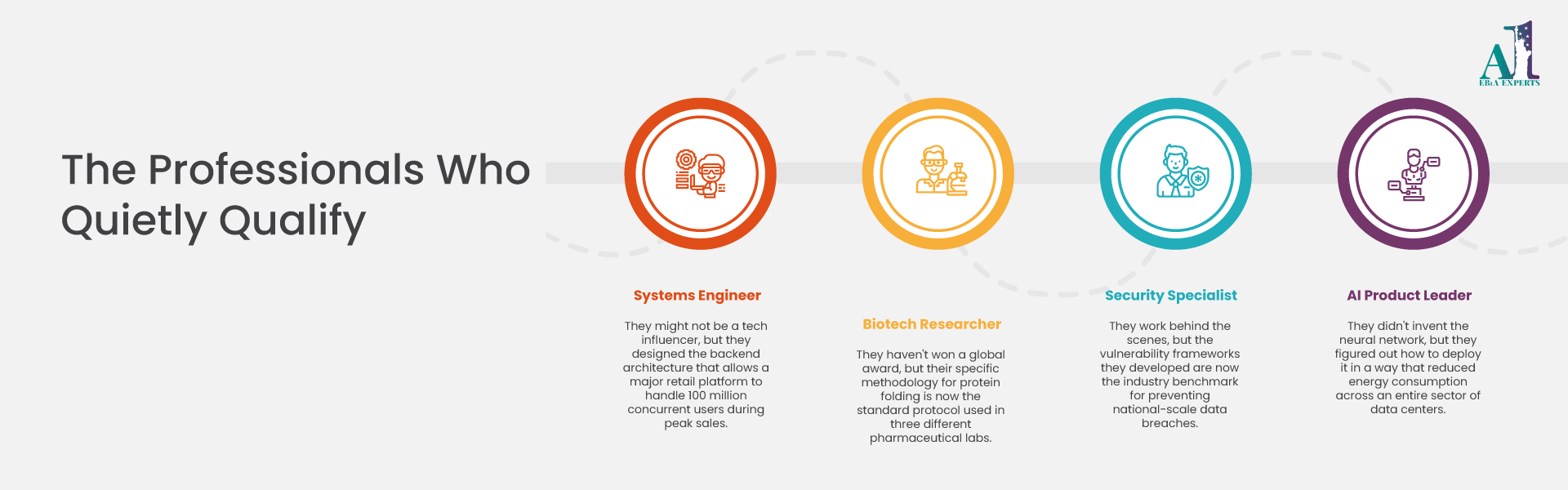
3. The Professionals Who Quietly Qualify
“Who are these invisible extraordinary individuals?” you might wonder.
They aren’t noble prize winners. They are professionals, like you, who form the backbone of modern
industry. Most professional who apply and qualify for EB1A green have the following titles:
Systems Engineer: They might not be a tech influencer, but they designed the backend
architecture that allows a major retail platform to handle
100 million concurrent users during peak sales.
Biotech Researcher: They haven't won a global award, but their specific methodology for protein
folding is now the standard protocol used in three
different pharmaceutical labs.
Security Specialist: They work behind the scenes, but the vulnerability frameworks they
developed are now the industry benchmark for preventing
national-scale data breaches.
AI Product Leader: They didn't invent the neural network, but they figured out how to deploy it
in a way that reduced energy consumption across an
entire sector of data centers.
Key Takeaway: If your work shapes outcomes at scale, you already have the foundation for a case.
Impact exists long before a green card strategy is ever formed; the goal is simply to document that
influence effectively and consistently.
4. Why Most Self-Assessments Fall Short
It is common for professionals to be their own toughest critics. Many talk themselves out of applying
because they compare their daily work to the absolute giants
of their field. This mindset isn’t helpful. Waiting until your profile feels perfect is one of the most
common mistakes you can make.
When an officer reviews a file, they aren't just looking for greatness in the abstract. They are looking
for answers to specific, functional questions:
“Who relies on this person’s work?”
“How is that reliance documented?”
“What would the industry lose if this person’s work disappeared tomorrow?”
Eligibility isn't found by checking boxes on a website. It is uncovered through a structured mapping of
your professional fingerprints and the ripple effects they
have caused across your industry.
5. The Two-Layer System: Criteria vs. Final Merits
Understanding the EB-1A requires navigating a two-part legal test.
Layer 1 is the quantitative phase, where you must meet at least three of the ten regulatory
criteria,
such as a high salary, original contributions of major significance, or a leading role in a
distinguished organization.
However, the real challenge lies in Layer 2, known as the Final Merits Determination. This is
where a
case is judged on its overall quality and the evidence of sustained acclaim. Many petitions pass the
technical requirements of Layer 1 but fail in Layer 2 because they lack not just a cohesive story backed
by reliable evidence. You can provide the documents, but without a narrative to connect them and explain
the overall impact of your work, the officer may not see the full picture.
Approvals are built with a powerful narrative that has a solid evidence-based foundation.
You aren't just submitting a folder of facts; you are submitting a thesis on your own relevance to the
United States. That thesis should be convincing enough for the USCIS to consider you an “extraordinary
individual”.
6. Evidence Is Not Enough Until It’s Framed and Positioned Well
A common pitfall is assuming that the sheer volume of documents, such as more charts, more code, or more
emails, will win you a green card.
Screenshots and internal awards show that you are active, but they don't necessarily prove you are
influential. To turn activity into proof, you need to provide context and explain the impact of your
work.
For example, compare these two approaches:
The Regular Approach: "I built a machine learning model for fraud detection."
The EB-1A Approach: "I developed a machine learning framework that reduced false-positive fraud
alerts by 40% across three major banking clients,
saving an estimated $20M in operational costs and becoming the new standard for the firm’s global
security suite."
Evidence becomes persuasive only when it explains why your work matters to people outside of your
immediate team.
It’s about showing the market-level consequences of your presence in the field.
7. Narrative Development: Turning History Into a Story
Adjudicators do not evaluate petitions like HR evaluates resumes; they approve believable impact stories
supported by reliable evidence.
A successful petition requires a clear narrative architecture that avoids a dry, chronological history
of your jobs. Instead, it follows a logical flow of influence:
Field of Expertise: What specific niche do you dominate?
Core Problem: What major industry challenge are you solving?
National Importance: Why does solving this problem matter to the U.S. economy or
infrastructure?
Unique Solution: How does your work uniquely address this, and who has adopted your solution?
Future Continuity: How will your continued work in the U.S. sustain this impact?
This is not just a career recap. It is a strategic argument that makes your continued presence in the
country seem like a logical necessity for the industry’s growth.
8. How EB1A Experts Engineer the Process
This is where the distinction between filing a case and engineering a case becomes vital.
At EB1A Experts, we focus on strategy. We
don't just compile papers; we map your
professional strengths, identify evidence gaps, and help you align your career milestones with legal
requirements.
Our process involves positioning your achievements in a way that is aligned with the USCIS evaluation
criteria. We synthesize your achievements into a high-integrity argument that anticipates an officer’s
questions before they are even asked.
We don't believe in manufacturing a profile. We believe in taking the raw materials of your successful
career and helping structure them into a narrative that meets the highest levels of scrutiny.
9. From "I Don’t Qualify" to "I Have a Case"
When you stop looking at the EB-1A as a genius visa and start seeing it as an impact visa, the
perspective shifts entirely.
This shift moves you from self-doubt to strategic awareness. You stop questioning if you are good enough
and start recognizing the proof of influence that has been there all along. It provides the clarity
needed to take control of your immigration destiny rather than leaving it in the hands of a sponsor or
an HR department. The emotional weight of the visa process begins to lift once you realize you are the
one holding the evidence of your own value.
10. The Real Risk Is Never Testing Your Eligibility
The greatest tragedy in the current immigration system isn't a denied petition; it's the thousands of
qualified professionals who never apply. They remain stuck in backlogs, passed over for promotions, or
tied to restrictive employment simply because no one explained the EB-1A in practical, professional
terms.
The sponsorship-free green card isn't a myth reserved for the “noble prize winners”. It is a viable path
for those who have had a significant impact in their industry.
The moment you stop assuming that you are ineligible, you are taking the first step toward an EB1A green
card.
11. FAQ
1. Can I get an EB1A
green card without research papers or publications?
Yes, it is absolutely possible to secure an EB1A green card without publications if you can demonstrate
extraordinary ability through alternative regulatory criteria.
USCIS does not mandate scholarly articles or journal publications as a baseline requirement for the EB1A
visa. The legal standard requires meeting at least 3 of 10 specific criteria or providing comparable
evidence of sustained acclaim. Professionals in industry roles, such as software engineers, product
leaders, and executives, often qualify by highlighting critical roles in distinguished organizations,
high remuneration, or original business-related contributions. Success in these cases relies on
documenting real-world impact, such as widespread product adoption, technical frameworks that set
industry standards, or significant revenue growth.
No, a PhD is not a mandatory requirement for the EB1A visa, as USCIS
evaluates professional impact
rather than academic degrees.
The EB1A category is open to individuals in the sciences, arts, education, business, and athletics who
have reached the very top of their field. While a PhD is common in academic petitions, industry
professionals can prove extraordinary ability through evidence of high-scale system architecture, patent
authorship, or leadership in reputable companies. Adjudicators focus on whether the applicant has
received national or international recognition for their achievements. Many successful petitioners hold
only a Bachelor’s or Master’s degree but command significantly high salaries or play essential roles in
high-profile technical projects.
3. Does an EB1A petition require a job offer or employer sponsorship?
No, the EB1A is a self-petitioned category that does not require a job offer, a permanent position, or
labor certification (PERM).
An applicant for an EB1A visa can file Form I-140 on their own behalf without any involvement from a
U.S. employer. This provides significant professional mobility, allowing the individual to change
employers or start their own company as long as they continue working in their established field of
expertise. USCIS only requires proof that the petitioner intends to continue their work in the United
States and that their work will substantially benefit the country. This independent filing path bypasses
the lengthy and restrictive recruitment processes associated with other employment-based green card
categories.
4. How does USCIS define "Original Contributions of Major Significance" for non-researchers?
For industry professionals, USCIS defines major significance as work that has fundamentally changed or
significantly influenced the field at large.
In a business or technology context, an original contribution of major significance may include the
development of a proprietary algorithm that is widely licensed or an open-source framework adopted by
thousands of developers. Extraordinary ability is demonstrated when the petitioner provides evidence
that their work has had an impact beyond their immediate employer or team. Documentation can include
implementation metrics, letters from independent experts discussing the adoption of the work, or
evidence of market disruption. Adjudicators look for a "rippling effect" where the professional’s
innovation has shifted industry standards or solved a long-standing technical problem.
5. What counts as a "Leading or Critical Role" for an EB1A visa?
A leading or critical role involves performing a vital function for an organization with a distinguished
reputation, such as a Fortune 500 company or a high-growth startup.
To satisfy this EB1A criterion, the professional must show that their contributions were essential to
the success of a specific project, department, or the entire organization. USCIS considers "leading"
roles based on the individual’s position in the hierarchy, while "critical" roles are judged by the
impact of their performance on the company's outcomes. Evidence typically includes organizational
charts, performance reviews, and detailed letters from executives describing how the applicant’s work
catalyzed a specific success, such as a major product launch or a successful funding round. The
reputation of the company itself must also be documented using rankings, media coverage, or financial
reports.





 December 16, 2025
 3 min read