1. Introduction
If you are preparing an EB1A
petition in 2026, there is a high chance you have already seen the phrase
“EB1A RFE” in your search results.
It is also likely that you have heard other applicants say EB1A RFEs are increasing or that USCIS has
become unusually strict.
While it is true that RFEs are becoming more common, the real reason is often misunderstood.
For most applicants, an RFE does not mean they are unqualified. It also does not automatically mean the
EB1A
extraordinary ability standard has become impossible to meet.
In many cases, an RFE happens because the petition does not make the applicant’s case easy to approve
quickly.
RFEs are frequently triggered by avoidable evidence positioning gaps and narrative clarity issues, not
by a lack of achievement.
This article explains the EB1A RFE trends we are
seeing, the most common EB1A RFE reasons that show up
repeatedly,
and why EB1A scrutiny in 2026 feels higher even for strong candidates. Most importantly, it will help
you understand how to reduce RFE risk through better evidence strategy and stronger narrative
development.
A growing number of applicants are filing EB1A petitions across industries such as software engineering,
cloud and DevOps, cybersecurity, AI, product management, research, and healthcare. As EB1A becomes more
popular, the overall quality of petitions varies widely. Many applicants use the same formats, repeat
similar language, or build their petition like a professional résumé instead of a legal case.
That leads to a predictable outcome. USCIS officers see many cases that contain impressive claims, but
those claims are not supported in a way that is clearly verifiable and easy to evaluate under EB1A
requirements. When the petition feels unclear, a request for evidence becomes the most practical step
for the officer. The officer is not necessarily rejecting the applicant’s accomplishments. They are
often asking the applicant to clarify, validate, or connect the evidence so the officer can approve with
confidence.
This is why it is accurate to say EB1A RFEs are increasing, but not because the standards themselves
suddenly changed. RFEs are increasing due to positioning gaps, not stricter standards. In fact, many
RFEs are driven by the same repeatable patterns, which means your RFE risk can be reduced if you
understand what USCIS is currently questioning.
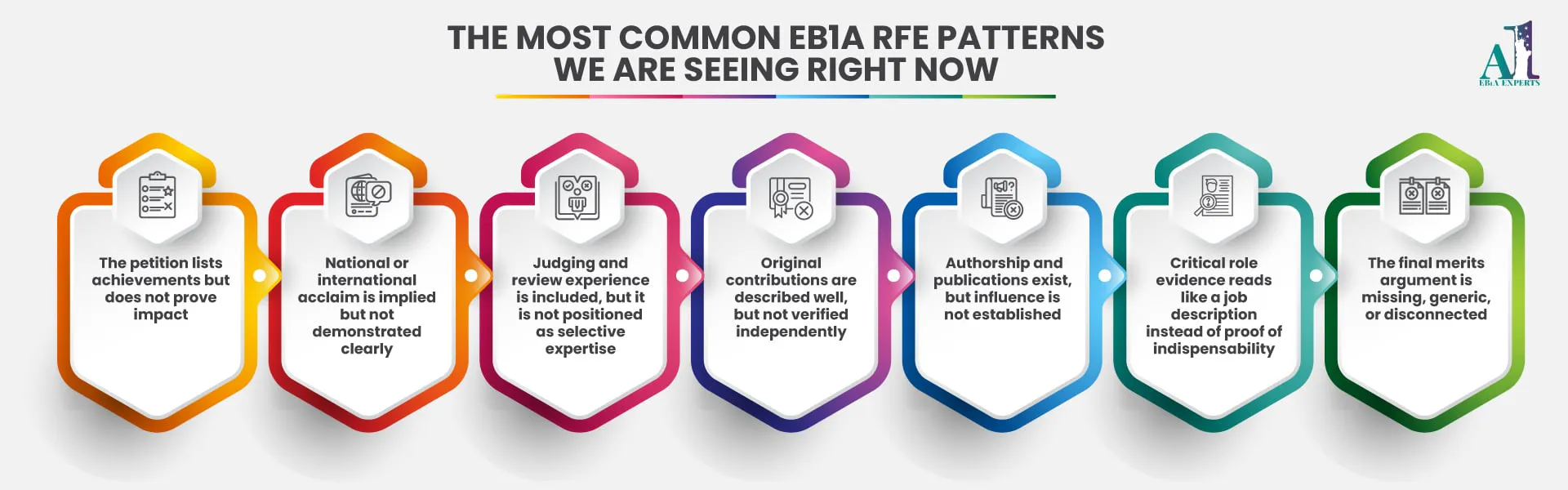
3. The most common EB1A RFE patterns we are seeing right now
Most EB1A RFE reasons fall into a few predictable categories. These patterns show up regardless of job
title or field.
They also show up in cases that are objectively strong, especially when evidence is collected but not
organized strategically.
1. The petition lists achievements but does not prove impact
One of the most common EB1A RFE patterns is when an applicant submits a list of accomplishments but does
not prove how those accomplishments changed in the real world.
Many petitions highlight awards, successful projects, leadership roles, or recognition inside the
company.
However, the petition does not clearly demonstrate measurable influence or why those achievements matter
beyond internal work performance.
USCIS is often looking for evidence that the applicant’s work created outcomes that can be verified
independently.
That might include adoption metrics, performance improvements, usage growth, impact on business results,
risk reduction, or influence on systems that matter to a broader audience.
When the petition does not connect achievements to outcomes in a direct and documented way, the officer
may request additional evidence.
This is one of the main reasons applicants feel surprised by an RFE. They believe the achievement is
obvious, but USCIS requires the petition to prove the significance in a structured, evidence-backed way.
2. National or international acclaim is implied but not demonstrated clearly
Many EB1A applicants have strong careers at well-known companies. That is valuable, but EB1A is not simply an award for being
competent or successful. The case must
show extraordinary ability and sustained acclaim. A common RFE pattern appears when a petition makes the
applicant sound impressive, but the evidence shows recognition only within the applicant’s own employer.
USCIS often asks for clarification when it is not clear that the applicant is among the small percentage
at the very top of the field. The officer may question whether the recognition is truly national or
international in scope or whether it is limited to a single organization. This is especially common in
roles where impact is real but not naturally public, such as engineering infrastructure, security work,
internal platforms, or compliance systems.
Strengthening this area requires showing recognition that extends beyond internal teams. It can include
external adoption, evidence of influence in the industry, peer recognition outside the employer, or
proof that other experts rely on the applicant’s work.
3. Judging and review experience is included, but it is not positioned as selective
expertise
Judging and peer review can be powerful EB1A evidence. However, USCIS often issues RFEs when
applicants state they have judged others but do not prove that this role reflects expert-level
recognition. For example, applicants may include paper reviews, mentorship, interview panels, hackathon
judging, or code review authority. These are meaningful experiences, but USCIS wants to understand why
the applicant was chosen and what level of expertise that selection represents
An RFE becomes more likely when the petition does not explain whether the judging opportunity was
selective, whether there were qualification standards, or whether the applicant’s judgment had real
weight. The officer may request evidence that this role was not routine participation but rather a
recognition of the applicant’s standing in the field.
The strongest approach is to show how the judging role was earned, why the applicant was trusted with
evaluation responsibility, and how the judging work aligns with extraordinary ability and sustained
acclaim.
4. Original contributions are described well, but not verified independently
Original contributions of major significance is one of the most influential EB1A criteria, and it is
also one of the most scrutinized. A common EB1A RFE reason occurs when applicants describe contributions
in detail but rely heavily on self-authored explanations. Even when the work is impressive, USCIS
expects proof that the contribution was significant and that the significance is supported by
independent documentation.
This is where many EB1A petitions lose strength. The petition may include detailed technical
explanations or internal achievements, but the officer wants to see evidence that confirms the
contribution had broader importance. This can include adoption by other teams, measurable improvements,
strategic value, external references, documented impact at scale, or expert letters that explain the
significance in a concrete way.
When original contributions are not supported with external validation, USCIS often requests more
evidence or more detailed explanation. This is not because the applicant did not contribute. It is
because the petition did not prove major significance clearly enough for a legal decision.
5. Authorship and publications exist, but influence is not established
In research or publication-heavy profiles, applicants often include scholarly articles, conference
papers, or technical writing. That is important evidence, but it needs to show influence. USCIS may
issue an RFE when authorship is presented as a list rather than as evidence of field impact.
This often happens when the petition includes publications without explaining who relied on them, how
widely they were cited, how they shaped work in the field, or why the publications reflect extraordinary
ability. The officer may ask for citation evidence, significance context, or proof that the authored
work contributed to sustained acclaim.
A strong EB1A narrative makes the publications part of a bigger argument. It explains why the
applicant’s authored work matters and how it demonstrates influence that stands above peers.
6. Critical role evidence reads like a job description instead of proof of
indispensability
The critical role criterion is often misunderstood. Applicants may believe that having a senior title or
being a key team member automatically proves they played a critical role. USCIS looks for something more
specific. They want to see evidence that the applicant’s role was critical to a distinguished
organization and that their performance had meaningful consequences.
An RFE becomes likely when the petition includes job descriptions, performance reviews, or internal
praise without showing why the applicant’s role was essential and how their work materially affected
outcomes. Officers often want to see how the applicant’s decisions influenced high-stakes initiatives,
how the organization depended on their expertise, and why the applicant’s role was not easily
replaceable.
The goal is not to claim you were important. The goal is to prove that you were critical in a way that
maps to the EB1A extraordinary ability standard.
7. The final merits argument is missing, generic, or disconnected
One of the most overlooked EB1A petition weaknesses is the final merits argument.
Many applicants focus on meeting three criteria, then assume the case is complete.
In practice, final merits is where USCIS evaluates whether the full record proves extraordinary ability
and sustained acclaim.
An RFE is more likely when the petition feels like separate evidence pieces that do not connect into a
coherent story. Officers may believe the applicant satisfies individual criteria but still need to
understand the overall picture. The final merits section must explain why the applicant is among the
small percentage at the top of the field, how the acclaim is sustained, and how the evidence supports
the petition as a whole.
When final merits is done well, it reduces uncertainty for the officer. When the final merits is weak,
the officer often requests more evidence or clarification even when the underlying achievements are
strong.
4. What do these EB1A RFE patterns have in common?
The reason EB1A RFEs feel unpredictable is that applicants focus on the surface-level RFE question
instead of the deeper pattern.
Most EB1A RFE trends in 2026 point back to the same root cause.
USCIS needs to evaluate credibility fast, and they need to see proof that is independent, organized, and
mapped clearly to the EB1A criteria.
If your petition contains strong evidence but does not show impact, scope, and sustained recognition in
a structured way, the officer may hesitate. When the officer hesitates, an RFE becomes the safest path
forward. This is why applicants should treat EB1A evidence as a strategy problem, not a collection
problem. The goal is not to submit more documents. The goal is to submit proof that makes approval
obvious.
6. FAQs
1. Are EB1A RFEs increasing in 2026?
Yes, EB1A RFEs are increasing, and many filers are experiencing more scrutiny compared to earlier filing
years.
The reason is not always stricter standards. It is often because officers are pushing for clearer
evidence mapping,
stronger independent validation, and better final merits arguments that make eligibility obvious from
the record.
2. What are the most common EB1A RFE reasons?
The most common EB1A RFE reasons include unclear proof of major significance for original contributions,
weak national or international acclaim positioning, judging roles that lack selective expert framing,
and critical role evidence that looks like a job description.
Many RFEs also point to a weak or generic final merits argument that does not connect the evidence
logically.
3. Does an EB1A RFE mean my petition will be denied?
No, receiving an EB1A RFE does not mean denial is guaranteed.
An RFE typically means USCIS needs clarification or additional evidence to make a decision.
Many EB1A petitions are approved after a strong RFE response, especially when the applicant addresses
the exact concerns
and improves the credibility and structure of the evidence presented.
4. How can I prevent an EB1A RFE before filing?
The best way to prevent an EB1A RFE is to focus on evidence strategy and narrative development early.
Instead of collecting documents randomly, map each piece of evidence to a specific EB1A criterion and
explain what it proves.
Strengthen independent validation, show measurable impact, and write a final merits argument that ties
your achievements to sustained acclaim.
5. What should I do if I already received an EB1A RFE?
If you already received an EB1A RFE, the most effective approach is to identify the officer’s core
objection and respond directly with structured evidence.
Avoid dumping unrelated documents or repeating generic explanations.
A strong RFE response usually clarifies the impact, adds independent verification, and strengthens the
final merits narrative so USCIS can approve confidently.





 January 05, 2026
 3 min read