One of the most persistent myths around EB1A is the belief that similar
achievements lead to similar outcomes. Many applicants assume that if two professionals have comparable
resumes, publications, awards, or leadership roles, USCIS should logically approve both cases. In
reality, EB1A is not evaluated on a checklist or scorecard. It is assessed comparatively, strategically,
and subjectively.
This article breaks down two real-world style EB1A
profiles with nearly identical credentials but vastly different outcomes. One case was approved
smoothly. The other received an RFE and eventually a denial. The difference was not talent. It was a
strategy.
Applicant A and Applicant B were both senior professionals in the same technical field. Each had over 10
years of experience, strong academic backgrounds, multiple peer-reviewed publications, and leadership
roles within their organizations. Both applicants had served as reviewers for journals. Both had
contributed to high-impact projects. Both had evidence of national-level work and recognition. On paper,
their profiles looked interchangeable.
Applicant A worked at a well-known company but had fewer total documents. Applicant B had more
publications, more recommendation letters, and more pages of evidence. From a distance, Applicant B
appeared stronger. Yet outcomes told a different story.
3. Case Strategy Comparison
1. Criteria Selection
Applicant A selected the EB1A
criteria that aligned tightly with a single theme of influence. The case focused on original
contributions of major significance, judging work, and leading critical roles. Each criterion supported
the same core argument. Applicant B attempted to satisfy more criteria, assuming volume increased
approval probability. The criteria were loosely connected and treated independently rather than
strategically.
Applicant A prioritized evidence that demonstrated a downstream impact. Independent citations,
third-party adoption, and documented influence on industry practices were placed front and center.
Applicant B submitted large volumes of internal documents, certificates, and descriptive letters that
showed activity but not consequence.
3. Narrative Logic
Applicant A’s petition read like a professional story. Every section answered the officer’s implicit
question: Why this applicant above others in the same field? Applicant B’s case read like a resume
extension. Achievements were listed but not connected.
4. Officer Readability
Applicant A’s case was structured for quick comprehension. Clear headings, summaries, and logical
transitions guided the adjudicator. Applicant B’s submission was dense, repetitive, and cognitively
demanding.
4. USCIS Outcomes: Approval vs RFE and Denial
Applicant A received an approval without an RFE. The officer’s reasoning reflected a clear understanding
of the applicant’s impact and national significance. Applicant B received an RFE questioning the major
significance and final merits. The officer acknowledged achievements but did not see sufficient
differentiation from peers. The final denial cited a lack of persuasive evidence rather than a lack of
accomplishments.
This divergence illustrates a core truth. USCIS does not deny because someone is unqualified. It denies
when the narrative fails to prove extraordinary positioning.
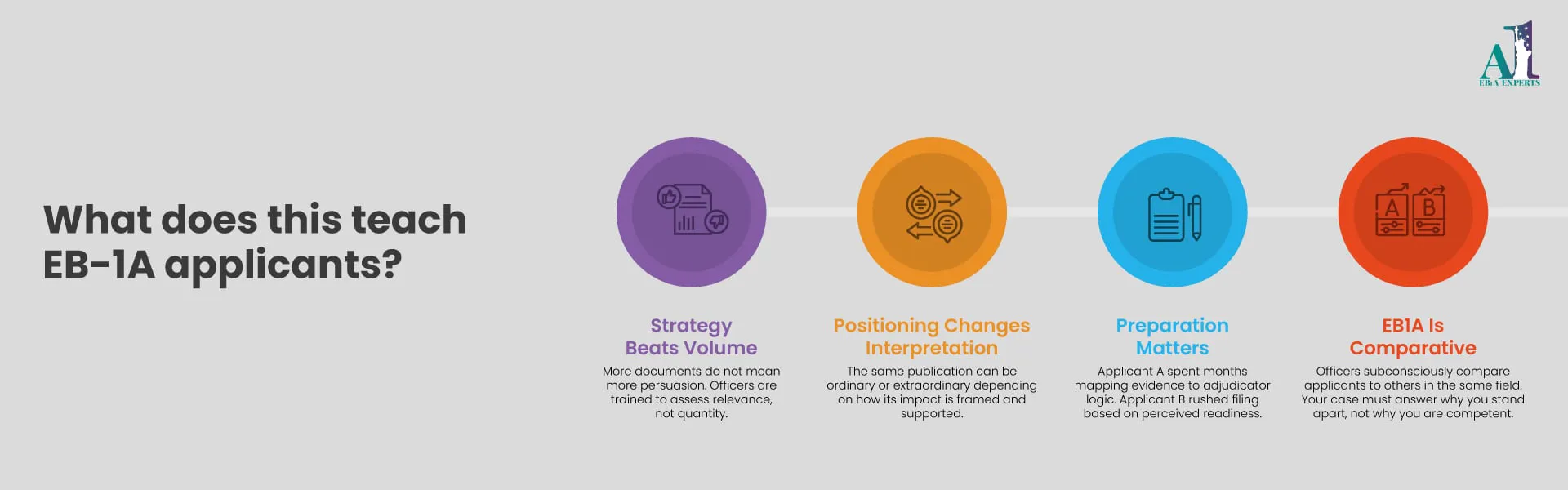
Strategy Beats Volume: More documents do not mean more persuasion. Officers are trained to
assess relevance, not quantity.
Positioning Changes Interpretation: The same publication can be ordinary or extraordinary
depending on how its impact is framed and supported.
Preparation Matters: Applicant A spent months mapping evidence to adjudicator logic.
Applicant B rushed filing based on perceived readiness.
EB1A Is Comparative: Officers subconsciously compare applicants to others in the same field.
Your case must answer why you stand apart, not why you are competent.
6. Conclusion
EB1A is not evaluated in isolation. It is evaluated comparatively, strategically, and through the lens
of officer logic. Two applicants can share credentials and experience yet reach opposite outcomes based
solely on case architecture. If you want clarity on how your profile would be interpreted by USCIS, a
positioning review is essential. EB1A
Experts helps applicants transform strong
resumes into officer-ready EB1A cases with precision and honesty.
7. FAQs
Is EB1A approval based on the number of achievements?
No. USCIS evaluates impact, influence, and differentiation, not raw counts.
Can two similar profiles receive different decisions?
Yes. Strategy, narrative clarity, and evidence hierarchy heavily influence outcomes.
Does satisfying more criteria improve approval chances?
Only if the criteria support a cohesive argument. Random criteria selection can weaken a case.
What causes RFEs in strong EB1A profiles?
Poor framing of major significance, weak independent evidence, or unclear national impact.
When should I get my profile reviewed?
Before filing, early strategic positioning often determines success more than later fixes.





 December 22, 2025
 3 min read