1. Introduction: Why Most EB1A Self-Checks are Misleading?
Those who search for EB1A requirements online tend to find two extremes: overwhelming confidence or
excessive fear. Many individuals will believe they fit into this category because they meet the EB1A
eligibility checklist. In contrast, others will eliminate themselves after seeing words like "awards" or
"publications" and have nothing else to consider.
An issue with most self-assessments is that they often use a "surface-level checklist approach" to
evaluate eligibility rather than how an individual case will be reviewed for EB1A approval. This type of
self-assessment ignores critical variables such as the quality of the evidence and the context in which
success was achieved. As with all past EB1A approvals, the approval officer evaluates not just how many accomplishments a
person has had but instead looks for a pattern of influence, credibility, and long-term impact from
their accomplishments.
Thus, the evidence from successful EB1A cases contradicts the theoretical assumption of qualification.
Although many successful profiles may not appear "ideal" on paper, they often align with the EB1A
approvalbenchmarks derived from prior EB1A approval decisions.
This self-assessment guide for EB1A helps the user evaluate his or her own readiness for EB1A approval
using patterns, not guesswork.
2. What EB1A Ready Actually Means (Not What You’ve Been Told)?
Prepared for EB1A does not require being "famous" (and/or having a high title) or holding a PhD. EB1A
criteria for tech workers were also granted to candidates based on their level of influence rather than
their visibility.
The USCIS focuses on how you have proven to have made an impact in your profession, how other members of
your profession see you as having credibility and/or being a leader in your profession. Having an
impressive job title is of significantly less importance than how your work impacts the decision-making
process or the way in which it is used as part of developing standards for your profession. EB1A evaluation based on the number of criteria, don't require you to meet the minimum of ten criteria.
The vast majority of approved applications are based on a few, robust, established criteria rather than
spreading your accomplishments thin across all ten criteria.
How you position your work connects with other people's understanding of what makes up an EB1A profile.
If you only list credentials on your resume without putting it into context with examples of how you
have used the credentials to create results, you are less likely to be successful than someone who
speaks of actual results achieved through their work.
The main takeaway from this analysis is that an EB1A profile's readiness depends on how you have
validated your work, not simply what you have done.
3. The EB1A Readiness Framework (How This Self-Assessment Works)
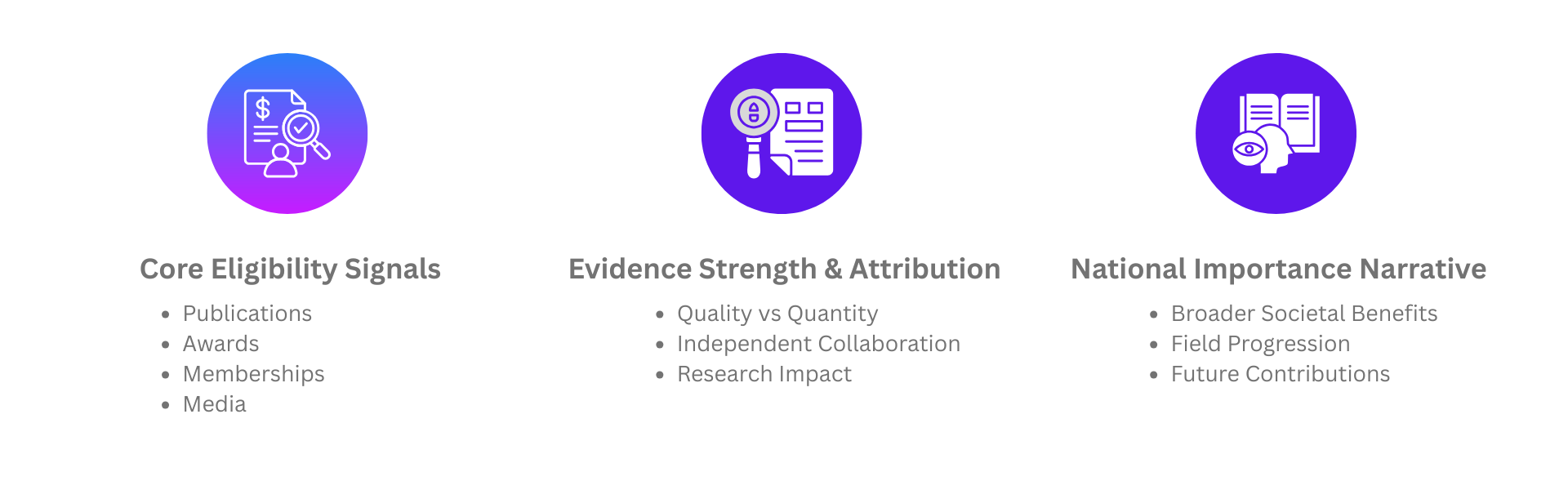
The EB1A self-assessment guide uses a 3-step readiness framework to determine your level of
eligibility.
Layering the framework:
Core Eligibility Signals
Evidence Strength & Attribution
National Importance Narrative
4. Layer 1: Core Eligibility - (Self check) - Your Recognition & Role as a Leader
Recognition and Leadership
Question: As to whether or not you lead or significantly contributed to the success of others
(has
to have a positive effect on their work).
Strong: You were the reason for setting guidelines, frameworks, or the ultimate decisions
made (used by others).
Moderate: You played a significant role within a group (recognized as such).
Weak: You performed well but didn't have strategic influence over the outcome.
Selection - You Were Selected Over Peers for Opportunities
The example would be if you had been a candidate for a promotion, a member of an expert panel, or
assigned to high-value roles.
Strong: The selection process was clearly competitive and well-documented.
Moderate: You benefited from being selected from many candidates through the internal
validation process.
Weak: You entered the company as a user and progressed from user to team member to lead to
manager or director.
Independent experts acknowledge your contributions as an engineer through peer evaluations, external
reviews, and advisory roles.
This is demonstrated in the following real-world example, where a mid-level engineer successfully
spearheaded a very specialized system implementation for many different companies. Although this
individual was relatively unknown to the general public, independent experts who validated the
engineers’ exceptional contributions provided substantial corroborating evidence for why this individual
could secure an extension of approval for such a narrow scope of effort.
These indicators form the foundation of EB1A success indicators.
5. Layer 2: Evidence Strength: Where Many Profiles Fail
Many applicants do not lack the experience of previous employment; they simply present the weakest proof
to prove their experience through supporting documents. It is critical to distinguish between conducting
an important activity and demonstrating one.
While common places are identified:
Reporting responsibilities versus results
Showcasing team accomplishments without showing individual contribution(s)
Work classified/hidden as confidential or within a company without any validation by a third party.
Substantial metrics without a reasonable explanation of what happened
Officers do not generally view numbers alone as sufficient. They want to know how the contributions of
the applicant impacted decisions or outcomes.
The truth is, applicants who were eventually approved submitted fewer but stronger explanatory
documents, partnered with evidence to demonstrate each of the EB1A approval benchmarks. High-quality evidence (the kind that typically leads to EB1A approval) is based on alignment to EB1A
evaluation, not in terms of quantity.
6. Layer 3: Future Impact and/or National Importance
The review of EB1A petitions is primarily forward-looking. Officers will assess how the applicant's
future work will benefit and/or enhance the economy of the United States; there is, therefore, a
substantial disconnect regarding what kind of application officers will approve.
A high-quality profile should connect their skills and expertise with innovation,
competitiveness, and future industries, including:
The U.S. Innovation
Economic growth, including job losses and successes;
Infrastructure/public interest/security.
This is usually the layer where marginal cases, or the cases that present a high quality of credentials but lack good framing around a future impact, will be stalling. As a reference,
The framing of the applicant's case was based on the problems the applicant identified in order to provide early solutions for issues that their work solved (before being addressed) in the growth of the emerging U.S. market.
7. Quick Self-Assessment Scorecard
Area
Your Rating
Core Signals
Strong / Medium / Weak
Evidence Quality
High / Moderate / Low
Narrative Clarity
Clear / Unclear
How to interpret results:
Strong + High + Clear → Typically EB1A ready
Medium scores → Often approvable with restructuring
Weak evidence → Requires preparation, not rushing
Medium does not mean rejection. Many successful cases started there.
8. What to do Based on Your Readiness Level?
If you are definitely EB1A qualified, your attention should be on clarifying and being consistent with how you present yourself. Be as specific as possible in presenting your application.
If you are almost ready but still not ready, you will want to recast your accomplishments, add more attribution, and connect the information in your case for the EB1A success indicators to be considered further.
If you are early on in the game but have promise, make sure you are creating good evidence and building your strategic audience. It is important to get the timing right.
At every stage of preparing for the EB1A request, having the expert evaluation of experts with approval history is the best way to mitigate unnecessary risk.
9. Why Real-Approval-Based Evaluation Matters?
There is a lot of generic information out there about what an applicant needs to demonstrate
Extraordinary ability requirements, but there are specific patterns in successful applications that each
applicant needs to recognize. EB1A Experts evaluate hundreds of previously approved applications to determine the types of support
that consistently achieve approvals and what the issues are that frequently trigger RFE’s or denials.
Pattern-based EB1A evaluation leads to clearer decisions and better outcomes.
10. FAQs
What is the fastest way to check if I qualify for EB1A?
A structured EB1A self-assessment guide using approval benchmarks is faster than relying on a checklist
alone.
How many criteria do I need to meet?
There is no fixed number. USCIS evaluates overall strength, not just the EB1A eligibility checklist.
Do I qualify if I have no publications?
Yes. Many approved profiles rely on industry impact rather than publications.
Does salary benchmarking really matter?
It can support selectivity, but it rarely stands alone.
What if I meet the criteria but still feel unsure?
That’s common. Uncertainty often points to weak positioning, not weak credentials.
Are early-career professionals eligible?
Yes, if their work shows strong EB1A profile readiness signals.
How do I know my evidence is strong enough?
If it clearly shows influence, trust, and future relevance aligned with EB1A approval benchmarks, it
likely is.
Wondering where you truly stand? Get a free readiness evaluation based on real approvals, not
assumptions.
Understand your strengths, gaps, and the smartest path forward before filing.





 April 30, 2025
 3 min read