For many international students, the F-1 visa is only the beginning of their professional journey in the
United States. As graduation approaches or as OPT or STEM OPT timelines start to feel uncomfortably
short,
the same question comes up again and again:
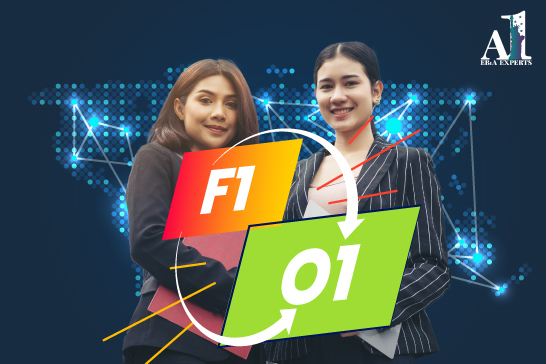
Is it actually possible to move from F-1 to O-1 Visa?
In 2026, this question matters more than ever. With continued uncertainty around H-1B lotteries,
stricter
timelines for work authorization, and increased scrutiny in employment-based immigration, students with
strong professional records are looking for alternatives that offer stability and flexibility.
The O-1 visa is
often mentioned as one such option. But it’s also misunderstood.
This guide breaks down what USCIS actually looks for, who realistically qualifies, and how international
students can think strategically about an F-1 to O-1 Visa transition without relying on assumptions or
shortcuts.
2. Understanding the O-1 After F-1 Transition
The F-1 visa is a student status, designed primarily for full-time academic study. While it
allows limited employment through CPT, OPT, and STEM OPT, work authorization under F-1 is temporary and
tightly regulated.
The O-1 visa for international students, on the other hand, is a work visa for individuals who can
demonstrate extraordinary
ability or achievement in their field. It requires sponsorship from a U.S.
employer or authorized agent and is tied to specific professional work.
The key distinction is this:
F-1 is based on enrollment and compliance
O-1 is based on evidence of distinction and recognition
Because of this difference, O-1 is not a “next step” visa in the way OPT or STEM OPT is. Eligibility
depends entirely on whether your professional work meets USCIS’s standards not on how long you’ve been
in the U.S. or how recently you were a student.
3. Is O-1 Strategy Actually Possible After F-1?
Yes, but only under the right conditions.
USCIS does not disqualify applicants because they were recently on F-1 status. Officers also do not
evaluate cases based on age, years of experience, or whether someone is “early career.”
Instead, USCIS focuses on one central question:
Has this individual demonstrated sustained recognition for extraordinary ability or achievement in
their field?
If the answer can be supported with strong, well-documented evidence, an O-1 approval is possible even
shortly after F-1 or while on OPT or STEM OPT.
If the answer relies mainly on potential, education, or internal job performance, the case is unlikely
to
succeed.
4. Who Has a Realistic Chance at O-1 Visa Eligibility After F-1?
International students who qualify for O-1 Visa 2026 after F-1 typically share one thing in common:
their work extends beyond normal student or entry-level expectations.
Strong O-1 candidates often demonstrate:
Professional output during F-1, OPT, or STEM OPT: This may include published research,
patented
work, commercial products, major technical systems, startups, performances, or original creative work.
External recognition: Awards, media coverage, citations, speaking invitations, peer reviews,
judging
roles, or expert acknowledgments that come from outside their employer or school.
High-impact roles: Contributions that were critical to an organization, project, or field not
routine assignments.
Association with respected institutions or clients: Work connected to well-known
organizations can
help validate significance, but reputation alone is not enough without evidence of individual impact.
/li>
Importantly, grades, degrees, coursework, and academic enrollment do not count as O-1 evidence by
themselves. USCIS evaluates professional distinction, not academic progress.
5. The Common Myth of O-1 Petition Audience: “I’m Just a Student”
One of the biggest misconceptions about O-1 eligibility is the idea that student status automatically
weakens a case.
In reality, USCIS
does not evaluate your visa history. Officers evaluate:
What you have accomplished
How your work is recognized
Why it matters within your field
A student whose work is cited, awarded, implemented, or relied upon by others can be a stronger O-1
candidate than a professional with years of routine experience.
What matters is impact and recognition, not the label attached to your status.
6. Timing Strategy: When Should You Apply?
Timing plays a critical role in F-1 to O-1 transitions not because USCIS imposes deadlines, but because
work authorization gaps can create risk.
Applying while on OPT: This is the most common window. Many applicants use OPT to build
professional
traction and gather evidence while remaining work-authorized.
Applying while on STEM OPT: STEM OPT often provides additional time to take on leadership
roles,
publish work, receive independent recognition, or expand the scope of professional contributions.
Filing before OPT or STEM OPT ends: Unlike H-1B, there is no automatic cap-gap
protection for O-1.
If your F-1 work authorization expires before your O-1 is approved, you may have to stop working or
leave the U.S.
Because of this, O-1 should not be filed reactively. Filing too early can be just as risky as filing too
late if the evidence is not fully developed.
7. What USCIS Actually Looks for in Opt to O-1 Evidence?
O-1
petitions must satisfy at least three regulatory criteria, but USCIS does not evaluate documents
mechanically. Officers assess quality, context, and credibility.
For example:
Awards: USCIS examines selectivity, competition level, and relevance not just the title.
Publications/research: The focus is on influence: citations, adoption, or reliance by others.
Critical roles: Officers want to understand why your role mattered and what would have
happened without your contribution.
Media coverage: Coverage must be about your work or expertise, not generic company
announcements.
High compensation: Salary must be contextualized against peers in the same field and
location.
Strong cases explain not only what the evidence is, but why it proves extraordinary ability.
8. Why Many F-1 to O-1 Cases Fail?
O-1 denials are rarely about lack of talent. More often, they result from:
Submitting documents without a unifying narrative
Over-reliance on employer recommendation letters
Generic expert letters that repeat resumes
Failure to explain field-level impact
Filing before recognition is clearly established
USCIS is not persuaded by volume alone. Without strategic framing, even strong credentials can be
misunderstood or undervalued.
9. An Evidence-First Strategy for O-1 Visa Requirements After F-1
At EB1A Experts, O-1 cases are approached the same way USCIS reviews them:
as an evidence-driven evaluation of impact and recognition.
This includes:
Mapping evidence to specific O-1 criteria before filing
Establishing a clear professional narrative tied to field significance
Using independent expert perspectives strategically
Benchmarking achievements against field standards
Anticipating USCIS questions and addressing them proactively
This approach reduces uncertainty and strengthens long-term alignment with future immigration goals.
10. O-1 and Long-Term Immigration Planning
While the O-1 visa does not automatically lead to permanent residence, the evidence used in a strong O-1
petition often overlaps with employment-based immigrant categories. Planning with this in mind can
reduce duplication later and help ensure that professional achievements are documented consistently over
time.
11. So, Is O-1 Possible After F-1?
Yes. O-1 is possible after F-1 for international students who can clearly demonstrate
extraordinary
ability through recognized professional work.
It is not guaranteed, automatic, or based on academic credentials alone. Success depends on:
Evidence quality
Timing
Strategic presentation
For those who meet the standard, O-1 can offer flexibility, stability, and a path forward when other
options feel uncertain.
12. FAQs
Can I apply for an O-1 visa immediately after graduation?
Yes, but only if your professional work already meets O-1 standards. USCIS evaluates recognized impact
and distinction, not graduation status. Without strong, independent evidence, applying immediately after
graduation can significantly weaken your case.
Is the O-1 visa harder to get than the H-1B?
The O-1 has higher evidence requirements but no lottery or annual cap. Approval depends on proving
extraordinary ability through documentation, not chance. For qualified individuals, O-1 can be more
predictable than H-1B.
Can a startup sponsor an O-1 visa after F-1?
Yes. Startups can sponsor O-1 visas if they demonstrate legitimate operations, a qualifying role, and
sustained work. The case must clearly show why the applicant’s contributions are critical and recognized
within their field.
Does OPT or STEM OPT experience count toward O-1 eligibility?
Yes. Work completed during OPT or STEM OPT counts if it shows independent impact, leadership, or
recognition beyond routine duties. USCIS focuses on the quality and significance of the work, not the
visa under which it was performed.
What happens if my O-1 petition is denied?
A denial does not permanently bar future O-1 filings. However, reapplying requires a revised evidence
strategy, stronger documentation, and clearer positioning. Filing again without addressing USCIS
concerns often leads to repeated denials.
Not sure if your work is strong enough for an O-1 after an F-1?
EB1A Experts evaluate your evidence
the way USCIS does before you file,
so you can make informed
decisions with clarity and confidence.





 December 23, 2025
 3 min read