If you have been keeping an eye on the US tech landscape lately, you have probably noticed a shift
that’s hard to ignore ,which might impact your Extraordinary ability visa planning as well.
The latest NFAP H-1B report for FY25 reveals a massive decline in H-1B approvals for top
India-based IT companies. This decline is not something that can be ignored. We are talking about a drop
of nearly 70% compared to a decade ago and over 35% just since last year.
At the same time, US tech giants like Amazon, Google, Meta, and Microsoft are still securing the lion’s
share of approvals. However, Indian IT companies are hesitant in hiring Indian talent due to the current
uncertainty associated with the H-1B visa. This is making many Indian professionals rethink their
US immigration
strategy in 2026. It leads to a pretty urgent question: Is the H-1B still the reliable
long-term path we once thought it was?
The era where a job offer from a major services firm guaranteed a predictable path to the American Dream
is fading. In its place is a more competitive, merit-based environment that favors individual impact
over corporate volume. For the high-skilled professional, this isn't just a hurdle; it's a signal to
pivot.
The data from the NFAP isn’t just about numbers; it tells a story of two major trends. First, Indian
IT companies are changing how they work, leaning more on local US hires and offshore teams, which
naturally reduces their need for H-1B visa approvals.
Second, US tech companies are doubling down on foreign talent, especially recent grads from US
universities, to fuel big moves in AI and cloud engineering. In FY25, Amazon topped the list with over
4,600 initial approvals, followed closely by other Big Tech firms. For the first time, the top four
slots for initial H-1B approvals were occupied exclusively by US-headquartered companies.
What does this mean for you?
It means H-1B opportunities are becoming much more employer-specific rather than being spread evenly
across the industry. If you aren't at one of these top-tier product firms, your chances of a successful
lottery selection or even a smooth extension are statistically lower than they were a few years ago.
3. Why This Creates Long-Term Uncertainty for H-1B Professionals
If you are working for or planning to join an India-based IT firm, this shift brings some real
uncertainty to the table. We are witnessing several red flags in the current USCIS H-1B data FY25
:
Fewer Initial Seats: The pool of new visas for services-based roles is shrinking as US firms
prioritize AI and specialized research.
The Extension Trap: Even for those already in the US, scrutiny is rising. For instance, some
firms
saw extension rejection rates jump to 7% recently, up from just 3% or 4% in previous years.
Escalating Costs: With proposed supplemental fees as high as $100,000 for certain H-1B
filings,
employers are becoming more selective about who they are willing to sponsor.
The Golden Handcuffs: Being locked in to a specific employer while facing a 20-year green
card
backlog in the EB-2 or EB-3 categories is becoming an untenable risk for many.
Even though H-1B approvals are still happening, the path has lost that predictable sure thing feel it
had in previous years.
4. Why EB1A Is Entering More
Strategic Conversations
Because the employer-sponsored route feels a bit shaky and highly uncertain right now, more people are
looking at self-petitioned options like the EB1A
green card.
The EB1A extraordinary ability category is unique because it is based on your skills and impact,
not solely your job title or how big your company is. The real driver here isn’t just speed; it’s
control.
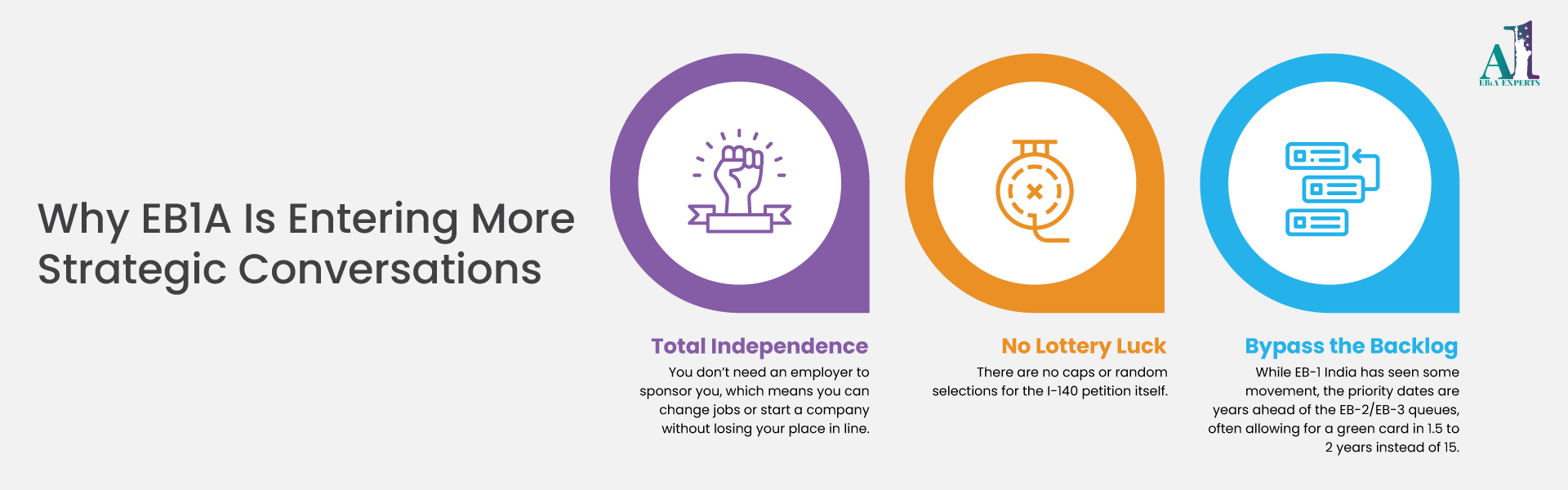
Total Independence: You don’t need an employer to sponsor you, which means you can change
jobs or
start a company without losing your place in line.
No Lottery Luck: There are no caps or random selections for the I-140 petition itself.
Bypass the Backlog: While EB-1 India has seen some movement, the priority dates are years
ahead of
the EB-2/EB-3 queues, often allowing for a green card in 1.5 to 2 years instead of 15.
For those with a solid track record, such as leadership, awards, or high-value contributions, EB1A is
becoming the ultimate hedge against H-1B volatility.
5. EB1A Is Not for Everyone, and That Matters
Let’s be real: EB1A isn’t a one-size-fits-all replacement for the H-1B.
USCIS sets a high bar, looking for evidence of sustained national or international recognition. It is
not just about how many years you have been in the industry, but how significant your work has been for
the field.
To qualify, you generally need to meet at least 3 out of 10 specific criteria, such as:
Original Contributions: Proving you have developed a framework, patent, or technology that
has major
significance to the industry.
Critical Roles: Showing you have led a high-stakes project at a distinguished organization
(like a
Fortune 500 firm or a successful startup).
High Remuneration: Benchmarking your salary and equity against the top earners in your
specific
field.
Judging the Work of Others: Serving as a code reviewer for major projects, a hackathon judge,
or a
peer reviewer for journals.
Many professionals in AI, cybersecurity, and specialized engineering often sell themselves short. They
don’t realize how their specific work aligns with the EB1A vs H-1B criteria. Often, it’s not
about
having more credentials; it’s about how you frame the impressive work you are already doing and
present
the respective evidence accordingly.
6. What Smart Professionals Are Doing Differently in 2026
Instead of just waiting to see what happens with the H-1B lottery, savvy professionals are taking a more
proactive approach. The 2026 Strategy is all about building a profile that is not employer-dependent.
Smart movers are:
Assessing Eligibility Early: They don't wait for a layoff. They look at the 10 criteria now
to see
which 2 they already have and which 1 they need to develop.
Building in Public: They are contributing to open-source projects, speaking at niche tech
conferences, and writing white papers to satisfy the authorship and original contributions criteria.
Gathering Objective Proof: Instead of generic letters, they are collecting metrics. For Ex:
My
algorithm saved the company $2M or My system supports 10 million concurrent users.
Diversifying Strategy: Many use the O-1 visa as a bridge. It has a similar high bar but acts
as a
temporary work visa while they prepare their permanent EB1A petition.
The goal here isn't to panic; it is to make sure you have options.
7. Conclusion: The Immigration Landscape Is Rebalancing
The dip in H-1B approvals for Indian IT firms is a sign of a much larger rebalancing in the US
workforce. The system is moving away from bulk-processed labor toward high-impact, individual talent.
For high-skilled professionals, this is the perfect time to look at alternatives to H-1B and
build a career path that doesn't depend entirely on a company's hiring cycle.
Whether you are a Senior Engineer, a Product Leader, or an AI Researcher, your extraordinary ability is
your best insurance policy in an uncertain market.
8. FAQs
1. Does this mean H-1B is no longer viable?
No. H-1B remains a functional non-immigrant path, but it is increasingly employer-dependent and subject
to high registration rejection rates.
The H-1B program continues to be the primary way for high-skilled foreign nationals to work in the US.
However, USCIS data shows that over 300,000 beneficiaries were rejected in the FY25 lottery due to the
85,000 annual limit. Additionally, new policies such as the $100,000 fee for entry from outside the US
have added significant financial barriers. While still viable for entry, the visa now requires more
specific employer selection and carries higher long-term risks.
2. Are Indian professionals being denied more than others?
No. Data indicates a reduction in total H-1B usage by Indian-based firms rather than a specific increase
in individual denial rates.
While approvals for the top seven Indian IT companies dropped by 37% year-over-year, the overall denial
rate for initial employment remained relatively low at 2.8% in FY25. The shift is largely due to
companies increasing local hiring and offshore delivery models. Indian professionals at US-headquartered
firms like Amazon or Google continue to see high approval rates, often with denial rates as low as 1%.
3. Can EB1A be filed while on H-1B?
Yes. The EB1A green card is an immigrant petition that can be pursued concurrently with a valid H-1B
non-immigrant status.
The EB1A visa category allows for self-petitioning, meaning it does not require an employer’s signature
or involvement. Many high-skilled professionals maintain their H-1B status for work authorization while
their extraordinary ability petition is being adjudicated by USCIS. This dual-track approach provides a
safety net, ensuring the applicant remains in legal status regardless of the petition outcome.
4. Is EB1A only for researchers or scientists?
No. The EB1A visa is open to individuals in various fields, including business, technology, arts, and
athletics, who can demonstrate extraordinary ability.
USCIS criteria for EB1A approval are broad and designed to identify those at the top of their respective
fields. In the tech sector, this often includes software architects, product leaders, and cybersecurity
experts who may not have academic publications. Professionals can satisfy requirements through evidence
of critical roles in distinguished organizations, original contributions of major significance, or high
commercial success.
5. Should I wait until my H-1B becomes risky?
No. A strategic EB1A green card application is most effective when planned early rather than in response
to an immediate immigration crisis.
EB1A
extraordinary ability requires a record of sustained acclaim, which often takes months or years to
document properly. Early assessment allows professionals to identify gaps in their profile and
proactively build evidence, such as judging or original contributions. Given the current volatility in
H-1B policy and the increasing costs of sponsorship, establishing an independent path to residency
provides essential career stability.
Feeling unsure about your H-1B future? If you want to see if EB1A is a realistic move for you, EB1A Experts offers a free strategy evaluation. We’ll skip the guesswork and give
you a clear look at where you stand.






 December 29, 2025
 3 min read