1. Introduction: When Strong Profiles Still Get RFEs
Mohan Lohia (name changed for anonymity) was a senior professional in a specialized STEM domain, with
over
18 years of experience, peer-reviewed publications, industry awards, and leadership roles. On paper, his
EB1A petition checked every box. The evidence was present. The criteria were
met. An I-140
approval felt
inevitable.
But USCIS had other plans.
Mohan received a Request for Evidence (RFE), and panic set in.
If you have ever faced a similar moment, this blog is for you. An RFE from USCIS can feel like a
question mark on years of hard-earned professional credibility. Highly accomplished individuals often
struggle to understand why this happens. The answer lies in how USCIS evaluates merit, not just
credentials.
This RFE to
approval case study examines how Mohan responded strategically and secured approval. Instead
of treating the RFE as a setback, he used it as a pivot point. The outcome proves one critical truth:
EB1A success depends not only on what you submit, but on how convincingly you align your evidence with
USCIS expectations.
Mohan’s EB1A petition claimed multiple criteria, including original contributions of major significance,
authorship of scholarly work, and a leading or critical role. His initial evidence strategy followed a
familiar pattern. Achievements were documented exhaustively. Recommendation letters emphasized expertise
and seniority. Exhibits were organized neatly, criterion by criterion.
The profile itself was strong. However, the petition leaned heavily on credentials and volume rather
than clearly establishing industry-wide impact. While the filing was technically compliant, it failed to
connect accomplishments to broader influence within the field. This disconnect between achievement and
impact is a common blind spot. In Mohan’s case, it became the primary trigger for a USCIS Request for
Evidence, despite the strength of his background.
Recent USCIS adjudication data shows that EB-1A approval rates in 2025 remain relatively steady at around 66–67%, despite increased scrutiny. However, USCIS does not publicly release category-specific RFE statistics for EB-1A petitions.
While many practitioners and independent analyses observe a notable rise in RFEs in EB-1A cases,
estimates placing RFE rates in the 40–50% range are based on case-level observations and third-party
analysis, not on officially published USCIS data.This means that many successful profiles may likely get
an RFE if the adjudicating officer feels that certain areas need more clarification through better
evidence.
3. The RFE: What USCIS Questioned
The RFE did not dispute Mohan’s qualifications outright. Instead, it raised themes that frequently
appear in EB1A RFEs and reflect common reasons for USCIS RFE issuance. First, USCIS questioned
whether
Mohan’s contributions truly rose to the level of “major significance” beyond his immediate organization.
The officer sought concrete evidence demonstrating industry-wide impact, not just internal value.
Second, the leading or critical role claim lacked outcome-driven evidence. While Mohan’s role was
senior, USCIS remained unconvinced about the tangible effect of that role on the organization and, more
importantly, on the field at large. At its core, the RFE exposed a misalignment. The petition described
what Mohan did but not why his work was original, unique, or influential beyond his employer.
This reflects how USCIS approaches adjudication. Officers implicitly ask:
What measurable impact did the claimed role create?
What makes the contributions original and distinctive?
Is there credible proof that the industry adopted, relied on, or was influenced by this work?
Without clear answers, even strong profiles invite skepticism.
4. Strategy Shift: Evidence Re-Positioning, Not Expansion
Mohan’s response focused on evidence repositioning USCIS, not evidence expansion. This shift
proved
decisive.Before the RFE, accomplishments were presented largely as a list. After the RFE, every exhibit
was reframed around impact. The goal was no longer to show that Mohan was impressive but to demonstrate
that his work changed outcomes.
First, existing materials were mapped directly to measurable indicators such as adoption rates,
commercial implementation, citations, and policy influence. Second, independent validation replaced
self-referential explanations. Third-party data, external recognition, and objective benchmarks took
priority over internal praise.
National and industry-wide relevance became central. Instead of focusing on Mohan’s responsibilities
within an organization, the response showed how his leading role and innovations influenced practices
beyond it.
This USCIS Request for Evidence strategy transformed the narrative from capability to
consequence. It
mirrors many strong RFE response examples seen in successful cases handled by EB1A Experts, where
precise repositioning clarifies significance without overstating claims.
5. Outcome & Insights
Mohan’s petition was approved, making this an EB1A petition approved after RFE and a clear
example of
USCIS RFE response success.
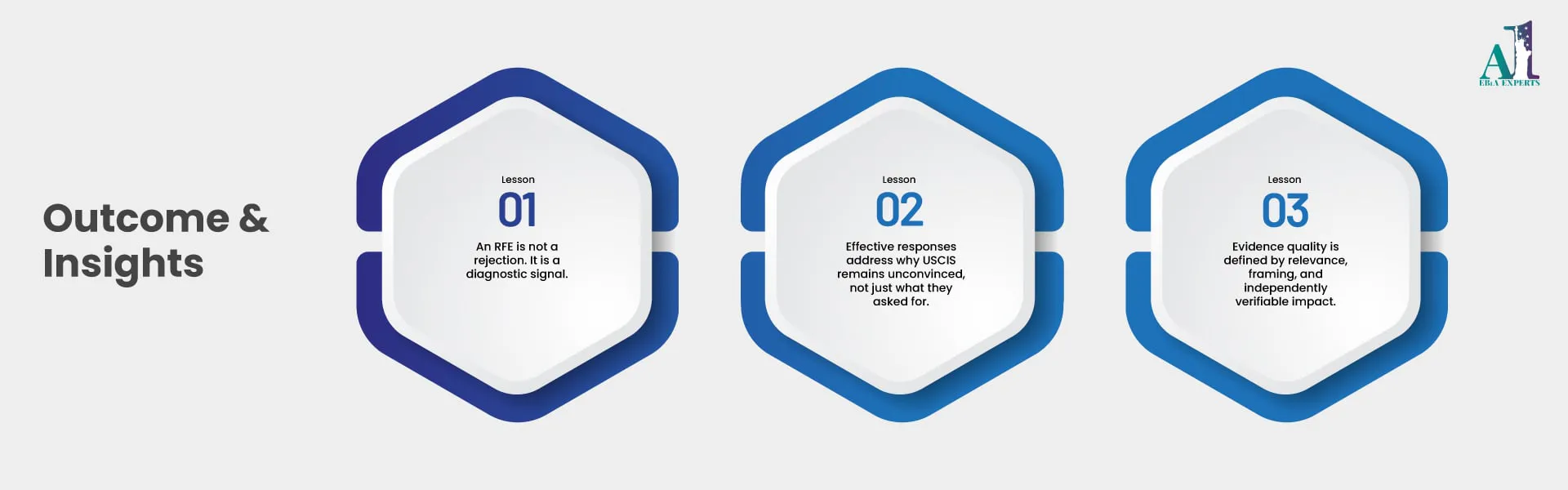
Three lessons stand out:
First, an RFE is not a rejection. It is a diagnostic signal.
Second, effective responses address why USCIS remains unconvinced, not just what they asked for.
Third, evidence quality is defined by relevance, framing, and independently verifiable impact.
This EB1A RFE approval case study reinforces that final merits determination hinges on how
clearly the
impact is established, not on how much evidence is submitted.
6. Conclusion
An RFE does not invalidate your achievements. It challenges how they were presented. USCIS looks for
proof of influence, adoption, and relevance, not just credentials. The above-mentioned case of approval
after RFE demonstrates that the right strategy can change the outcome without adding new evidence.
7. FAQs
1. What is an RFE from USCIS?
A Request for Evidence (RFE) is a formal notice from USCIS asking for clarification or stronger proof
before deciding your petition. In many EB1A RFE case study examples, the issue isn’t missing credentials
but unclear positioning. Understanding the notice correctly is the first step toward EB1A RFE to
approval.
2. Can an EB1A petition be approved after receiving an RFE?
Yes, absolutely. Many applicants receive EB1A approval after RFE outcomes when their response addresses
the officer's concerns strategically. An EB1A RFE to approval path depends on how well the response
reframes impact, not on adding volume. Each EB1A RFE case study confirms that approvals are common with
proper handling.
3. Why do EB1A petitions commonly receive RFEs?
EB1A adjudication is subjective, and RFEs occur when evidence does not clearly show sustained national
or international impact. Many EB1A RFE case study reviews reveal that achievements exist, but the USCIS
RFE response strategy failed to connect them to field-wide significance, leading to avoidable RFEs.
4. What does “evidence repositioning” mean in an RFE response?
Evidence repositioning focuses on reframing existing materials to emphasize influence, originality, and
independent recognition. A strong USCIS RFE response strategy explains why the evidence matters. Most
EB1A approved after RFE cases rely on this approach rather than submitting new achievements,
accelerating
EB1A RFE to approval.
5. How long does USCIS take to decide after an RFE response?
After submission, USCIS typically decides within a few weeks to a few months, depending on workload and
complexity. Clear responses that follow a proven USCIS RFE response strategy often move faster. Knowing
how to respond to EB1A RFE correctly increases approval odds and supports EB1A RFE to approval success.
If an RFE has left you questioning your strategy, a free profile
evaluation can clarify what USCIS is
actually looking for. EB1A Experts review your evidence through an adjudicator’s lens and show you how
to reposition it effectively.





 December 30, 2025
 3 min read