The modern workforce looks very different from what U.S. immigration laws
were originally built around.
Today, some of the most influential professionals in technology, business, science, and digital
innovation are not employees at large corporations. They are founders launching startups, freelancers
serving global clients, and consultants solving complex problems across industries.
Yet many independent professionals assume that U.S. permanent residency is out of reach because they do
not have an employer sponsor.
That assumption is wrong.
EB1A is specifically designed as a self-petition
green card category. It allows individuals with
extraordinary ability to apply for permanent residence without employer sponsorship. For founders,
freelancers, and consultants, this creates a powerful opportunity to secure an employment-based green
card without employer involvement.
The key is understanding how to position independent work as extraordinary ability and how to present
evidence in a way that aligns with how USCIS
evaluates EB1A cases. This guide explains how EB1A for
founders, EB1A for freelancers, and EB1A for consultants actually works, and how independent
professionals can build a winning strategy.
2. Understanding EB1A as a True Self Petition Green Card
EB1A stands for Employment-Based First
Preference, Extraordinary Ability. It
is reserved for individuals who have risen to the very top of their field and can demonstrate sustained
national or international acclaim. Unlike many other green card categories, EB1A does not require a job
offer. It does not require labor certification. It does not require employer sponsorship.
This is why EB1A extraordinary ability self petition cases are especially well suited for entrepreneurs
and independent professionals. USCIS evaluates EB1A cases in two stages. First, officers check whether
the applicant meets at least three out of ten regulatory criteria. Second, they perform a final merits
determination to decide whether the total evidence proves extraordinary ability.
For EB1A independent professionals, success depends less on job titles and more on impact. USCIS looks
for proof that your work has influenced your field in a meaningful way.
3. Founder, Freelancer, and Consultant EB1A Eligibility Explained
Independent professionals often worry that their non-traditional career paths will hurt their chances.
In reality, USCIS does not require a specific employment structure. What matters is the level of
recognition and influence you have achieved.
Founder EB1A Eligibility
Founder EB1A eligibility is built around showing that your startup work has produced measurable, field
level impact. This can include:
Creating widely adopted products or platforms
Introducing new technical approaches
Scaling solutions that influence industry standards
Leading ventures that receive major attention or investment
Startup founder EB1A cases work best when the founder is positioned not simply as a business owner, but
as a driver of innovation.
EB1A for Freelancers
EB1A for freelancers focuses on demonstrating sustained demand for your expertise. Freelancers often
work across multiple clients and projects. This diversity can become a strength when framed correctly.
Freelancer EB1A petition strategies highlight:
High-value projects
Selective client engagements
Recognized expertise
Measurable outcomes
EB1A for Consultants
EB1A for consultants centers on showing that organizations rely on your specialized knowledge to solve
critical problems.
Consultant EB1A green card cases often emphasize:
Advisory roles on major initiatives
Strategic decision-making authority
Influence over technical or business direction
Industry recognition
Consultants frequently operate at high levels of responsibility, which aligns well with the EB1A
critical role evidence.
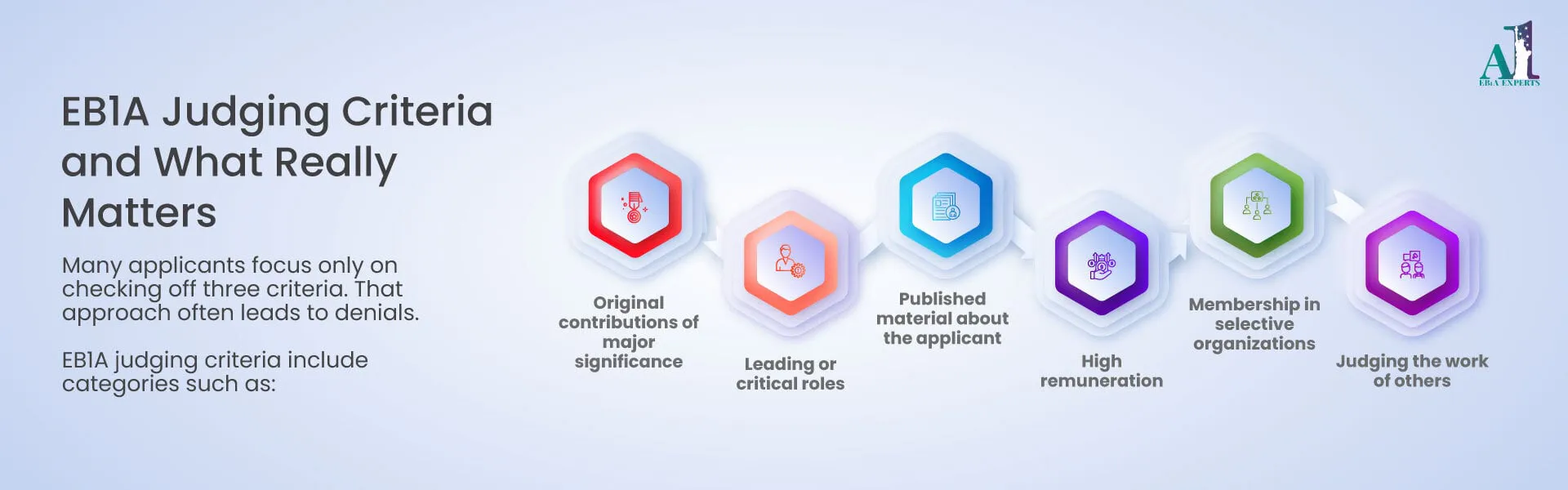
Many applicants focus only on checking off three criteria. That approach often leads to denials.
EB1A judging criteria include categories such as:
Original contributions of major significance
Leading or critical roles
Published material about the applicant
Published material about the applicant
High remuneration
Membership in selective organizations
Judging the work of others
Meeting three criteria is only the starting point. The real decision is made during the final merits
determination, where USCIS asks whether your career as a whole demonstrates extraordinary ability.
Strong EB1A cases present a cohesive story that connects all evidence to one central theme. That theme
is impact.
5. How to Prove Extraordinary Ability Without Employer?
Independent professionals prove extraordinary ability by showing influence beyond a single company.
This means documenting how your work:
Solves important industry problems
Advances technology or business practices
Is relied upon by others
Produces measurable outcomes
For founders, freelancers, and consultants, extraordinary ability is not about where you work. It is
about what your work changes. A well-prepared case explains why your contributions matter at a national
or international level.
6. Evidence Strategy for EB1A Founders, Freelancers, and Consultants
The evidence strategy for EB1A founders and independent professionals focuses on quality, relevance, and
narrative cohesion.
EB1A Original Contributions of Major Significance
This category is often the backbone of strong cases.
Examples include:
Patented technologies
Proprietary platforms
Novel methodologies
Influential frameworks
Evidence should show adoption, recognition, and real-world use.
Critical Role Evidence
Critical role means your work is essential to the success of an organization or initiative.
This can be demonstrated through:
Leadership documentation
Organizational charts
Internal communications
Client letters
Performance metrics
Independent professionals frequently occupy mission-critical positions even without formal titles.
EB1A Publications and Media Coverage
This includes:
Press articles
Industry blogs
Podcasts
Interviews
Guest contributions
Published material should discuss your work, not merely mention your name.
EB1A Commercial Success Evidence
Commercial success can include:
Revenue growth
User adoption
Licensing income
Client acquisition
Market expansion
Financial data helps translate innovation into measurable impact.
EB1A Membership Criteria
Membership must be selective and based on achievement.
General professional associations rarely qualify. Elite, invitation-only organizations carry more
weight.
7. National or International Acclaim for Independent Professionals
National or international acclaim, EB1A does not require celebrity status.
It requires evidence that your work is recognized beyond your immediate circle.
Letters of recommendation for EB1A founders and independent professionals are most persuasive when they
come from recognized experts who can objectively describe your impact.
O1 to EB1A for Founders, Freelancers, and Consultants
O1 to EB1A for founders is a common pathway, but not a requirement.
O1 visas demonstrate extraordinary ability, but EB1A requires a higher level of evidence. Many
applicants file EB1A directly without O1.
The decision depends on individual profile strength and long-term strategy.
9. Common Mistakes Independent Professionals Make
One common mistake is relying too heavily on job titles.
Another is submitting large volumes of evidence without explanation.
Many applicants fail to connect their achievements into a cohesive narrative.
Others ignore final merits determination and focus only on regulatory criteria.
Strong cases avoid these pitfalls by emphasizing strategy.
Building a Winning EB1A Narrative Without Employer Sponsorship
A winning EB1A narrative positions you as:
A recognized expert
A driver of innovation
A contributor whose work benefits the U.S.
Your petition should tell a clear story of progression, impact, and sustained excellence. Narrative
coherence often matters more than the sheer number of documents.
Who Should Consider EB1A Without Employer Sponsorship?
Startup founders
Solo consultants
Independent engineers
Product builders
Researchers
Fractional executives
Technical advisors
If your work influences how others operate in your field, EB1A may be viable.
10. Final Thoughts: Extraordinary Ability Is About Impact, Not Payroll
EB1A for entrepreneurs, freelancers, and consultants is not an exception to the rule. It is exactly what
the category was created for.
Independent professionals often have broader influence than traditional employees. When properly
positioned, their cases can be extremely strong. The difference between approval and denial is rarely
raw talent. It is strategy.
11. FAQs
Can founders file EB1A without a sponsoring company?
Yes. EB1A is a self petition green card category. Founders can apply without employer sponsorship if
they demonstrate extraordinary ability through sustained national or international acclaim and show that
their work has produced significant impact in their field, such as widely adopted products, influential
innovations, or industry recognition.
What evidence is most important for a freelancer EB1A petition?
Freelancers should prioritize evidence showing original contributions, critical roles in high impact
projects, published material about their work, commercial success, and expert recommendation letters.
USCIS focuses on the influence and outcomes of the work, not whether it was performed as an employee or
independent contractor.
Do consultants need full-time clients to qualify for EB1A?
No. EB1A does not require full-time or exclusive clients. Consultants must show that their expertise is
sought after, that they play critical roles in important initiatives, and that their work demonstrates
sustained acclaim and significant influence within their field.
Is O1 required before filing EB1A for independent professionals?
No. Many founders, freelancers, and consultants file EB1A directly without first holding an O1 visa.
While O1 can strengthen a profile in some cases, EB1A eligibility is based on extraordinary ability
evidence, not prior visa classification.
How long does EB1A processing take for self-petition cases?
Processing times vary depending on the service center and case complexity. With premium processing,
I-140 adjudication is generally issued within 45 days. Adjustment of status or consular processing
timelines may add several additional months.
What makes EB1A different from EB2 NIW for founders and entrepreneurs?
EB1A requires proof of extraordinary ability and sustained acclaim, while EB2 NIW focuses on an advanced
degree or exceptional ability plus national interest. EB1A typically has a higher evidentiary standard
but can offer faster long-term immigration outcomes for strong profiles.
Can founders outside the United States file EB1A?
Yes. Founders and independent professionals living outside the U.S. can file EB1A through consular
processing after I-140 approval. The self-petition nature of EB1A applies regardless of physical
location.
Founders, freelancers, and consultants do not win EB1A through generic templates. They win through
evidence strategy, narrative development, and precise positioning.




 December 15, 2025
 3 min read