If you have ever applied for a EB1A
visa or green card, you already know the
process can feel overwhelming. Forms, evidence, and documentation quickly pile up, turning your story
into stacks of paperwork. Yet behind every application is a real person, a real family, and a real life
that cannot be fully captured by checkboxes and official records alone even with immigration letter of
support.
That is where a family support letter for immigration becomes powerful. It adds the human context that
numbers and documents simply cannot convey, offering US Citizenship and Immigration Services (USCIS) a
glimpse into who you are beyond your file. Whether you are pursuing a green card, adjustment of status,
an I-130 petition, an I-485 application, or even a hardship waiver, these letters can strengthen the
credibility of your entire case.
But here is the part many applicants overlook: not every support letter helps. In fact, a poorly written
one can raise concerns and do more harm than good.
In this guide, we break down what actually strengthens your case, what can hurt it, and how to write a
letter that truly makes an impact.
2. What Is a Family Support Letter for Immigration?
In simple terms, a letter
of support for immigration application is a written statement from someone who
knows you personally (usually a family member or close friend) to attest to specific facts about your
life. You might also hear this being popularly referred to as immigration character reference
letter.
Understanding the Differences Between Affidavit of Support (Form I-864) and Family Support Letter
It is important to distinguish a support letter from the Affidavit of Support (Form I-864). The
I-864 is a legally binding financial contract where a sponsor promises the government that an immigrant
will not need public assistance. A family support letter, on the other hand, is a qualitative document.
It is about your history and character, not just your bank account.
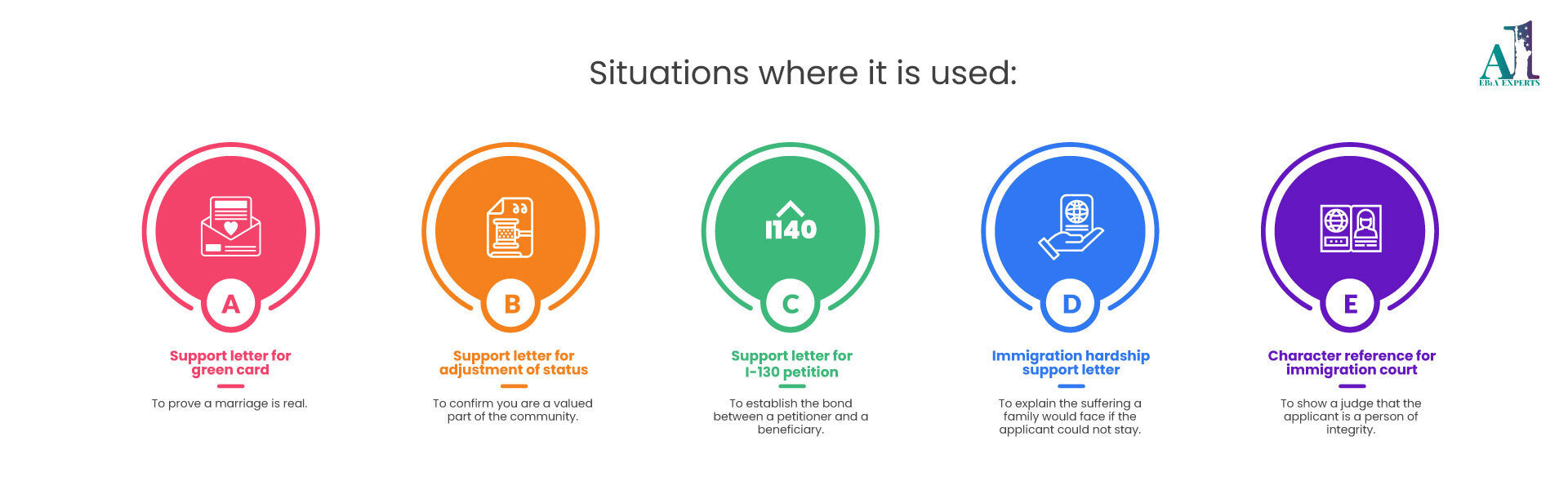
Situations where it is used:
These letters are incredibly versatile and are often used as:
Support letter for green card: To prove a marriage is real.
Support letter for adjustment of status: To confirm you are a valued part of the community.
Support letter for I-130 petition: To establish the bond between a petitioner and a
beneficiary.
Immigration hardship support letter: To explain the suffering a family would face if the
applicant
could not stay.
Character reference for immigration court: To show a judge that the applicant is a person of
integrity.
When you look at examples of immigration support letters, you will see that the identity of the
writer
is just as important as what they say. Ideally, the writer is someone with long-term, firsthand
knowledge of your life who can speak to your evolution as an individual.
3. When Does a Family Letter Help the Most?
A family letter is most effective when it directly addresses the specific legal requirements of your
case. Let’s break down the three primary areas where these letters make the biggest impact:
1. Proving a Bona Fide Relationship
For marriage-based cases, a proof of a bona fide relationship letter is essential. USCIS is
naturally skeptical of marriage fraud, so a family letter for green card application helps by
describing
real, everyday moments. Instead of just stating that the couple is in love, a strong letter mentions
specific moments like when you saw them cooking together or how they supported each other during a
family illness. These details are further reinforced by mentioning shared financial history or joint
ventures, thus showing the social reality of your union.
2. Demonstrating Extreme Hardship
In cases involving waivers (like the I-601A), you must prove extreme hardship to a qualifying relative,
which the law defines specifically as a US citizen or LPR spouse or parent. While children are
not qualifying relatives for these waivers, a family letter can explain how the applicant's absence
would hurt the children, which in turn creates extreme emotional or financial hardship for the
spouse. This nuance is critical for legal approval in 2026.
3. Establishing Good Moral Character
A family-focused immigration character reference letter highlights your role as a provider. While
an employer can say you are punctual, a family member can say you are a devoted father who coaches his
daughter’s soccer team and cares for an elderly aunt. It helps the officer see you as a person whose
presence is vital to the stability of a domestic unit. In addition, if you have spent years volunteering
in the community or have been a dedicated parent and neighbor, this is where that story gets told. It
helps the officer see you as a person who contributes to the fabric of American society, making it more
likely they will view your application favorably.
4. What Makes a Strong Immigration Letter of Support?
To make sure your letter carries weight with an officer, you need to move past generalities and focus on
a clear, professional structure. The letter should include the following:
1. Clear Introduction of the Writer
The writer needs to establish their place in the family tree immediately. They should include their full
name, their legal status, and exactly how they are related to you.
2. Specific, Firsthand Examples
Generic praise is the enemy of a good letter. Instead, the relative should share a family-centric
anecdote: I remember when Maria took over the household duties for three months while our mother was
recovering from surgery. She balanced her work and the family’s needs without complaint. These stories
prove that the writer is a witness to your life.
3. Logical Structure and Professional Tone
While the letter should be personal, it still needs to be organized. Use clear paragraphs and a formal,
honest tone. You do not need to use fancy legal jargon (in fact, it is better if you do not), but you
should avoid overly emotional language that sounds like a plea rather than a statement of fact. A
professional layout makes the letter easier for an officer to read and digest quickly, which is crucial
given their high caseload.
Is a notarized immigration support letter mandatory? Not always, but it certainly adds a
professional touch. At a minimum, the letter must include the writer's contact information, a copy of
their ID (like a passport or green card), and a clear signature and date. Providing these documents
shows that the writer is a real person who is willing to stand behind their words and be contacted if
necessary.
5. Common Mistakes That Can Harm Your Case
Sometimes, even the best-intentioned letters can cause problems. Here are some immigration
letter mistakes to avoid:
1. Generic or Copy-Paste Letters
USCIS officers read thousands of these. They can spot a copy-paste job from a mile away. If the letters
sound generic and similar to the examples readily available on the internet, the adjudicating officer
will not let that slide. The letters should have its own unique voice and perspective.
2. Exaggerations or False Statements
It is tempting to make things sound perfect, but honesty is your best policy. If a letter claims you
have lived somewhere for five years, but your tax records say something else, you have just created a
red flag. The consequences of making false statements can be permanent, including a finding of fraud
that could end your chances of staying in the US Always double-check dates and addresses with the
writer.
3. Irrelevant Emotional Narratives
Focusing only on feelings without facts can actually weaken a letter. It is okay to be emotional, but
those emotions need to be tied to concrete examples or scenarios. For example, do not just say you will
be sad. Instead, explain how that loss of support would create a tangible hardship, such as who will
care for the children or how the bills will be paid. The officer needs to see the objective consequences
of the decision.
4. Submitting Too Many Weak Letters
Quality beats quantity. Two strong letters from parents or any close family member are much more
powerful than ten short notes from distant cousins.
6. Step-by-Step Guide – How to Write a Family Support Letter for Immigration
1. Generic or Copy-Paste Letters
Ready to write? Follow this actionable framework to get it right:
Step 1: Define the Relationship – Clearly state the familial bond (e.g., spouse, sister,
parents,
etc.).
Step 2: Authenticate the History – Mention specific dates or family events you have shared.
Step 3: Provide the Narrative – Use a specific story that shows the applicant's character or
the
family's dependence on them.
Step 4: Explicitly Support the Request – State why the family needs this person to stay.
Step 5: The Sworn Statement – You must use specific language for the letter to be considered
a
"sworn statement" without a notary.
Here is a simple template that you can modify accordingly:
Date: [MM/DD/YYYY]
To: US Citizenship and Immigration Services (or Immigration Court)
Subject: Letter of Support for [Applicant's Full Name], [A-Number if known]
Introduction: E.g.: “I, [Writer’s Name], a citizen of [Country], write this in support of
[Applicant’s Name]. I have known [Applicant] for [Number] years.”
Relationship: Explain your bond (e.g., "I am the applicant's older sister...").
Specific Observations: Talk about your observations that might help strengthen the applicant’s
impression. Explain why you think the petition should be considered by the USCIS. E.g.: "I have
witnessed [Applicant's Name]'s commitment to their family... [Insert specific anecdote here]."
Statement of Support: "I strongly support [Applicant's Name]'s application for [Green
Card/Waiver/etc.] because..."
Closing: "I declare under penalty of perjury that the foregoing is true and correct."
Contact Information & Signature: [Phone/Email] [Signature]
8. Final Thoughts
Family support letters may seem like a small part of a large immigration file, but their impact can be
surprisingly significant. When written thoughtfully, they help decision-makers see the real people,
relationships, and responsibilities behind the paperwork. They provide context, credibility, and
emotional clarity in situations where forms alone fall short.
At the same time, these letters carry responsibility. Generic praise, exaggerations, or inconsistencies
can create unnecessary scrutiny and weaken an otherwise strong case. That is why the goal is not to
submit more letters, but to submit better ones. A few sincere, detailed, and well-structured statements
from people who truly know your life can add meaningful weight to your application.
If you treat family support letters as strategic evidence rather than emotional add-ons, they can become
one of the most powerful supporting tools in your immigration journey.
10. FAQs – Family Support Letters for Immigration
1. Do family support letters really help immigration cases?
Yes, a family support letter for immigration provides qualitative evidence that corroborates a
petitioner's claims regarding relationship authenticity or character. While not considered primary legal
evidence by USCIS,
these letters serve as critical secondary evidence to establish a bona fide relationship or extreme
hardship. In 2026, USCIS officers utilize these narratives to look for "affirmative evidence" that
standard civil documents like birth certificates cannot provide. A well-drafted letter reinforces the
petitioner’s credibility during an adjustment of status or I-130 petition review.
2. Who is the best person to write a family support letter for immigration?
The most effective writers are immediate relatives who possess firsthand, consistent knowledge of the
applicant’s daily life and domestic integration. USCIS prioritizes letters from a spouse, parent,
sibling, or adult child who can attest to long-standing familial bonds. For an I-130 petition or green
card application, a relative who has witnessed the couple's relationship development carries significant
weight. Ideally, the writer should be a US citizen or Lawful Permanent Resident to maximize the
evidentiary value of the testimony.
3. What should be included in a family immigration support letter?
A strong letter must include the writer's full identity, legal status, the specific nature of the
relationship, and detailed, firsthand anecdotes. USCIS requires that the writer establish their own
credibility before vouching for the applicant’s extraordinary ability or character. The letter must
contain the date, the writer’s contact information, and a specific statement regarding the length of the
relationship. Most critically, it must include a sworn statement under penalty of perjury to be
considered a valid "affidavit" or "sworn statement" by the adjudicating officer.
4. Can a poorly written support letter harm my immigration case?
Yes, inconsistent, generic, or exaggerated letters can create material discrepancies that lead to a
finding of fraud or a Request for Evidence (RFE). If a family support letter for immigration contains
facts that contradict the I-485 application or oral testimony during a USCIS interview, it triggers
immediate scrutiny. Generic language suggests a lack of genuine connection, while false statements can
result in a permanent bar for the applicant. Adjudicators compare these letters against official records
to ensure a consistent narrative throughout the case.
5. Does a family support letter need to be notarized?
Notarization is generally not required by USCIS if the letter includes a specific "penalty of perjury"
statement as outlined in 28 U.S.C. § 1746. While notarization adds a layer of formal identity
verification, USCIS accepts unsworn declarations as long as they are signed and dated correctly.
However, in 2026, providing a notarized immigration support letter remains a best practice for complex
hardship waivers or removal defense cases. A notarized document confirms the signer's identity and helps
prevent "rejection of evidence" based on signature authenticity.
6. How many family support letters should I submit?
Submitting two to five high-quality, detailed letters is significantly more effective than providing a
large volume of repetitive or brief statements. Strategic evidence selection is key to avoiding "file
padding," which can distract USCIS officers from the core strengths of the petition. For an I-130 or
I-485 filing, focus on obtaining 2–3 comprehensive letters from diverse family perspectives (e.g., one
from a parent and one from a sibling). Quality in 2026 is defined by specific anecdotal evidence that
proves the "bona fide" nature of the relationship or the "extreme hardship" involved.






 January 14, 2026
 3 min read