EB2-NIW Case Strength Assessment

EB2-NIW: Your Green Card
Isn't a Favor. It's a Verdict.

No employer. No PERM. Just a case strong enough to
survive scrutiny that's only getting sharper.

0% Approval Rate
0% Approvals
0 Prongs
0 Attorneys

One Waiver. Three Things You Have to Prove.

Every petition is measured against the Dhanasar framework, the three-part test set
by the Administrative Appeals Office in 2016. Miss one prong, and the whole case falls.

Substantial Merit and
National Importance

Proof your work carries real stakes beyond your paycheck - in infrastructure, health tech, AI, security, or systems the U.S. depends on.

Well-Positioned to
Advance It

Proof your degrees, publications, patents, and track record show you can actually deliver this work - not just claim you're capable of it.

Worth Waiving the
Job Offer For

Proof the U.S. gains more by letting you self-petition freely than by forcing you through the slower, employer-tied PERM process.

No Employer Means No One Else's Timeline

You file for yourself, so your case isn't tied to a job. Switch employers, lose your job, or go independent mid-process - your place in line doesn't move. No refiling, no HR department deciding whether your green card is worth their time.

If your spouse is on H-4, their work permit is a separate process with its own wait - worth planning for. H-4 work permit renewals are now taking 6 to 13.5 months in 2026, and automatic extensions are no longer guaranteed for new applicants.

Your case moves at your pace. Not your employer's.

Independent professional working on their own schedule
No PERM Refile Priority date stays intact
6–13.5 months H-4 EAD processing, 2026
The 2026 Reality Check

NIW Just Hit a Turning
Point - Here's What Changed

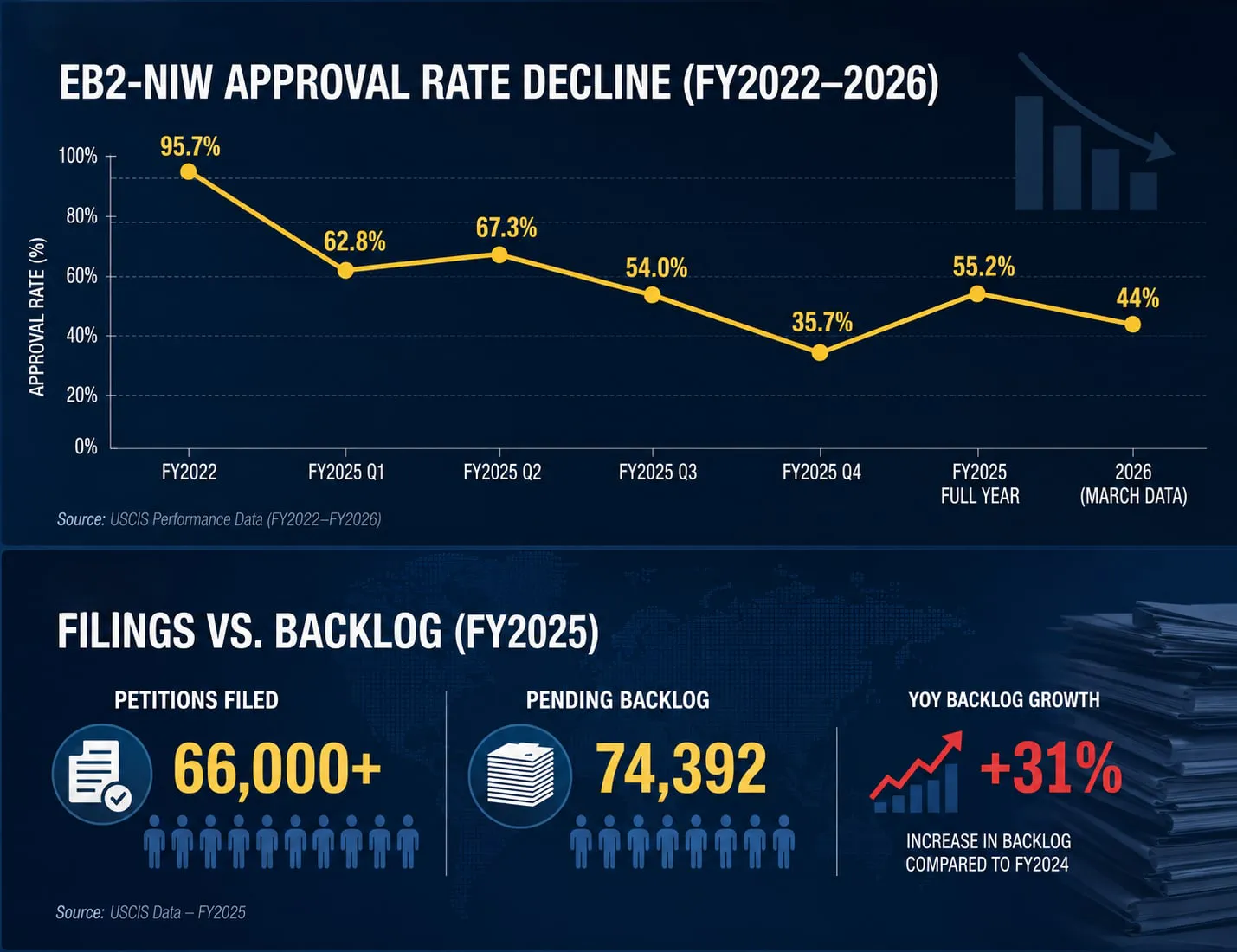
In Financial Year 2025, USCIS approved just 55.2% of EB2-NIW petitions - the lowest rate in years. In Q4 2025, denials outnumbered approvals for the first time on record. At the same time, filings surged past 66,000, pushing the pending backlog to 74,392 cases - a 31% jump in a single year.

More people are filing. Fewer are getting approved. The line behind you is longer than it's ever been.This isn't a reason to wait. It's a reason to stop filing a generic petition and start filing a defensible one.

NIW Just Hit a Turning Point - Here's What Changed
Why Most NIW Petitions Get Denied?

The Petitions That Fail Almost Always Fail the Same Way

Across the rise in denials, the same problems repeat: vague proposed endeavors, weak evidence mapping, and recommendation letters that restate a resume instead of proving impact.

USCIS is looking for a clear connection between your work and a national-interest outcome, explained in terms a reviewer with no technical context can follow.

A strong resume doesn't fail. A resume standing in for an argument does.
01
Prong 1

Proposed endeavor statements are too broad and fail to demonstrate substantial merit or national importance.

02
Prong 2

Recommendation letters repeat the applicant’s resume instead of proving that the applicant is well positioned to advance the proposed endeavor.

03
Prong 3

The petition does not clearly explain why the United States would benefit from waiving the job-offer and labor-certification requirements.

How EB1A Experts Builds Your Case

From Profile to Petition, Without the Guesswork

EB2 NIW case strategy planning
EB2 NIW petition evidence review

Fit assessment against the three Dhanasar prongs - before you spend a dollar on filing.

Evidence mapped to your actual role and industry, not a template.

One narrative that ties your technical work to a national-interest outcome USCIS can follow.

Coordination with immigration counsel through drafting, letters, and filing.

From Technical Depth to
National Importance

The Challenge: A senior software architect specializing in high-performance financial systems had strong technical credentials but no obvious “national importance” story - the core hurdle in any EB2-NIW petition.

Our Approach: We defined his Field of Expertise as “Software Architecture and Development with a focus on High-Performance Financial Systems,” mapping it to Advanced Computing on the White House’s Critical and Emerging Technologies list - a ~$49.5B market growing at 8.3% CAGR. Every piece of evidence was built to reinforce that single narrative.

The Results: Over 11 months: 2 awards won, 3 professional memberships secured, 2 peer-reviewed publications, and a fully finalized petition with no open threads at attorney handoff.

Why It Worked: Anchoring the field to a recognized national priority early made every credential easier to justify and kept the case cohesive rather than piecemeal.

Advanced Computing Market
Financial systems and immigration case documents
Software architect reviewing professional documents
Professional awards, publications and memberships

Every credential reinforced one national-priority narrative.

FAQ

Questions Applicants Ask Before Filing

No. USCIS dropped that requirement in 2016. A regionally focused project can qualify if it addresses a national priority or works as a model others could replicate elsewhere.
No. Some petitions get approved on objective evidence alone: patents, publications, metrics, media coverage. Letters help, but they cannot substitute for hard, verifiable proof of your work's impact.
No. Premium processing only guarantees a decision within 45 business days. It can return a denial or RFE just as fast as an approval, so build the case first.
Yes. Exceptional ability counts too. You need to meet at least three of six USCIS factors: high salary, memberships, recognition, a decade of experience, licensure, or notable contributions.
The evidence bar. EB1A demands sustained national or international acclaim. EB2 NIW only requires an advanced degree or exceptional ability plus proven national importance, a lower threshold to clear.

Find Out Where You Stand
Before USCIS Does

Book a strategy session and get a straight answer on your Dhanasar readiness,
a realistic timeline, and what your case needs before it's filed, not after an RFE.

Book Your Strategy Session