What if the only thing standing between you and a U.S. green card is a
misunderstanding?
If you have spent years building a solid career, the idea of applying for an EB-1A green card may have
crossed
your mind more than once when you think about long-term stability, freedom, or what comes next. And just
as
quickly, that thought often fades because of all the myths and EB1A
misconceptions surrounding the green
card.
Over time, these myths start to sound like quiet warnings rather than possibilities.
At EB1A Experts, we see so many accomplished professionals not applying for an EB1A visa. And that’s
because
they compare themselves to imagined standards, to exaggerated success stories, and to EB1A myths that
have been
repeated so often they start to feel like facts.
So, if you’ve ever come across any myths regarding EB1A or have just assumed that you won’t be a right
fit for it
then this article will help clear all those EB1A misconceptions. The ones that subtly
convince capable
people to
step back before they ever get evaluated. If you have ever wondered whether EB1A might be out of reach
for you,
it may be worth taking a closer look at what actually holds people back and why those reasons are often
wrong.
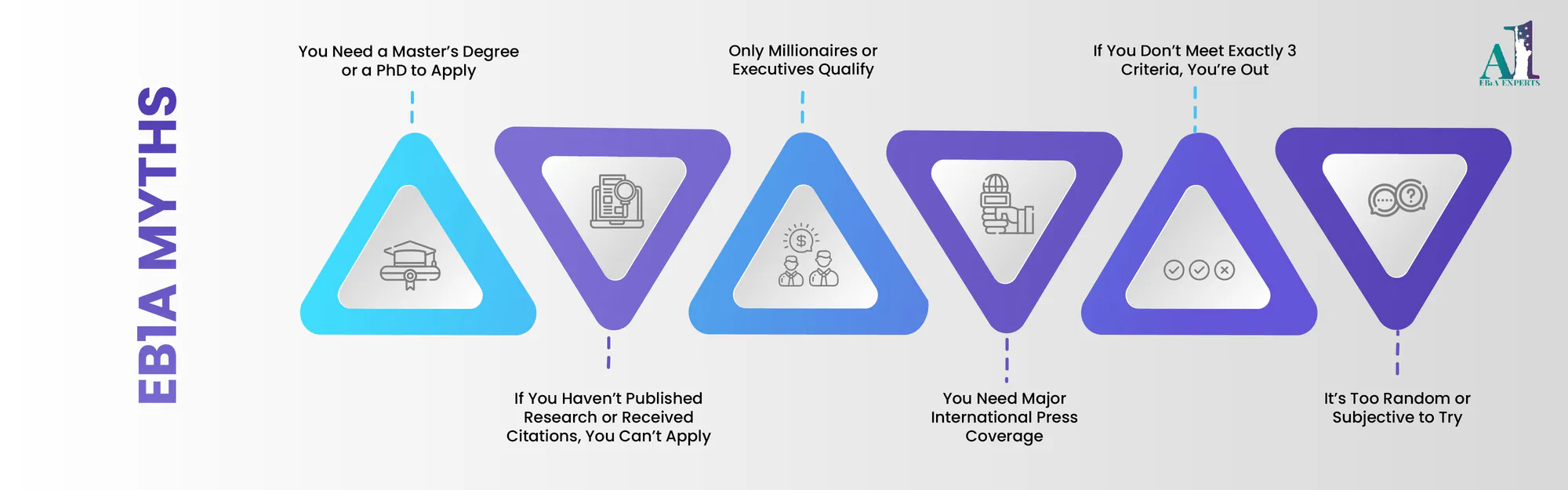
2. Myth 1: You Need a Master’s Degree or PhD to Apply
Maybe you’ve thought this yourself. You look at your resumé and think, “I don’t have the degrees they’re
looking
for.” And just like that, you disqualify yourself.
USCIS does not care about how many letters sit after your name. It cares about:
whether your work matters
whether people rely on it
whether your contributions stand out.
Some of the strongest EB1A cases we see belong to self-taught founders, business leaders, engineers, and
creatives
who built influence through real-world impact. These extraordinary ability visa facts often surprise
people.
Hence, the reality is if your work has moved your field forward, your degree does not get to decide your
future.
3. Myth 2: If You Haven’t Published Research or Received Citations, You Can’t Apply
This is one of the most common EB1A eligibility misunderstandings among tech professionals. As it
quietly scares
away non-academics. You see words like “publications” and “citations” and think, “That’s not my world.”
But EB1A is bigger than academia and publications are just one of many ways to show extraordinary
ability. USCIS
lists 10 criteria, and research is only a slice of the picture.
Patents
Original contributions
Judging the work of others
High compensation
Leadership roles
Media coverage
Selective memberships
These are core EB1A truth vs myths distinctions. No single type of evidence is required. What matters is
recognition. What actually matters then? Have people benefited from your work? Have peers recognized it?
Has it
changed how something is done? That is the heart of EB1A.
4. Myth 3: Only Millionaires or Executives Qualify
This myth hurts because it feels personal. Many professionals feel that even though they are successful,
they are
not rich enough or they are not a CEO and assume that EB1A is not meant for them.
But the fact is that EB1A evaluates relative remuneration, not absolute wealth. USCIS looks at whether
your
compensation reflects recognition compared to others in your field and geography. A senior engineer
earning in the
top 10% of their niche may meet the standard just as well as a C-suite executive.
So, what actually counts? Being highly valued for what you do. Not flashy titles or Forbes lists.
Extraordinary
does not mean famous. It means being valued.
5. Myth 4: You Need Major International Press Coverage
This is where many people quietly give up. But this is the biggest EB1A misconception. You do not need
CNN, BBC,
or The New York Times. USCIS evaluates whether coverage shows recognition and influence, not being a
global
celebrity.
Industry publications
Trade magazines
Niche blogs
Podcasts
Regional media
All of these also count if they focus on your work and not paid promotion.
So, how to think about it? If
someone
in your industry searched your name or your work, would they find credible third-party recognition? That
is what
matters.
6. Myth 5: If You Don’t Meet Exactly 3 Criteria, You’re Out
Now, this EB1A myth is the root cause of panic in tech professionals. You start counting criteria like
exam
answers. One, two or maybe two and a half. And then you stop.
But here’s what most people don’t realize. Meeting three criteria is not the finish line. It is the
entry point.
USCIS then looks at the full picture, that is:
Your story
Your consistency
Your sustained impact
And the truth is, a clear, well-framed narrative often outweighs scattered evidence forced into boxes.
Officers
are trained to assess extraordinary ability holistically, not mechanically. This principle also applies
equally to
those confused by O-1A myths and EB1A standards.
7. Myth 6: It’s Too Random or Subjective to Try
This EB1A application fear is understandable as we all know that immigration feels risky. It has high
stakes and
the journey feels quite emotional. You might think, “What if it’s just luck?”
But it’s not. A well-prepared EB1A petitions follow clear legal standards. According to recent data,
strong cases
see approval rates in the 60 to 70 percent range. So your strategy, presentation and clear evidence
matters more
than you think.
Most denials happen not because the person lacked merit, but because the story was poorly told.
8. Final Thought: Don’t Talk Yourself Out of Your Own Potential
EB-1A exists for professionals whose influence is real, even when it is not loud. And with better tech
EB1A
clarifications, many accomplished individuals realize their work already aligns with what the category
was
designed to recognize. If you have built something meaningful and are still moving forward, this path
may be
closer than it seems.
At EB1A Experts, we have seen firsthand how
often potential goes unnoticed
simply because the rules are
misunderstood. If you have built something meaningful and are still moving forward, this path may be far
closer
than you think.
9. FAQs
Is EB1A only for Nobel Prize winners?
No. This is one of the most common EB1A myths. While the category is labeled as “extraordinary,” USCIS
does not
expect Nobel Prizes or global fame. The EB1A visa is designed for
professionals who have shown
impeccable impact
and recognition within their field. And at EB1A Experts, we regularly see strong cases approved without
globally
famous awards.
Do I need a PhD to qualify for EB1A?
No, a PhD is not required to qualify for an EB1A green card. USCIS evaluates impact, originality, and
recognition.
And that is exactly what we do at EB1A Experts. We focus on how your work is valued, not the letters
after your
name.
Is EB1A harder for software engineers?
Not at all. In fact, many engineers frequently meet criteria through original contributions, high
compensation,
leadership roles, patents, or judging the work of others. The challenge is not eligibility, but framing.
At EB1A
Experts, we help tech professionals overcome EB1A application fears by positioning their real-world
impact
correctly.
Do I need media coverage about myself?
Media coverage can help, but it is not mandatory. USCIS does not require mainstream or international
press.
Industry publications, trade media, podcasts, and credible niche platforms can all qualify. What matters
is
third-party recognition, not publicity. Understanding this distinction is central to separating EB-1A
truth vs
myths when evaluating your profile.
Do I need to be famous to get EB1A?
No. EB-1A is not a popularity contest. This myth often overlaps with O-1A myths and leads professionals
to
self-eliminate unnecessarily. USCIS looks for professional recognition and influence within a field, not
celebrity
status. Many approved EB1A visa cases involve individuals who are well-respected by peers but unknown to
the
general public. At EB1A Experts, we see this pattern consistently.
Is EB1A too risky compared to H-1B?
EB1A is different from H-1B, not necessarily riskier. H-1B depends on lotteries and employer
sponsorship, while
EB-1A is merit-based and self-sponsored. For professionals with strong profiles, EB-1A can offer more
control and
long-term stability.
Is EB1A only for academics?
No, EB1A is not only for academics. This is one of the most limiting EB1A myths. While academics often
qualify,
EB1A was never designed exclusively for them. Entrepreneurs, engineers, product leaders, creatives, and
business
professionals regularly qualify through non-academic evidence also.




 October 20, 2025
 3 min read