Many applicants do not fail due to being “too many” or “not less than” extraordinary while doing EB1A
petition strategy.
Rather, they fail due to starting at inappropriate times, or not following the anticipated action plans.
Early Stage EB1A
Applicants – It’s not an uncommon phenomenon that many early-stage EB1A applicants experience
confusion about whether they are qualified, experienced and have stood the test of time. They often ask
themselves the question:
2. Quick Answer: Do You Need EB1A Assistance on Day One?
The reality is that not all people and organisations will require assistance on day 1 and you can also
create unnecessary stress, delays and mistakes in your EB1A filing if you set out without a proper plan
and strategy in place.
That said, the most important thing is you should ensure you have a considered early EB1A petition
strategy, including
Evidence that you currently possess
Providing evidence that the USCIS will require in order to grant your request
Identify priorities for next steps
It is NOT THE OBJECTIVE TO RUSH INTO EB1A-FILED ASSISTANCE; instead, the objective is to establish the
right foundation to ensure successful EB1A petition execution.
3. The Timing Myth: “Start Only When You’re Ready” (EB1A Assistance Matters Earlier Than You Think)
Many people who want EB1A believe "I will start applying for EB1A when I have more media/press, more
awards, more publications" do not realize that due to the lack of understanding of EB1A, this belief
leads to wasted time/money.
The EB1A
application process then takes longer because without the right legal guidance, many people
without the right legal guidance will:
Collect evidence that does not meet USCIS's criteria for EB1A, and it can take 6-12 months to collect.
Misunderstand USCIS's criteria for EB1A.
Increase the risk of receiving an EB1A Request for Evidence (RFE).
Not align their entire application narrative.
Applying/EB1A is not simply "waiting" to apply. It is about accurately preparing your application.
4. What “Starting EB1A” Actually Means (Not Filing Yet)
To clarify:
Starting the EB1A process = does not equal filing the EB1A.
"Start EB1A" does not mean submit the application tomorrow. It means properly preparing your EB1A
petition.
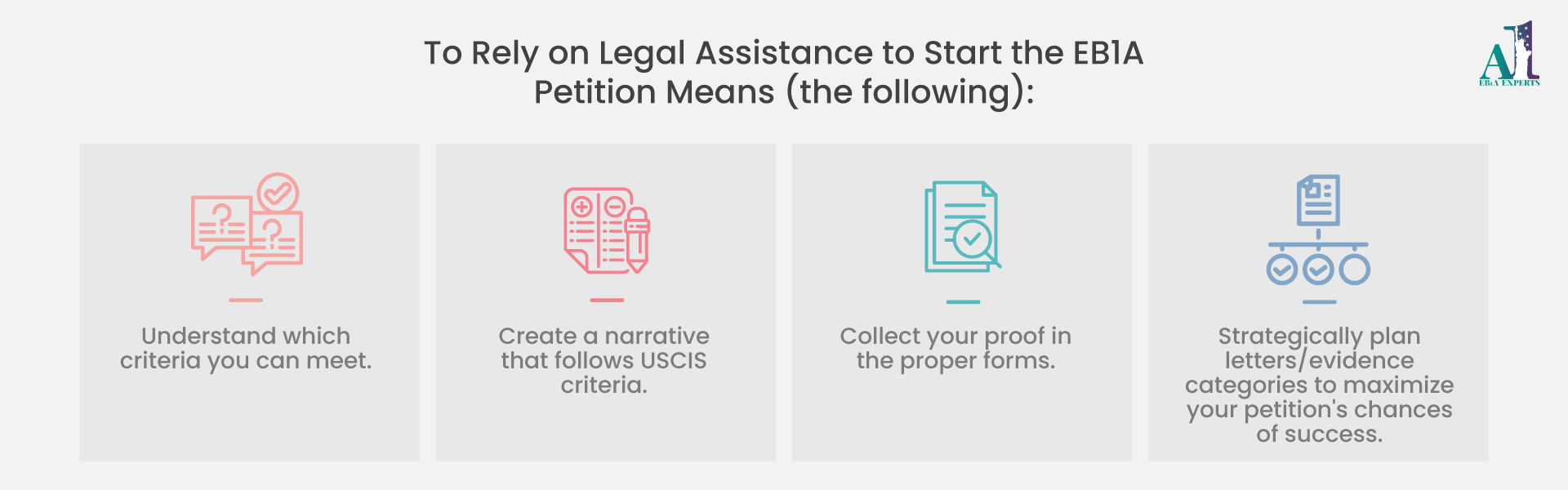
To Rely on Legal Assistance to Start the EB1A Petition Means (the following):
Understand which criteria you can meet.
Create a narrative that follows USCIS criteria.
Increase the risk of EB1A RFEs
Collect your proof in the proper forms.
Strategically plan letters/evidence categories to maximize your petition's chances of success.
This is the foundation of strong EB1A petition assistance, prior to the actual filing of the petition.
5. Do You Need EB1A Petition Assistance Day One? A Real Checklist
Not all individuals require full EB1A
assistance on an immediate basis.
You may not require EB1A assistance immediately if:
Awareness of EB1 A criteria and petition structures
Confidence to organize evidence clearly without assistance
Feel comfortable with self-filing versus attorney/representative decision making
You should seek EB1A assistance at the beginning of the EB1A application process if:
You may qualify for THE EB1A category but do not see how your accomplishments translate into an
EB1A
You have little experience building narrative(s) in support of an immigration petition
You are attempting to use an EB2/NIW logic in an EB1A application
Relying on recommendation letters as primary evidence
Frequently asking "What constitutes evidence?"
6. Quick Decision Table (EB1A Assistance vs Waiting)
If you feel like…
Then you may need…
“My evidence clearly fits EB1A criteria”
Minimal EB1A filing assistance
“I’m accomplished but not sure what USCIS wants”
Early EB1A profile evaluation
“I’m collecting documents randomly”
Structured EB1A petition strategy
“I’m worried about RFEs or denial”
EB1A expert guidance now
7. The Real Timeline: EB1A Assistance Is About Prep, Not Just Processing
Most individuals believe that the processing of an EB1A application will take a certain amount of time
while the United States Citizenship and Immigration Services is processing their case..
However, there are 2 different timelines when it comes to an EB1A petition.
Timeline 1: Time spent preparing for submission of the EB1A petition
This is the timeline that people underestimate the most, even for those who receive assistance to
submit
an EB1A application.
The majority of the time delays occur in this timeline before the actual EB1A petition is submitted as
well as prepared.
Preparing evidence
Mapping the criteria that you will submit
Drafting recommendation letters
Writing the narrative of the petition
Packing the final petition
Many applicants spend 3-6 months doing this part of the process.
Timeline 2: Time spent on EB1A petition requestusk (USCIS).
This timeframe consists of:
Regular versus expedited review.
Request for evidence (RFE) response, which increases risk for an EB1A example by not being able to
respond in time to an RFE and upon successfully responding to an RFE.
Time to complete additional reviews of the EB1A case.
There is a delay before USCIS reviews EB1A cases.
The earlier that petition assistance is utilized, the fewer delays that can occur.
8. The LevelUp AI Approach: Structured EB1A Petition Strategy (Not Salesy)
Some applicants might not need complete representation right away, but they still need clarity about
their EB1A petition.
LevelUp AI supports clarity by providing a roadmap for applicants during the preparation
stages of
their EB1A filings.
Key areas of support provided by LevelUp AI:
Criteria Alignment Check
Strength Scoring and Gap Identifying
Prioritization Plan for Evidence
Recommendation of Next Steps for 2 to 4 Weeks
EB1A Experts often stress the EB1A approval process isn’t about doing “more” but developing the right
evidence and presenting it in the correct order so that it reads as a decision-ready story.
Waiting may not always be bad, but waiting without direction is. Examples of Common EB1A filing
mistakes
include:
No strategy for building evidence
Use of generic recommendation letters
Assuming an applicant receives a high salary, they automatically qualify for EB1A approval
Focusing on the quantity of proof rather than the quality
Not building a narrative that demonstrates national and/or international impact
Attempting to condense six months of preparation into a two-week period
10. What You Can Do This Week (Even Without Filing Soon)
These mistakes reduce the success rate of EB-1A petitions and increase the likelihood of receiving a
request for additional evidence.
You can begin preparing your EB1A petition even if it is several months away from being filed.
5 easy steps to get started include:
Write out the 10 most significant contributions or measurable results achieved
Organize a proof folder for each of the EB1A criteria
Think of three possible recommenders (including those outside of your current employer)
Gather judging/mentoring/leadership documentation
Write a five-sentence impact narrative that makes sense to USCIS.
These tasks will help reduce confusion later when you are seeking help for EB1A.
11. Conclusion: Not Starting on Day One, But It’s Best to Not Wait Too Long
Can you have assistance right at the beginning? You likely don’t need it
However, you do need to start formulating your EB-1A petition strategy early.
Doing these things will save you many months of effort, decrease your chances of receiving an RFE from
USCIS, and allow you to put together the best case possible that is very clear to USCIS.
12. FAQs
Can I file an EB1A petition without professional assistance?
Yes, it is possible to file without EB1A assistance. Many applicants consider EB1A self filing vs
attorney support. However, success depends on how well you understand criteria mapping, evidence
formatting, and petition narrative structure.
When is it risky to handle an EB1A petition on your own?
It becomes risky when you are unsure what qualifies as strong evidence, rely heavily on
recommendation
letters, or don’t have a clear EB1A approval strategy. These gaps can increase EB1A RFE risk.
What are the signs that I should seek EB1A assistance early?
You may need EB1A petition assistance early if you feel successful but can’t translate achievements
into USCIS criteria, keep asking what counts as evidence, or worry about making EB1A filing mistakes.
Can EB1A experts help if I am still building my profile?
Yes. EB1A Experts often provide EB1A profile evaluation and roadmap planning even before filing. Early
EB-1A application guidance can help determine what to prioritize over the next few months.
Is EB1A assistance only for weak or borderline profiles?
No. EB1A assistance is not just for weak profiles. Even strong applicants use the EB-1A petition
strategy to present evidence clearly and strengthen their petition.
How does EB1A assistance improve approval chances?
EB1A petition assistance improves approval chances by reducing confusion, strengthening narrative
alignment, prioritizing the right evidence, and lowering EB1A RFE risk—leading to a higher EB1A
petition
success rate.
Not sure whether to start now or later? LevelUp AI can help you assess where you stand- and what to
prioritize next—before spending months preparing the wrong way.
Get started here!
.





 January 23, 2026
 3 min read