Imagine you are sitting at your kitchen table, surrounded by stacks of crisp white paper and legal
documents.
You are filling out a USCIS
form, perhaps the most important one of your life so far, when you
encounter a small, unassuming box labeled alien registration number.
You pause.
You’ve seen this term before, tucked away in the corner of a notice or etched onto a card, but why
does this single string of digits seem to follow you through every interaction with the US government?
This number is far more than just administrative shorthand; it is the silent thread that weaves
together every filing, decision, and record in your a-number immigration history. While it
often goes
unnoticed, failing to understand it can lead to significant hurdles. Most people interact with it
daily without truly grasping its weight. In this guide, we will provide total clarity: what is an
alien registration number, where it appears, and how to use it correctly to ensure your journey
stays
on track.
In the simplest terms, an alien registration number (often called an alien number or USCIS alien
registration number) is a unique seven, eight, or nine-digit identification number assigned by the US
Citizenship and Immigration Services (USCIS) to non-citizens. It serves as the primary identifier for
an individual’s immigration file.
Alien registration number format: It typically starts with the letter A followed by 7 to 9 digits.
For a standard a-number example, you might see something like A-123-456-789.
The Assignment: It is created by the Department of Homeland Security (DHS) when a person first
applies for certain immigration benefits, such as a green card or work permit, or if they are placed
in removal proceedings.
The Purpose: It allows the government to track your entire history, from your first entry to your
potential naturalization, within a single A-File.
Think of it as your immigration fingerprint. It isn't always visible in your daily life, but it is
always present in the background, anchoring your identity within the vast federal database.
3. Why Does the Alien Registration Number Exist?
The A-Number was born out of a need for historical consistency. Before the digital age, tracking paper
files for millions of people was an archival nightmare. The A-Number solved this by acting as a
permanent identifier that links all your records across different years and visa categories.
Consider this scenario: You first enter the US and file an alien registration number on i-485 receipt
notice while adjusting status. Later, you file for work authorization and eventually your permanent
residency. Finally, years down the line, you apply for US citizenship. Because of that one number,
USCIS can instantly pull up your history to ensure your records are consistent, preventing the need
for you to prove your identity from scratch every single time you submit a new application.
4. Who Gets an Alien Registration Number?
Not every person who enters the US receives one.
Do visa holders have alien registration numbers?
Generally, tourists on B1/B2 visas or short-term visitors do not. However, it is required for several
groups:
Every Lawful Permanent Resident is assigned one. This alien registration card number is the primary
way the government identifies your legal status and keeps track of your residency requirements.
Certain Visa Holders
Some non-immigrant workers, particularly those who have applied for employment benefits, will find an
alien registration number on employment authorization card (EAD) documents. If you are an F-1 student
on OPT, for instance, you will likely be assigned one.
Asylum and Adjustment Applicants
If you are seeking asylum or have filed for a Green Card, you will likely see your alien registration
number on i-797 approval notices or receipts early in the process, even before your actual status is
granted.
5. What Does an Alien Registration Number Look Like?
As mentioned, the typical format is the letter A followed by nine digits. However, older numbers might
be shorter. If you are filling out a digital form that requires nine digits but your number only has
seven or eight, you should add leading zeros (e.g., 001234567) to fill the space. On some official
cards, the A prefix is omitted, leaving only the numeric string.
6. Where to Find Your Alien Registration Number
If you are performing an alien registration number lookup, you can find the digits in several
practical locations:
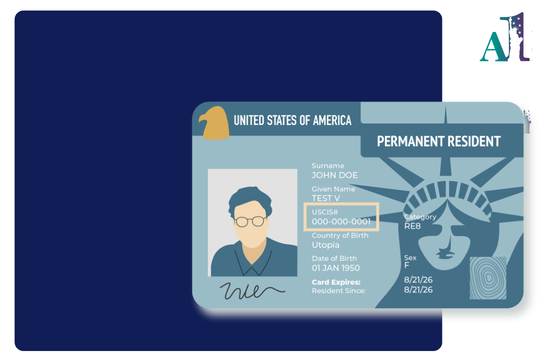
The most common place to look is the alien registration number on green card. On modern cards issued
after 2010, it is listed under the label USCIS#. Many people ask, “is alien registration number same
as uscis number?”
2. On USCIS Form I-797 (Approval Notices)
If you have not received your card yet, check your mail. Look at the top of your notice for a field
labeled A#. This is often how applicants learn how to find a-number on green card paperwork before the
physical card even arrives.
3. On Your Employment Authorization Document (EAD)
If you have a work permit, the alien number is located under the USCIS# field, just like on a Green
Card.
4. In Your USCIS Online Account
If you filed your paperwork electronically through the USCIS portal, log in and view your profile
summary; your number will be prominently displayed there.
5. On Immigrant Visas
For those who entered the US with an immigrant visa stamped in their passport, the number is usually
printed on the visa stamp itself, often labeled as a Registration Number.
7. Alien Number vs. Green Card Number
There is often significant confusion regarding the alien number vs green card number. While they
appear on the same card, they serve entirely different roles.
Feature
Alien Registration Number (A-Number)
Green Card Document Number
Purpose
Identifies you as an individual
Identifies the specific card document
Permanence
Stays with you for life
Changes every time a new card is issued
Common Label
A-Number or USCIS#
Receipt Number
Format
7–9 digits
13 characters (e.g., MSC2190...)
The green card document number (or permanent resident card number) tracks the specific application
that resulted in that card. In contrast, your A-Number remains yours forever. If you lose your card
and get a replacement, your A-Number stays the same, but your green card document number will
change.
8. Alien Registration Number vs. USCIS Online Account Number
While the A-Number tracks your identity, the USCIS Online Account Number is used specifically for the
digital filing system. Not everyone has an account number, but almost every immigrant has an A-Number.
If a form asks for an account number and you do not have one, you can usually leave it blank, but the
A-Number field is almost always required.
9. Why Your A-Number Matters More Than You Realize
In the world of federal bureaucracy, this number is the glue that holds your record together. It
ensures that USCIS does not confuse you with someone else of the same name and prevents the creation
of duplicate records. One incorrect digit can cause the system to lose your file in a digital limbo,
potentially delaying your processing by months. Accuracy is vital for background checks, faster
processing, and avoiding the dreaded Request for Evidence (RFE).
What Happens If You Enter the Wrong Number?
Mistakes happen, but a typo here is costly. If you provide the wrong number, you might face
significant delays as officers try to reconcile your record. In rare cases, your application might be
attached to someone else’s file or rejected entirely. Always double-check your format before hitting
submit.
Lost Your Alien Registration Number?
If you have a lost alien registration number, follow these steps:
Review old paperwork: Look for any alien registration number on i-797 notices.
Review your passport: Look for an immigrant visa stamp.
Contact your attorney: If you used legal counsel, they will have it on file.
FOIA Request: As a last resort, file a Freedom of Information Act request to retrieve your data
Is It Safe to Share Your A-Number?
Your A-Number is sensitive. While it is not quite as dangerous as a Social Security Number in terms of
financial theft, it should be guarded. Only share it with trusted legal representatives, employers, or
on official government forms. Avoid posting photos of your documents on social media where the alien
number on green card might be visible.
Final Thoughts: One Number, One Immigration Identity
The alien registration number is far more than a bureaucratic requirement; it is the cornerstone of
your legal presence in the United States. In an immigration landscape often defined by shifting
policies and complex paperwork, this number remains your one constant. It acts as the bridge between
your past applications and your future aspirations, ensuring that your identity remains clear and your
records stay unified.
By knowing where to find alien registration number and keeping it secure, you aren't just filling out
a form; you are taking active ownership of your immigration identity. This small string of digits is
the key to faster processing, accurate background checks, and a smoother path toward your goals.
Embracing the importance of your A-Number provides a sense of certainty and professional readiness,
giving you more control over a very big and significant journey.
Yes, for most modern documents like a green card or work permit, the number listed as the USCIS# is
your unique alien registration number.
USCIS began using the term USCIS Number on physical cards to make the identifier more user-friendly,
but the digits remain the same. This 7 to 9-digit string is used by the agency to track your entire
immigration file and history. Whether a form asks for your A-Number or your USCIS Number, you should
provide the same sequence of digits found on your card.
2. Is the a-number immigration identifier the same as the uscis case number?
No. Your A-Number identifies you as an individual, while a case number (receipt number) identifies one
specific application you filed.
An individual has only one permanent alien registration number but will receive a new receipt number
for every petition submitted to USCIS. For example, your I-140 petition and your I-485 adjustment of
status will have different receipt numbers, but both will be tied to your single A-Number. It is
important not to confuse these when tracking the status of a specific filing.
3. Do visa holders have alien registration numbers?
Most non-immigrant visa holders, such as B1/B2 tourists, do not have an A-Number unless they have
previously applied for an immigration benefit or work permit.
A-Numbers are generally assigned only when a non-citizen initiates a process for permanent residency
or certain types of work authorization. However, some H-1B or L-1 visa holders may receive an A-Number
if their employer has filed an I-140 immigrant petition on their behalf. If you are strictly a
short-term visitor, your record is typically tracked by your passport and I-94 number instead.
4. Where can I find the alien registration number on my green card?
The number is located on the front of the physical card, listed directly under the label USCIS#.
On older versions of the permanent resident card, it may have been listed on the back or labeled
simply as the A-Number. Regardless of the card's age, it will always follow the standard alien
registration number format of 7 to 9 digits. If you are currently waiting for your card to arrive, you
can also find this number on your I-797 approval notice.
5. Is the alien registration number the same as a Social Security Number?
No. An A-Number is used exclusively by immigration authorities for tracking legal status, whereas a
Social Security Number (SSN) is for tax and benefit purposes.
The A-Number is assigned by the Department of Homeland Security (DHS) and is specific to non-citizens
within the immigration system. An SSN is issued by the Social Security Administration (SSA) and is
used by both citizens and non-citizens who have work authorization. While both are critical
identification numbers, they are managed by entirely different government branches.
6. What should I do if I have a lost alien registration number?
You should perform an alien registration number lookup by checking previous I-797 notices, your
passport for immigrant visas, or your USCIS online account.
If you still cannot locate the number, your legal counsel likely has a copy of your records in their
case file. In situations where no paperwork is available, you may need to file a G-639 Freedom of
Information Act (FOIA) request with USCIS to obtain your file information. Having this number is
essential for any future filings, so keeping a digital copy in a safe place is highly recommended.
7. Does the alien registration number change when you get a new card?
No. Your A-Number is a permanent identifier that stays with you for life, even if your physical card
expires or is replaced.
While your green card document number changes every time a new card is issued, the A-Number remains
the same to maintain a consistent record. This ensures that your entire history from your first
petition through naturalization is linked to one person. The only rare exception is if a clerical
error resulted in two numbers being assigned, which USCIS would later consolidate.
8. What if my alien registration number format has only 8 digits?
If your A-Number has fewer than 9 digits, you simply add a leading zero (or zeros) at the beginning
when filling out digital forms.
Older A-Numbers were often issued with 7 or 8 digits before the current 9-digit standard was fully
implemented. USCIS systems are designed to recognize these shorter numbers as long as the total
character count is met with leading zeros. For example, if your number is A-12345678, you would enter
it as 012345678 on most electronic applications.
Take the Next Step in Your Journey
If you are an industry professional, researcher, or person of extraordinary ability looking to
transition from a temporary visa to permanent residency, your A-Number is just the beginning. Secure
your future in the US with a strategy designed for success.






 December 17, 2025
 3 min read