Some experts believe that only those who have received a Nobel Prize, are a celebrity scientist, or are
a founder of one of the most visible companies are eligible for EB1A. This
belief leads many extremely
talented professionals to stop evaluating their eligibility for EB1A. The truth is, the USCIS looks at
much more than awards and recognitions when determining the individual's level of influence,
originality, and sustained recognition in the field. Numerous individuals with uncommon EB1A criteria
wins have met all the ability requirements, but they did not know it. This article provides
EB1A
achievements examples that are often overlooked but are critical. By using these creative EB1A
strategies, professionals in technology, research, business, and startups can present their work
as
extraordinary
ability evidence without embellishing or hyping it.
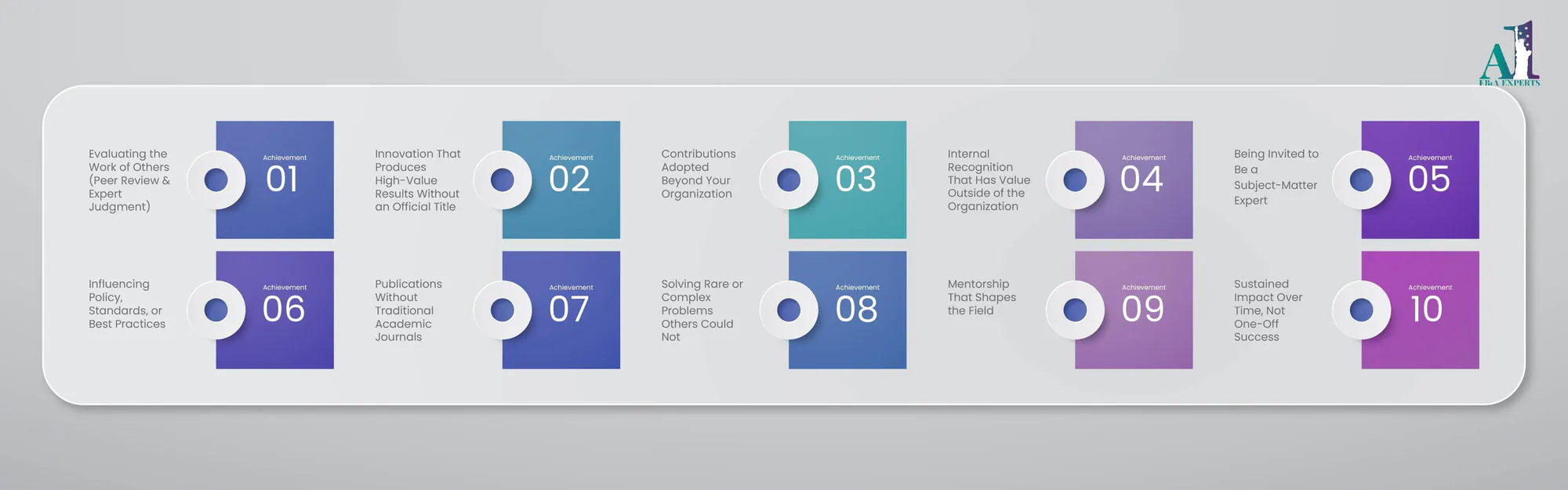
2. Achievement #1: Evaluating the Work of Others (Peer Review & Expert Judgment)
By reviewing technical papers, conference submissions, grant proposals, or internal evaluation results,
you are demonstrating your professionalism and ability to be trusted by the United States Citizenship
and Immigration Services (USCIS) for its review process when they evaluate cases based upon independent
evaluations, which is often an indication of your level of recognition.
Examples of the various evaluation types are:
Reviewing research or technical documents.
Being a member of both internal and external review committees.
Providing expert evaluations.
Most engineers and researchers overlook these EB1A supporting evidence ideas in dictating the future of
their profession or field. Yet numerous extraordinary-ability case studies highlight outstanding
ability from independent reviews.
3. Achievement #2: Innovation That Produces High-Value Results Without an Official Title
Contrary to popular belief, leadership is not defined solely by an individual's title within an
organization but rather by the ability to provide direction and control within their profession or
field. Accordingly, engineering professionals are often recognized for leading teams that make critical
architectural decisions, overseeing the execution of high-profile projects, and facilitating the
development of new products.
Key Elements Considered by USCIS
A person's ability to make decisions.
A person's ability to own major systems.
A person's ability to influence other teams.
Taken together, the outcomes associated with these multiple roles constitute compelling EB1A
innovative
accomplishments, further examples of EB1A
achievements.
4. Achievement #3: Contributions Adopted Beyond Your Organization
Categories of Contributions
Importance of the Category
Open-source tools
Opportunity to be relied upon by external groups
Reusable frameworks
Showcases the scalability of your ideas
Sharing methodologies
Allows others to validate your methodologies
When your work is used, not just created, by other organizations, this demonstrates that your work has
value to many companies, which underscores USCIS's emphasis on using a contribution rather than creating
one.
The aforementioned categories of contributions often yield uncommon EB1A criteria wins and serve
as compelling evidence of extraordinary ability.
5. Achievement #4: Internal Recognition That Has Value Outside of the Organization
There are awards for different types of achievements or contributions within your company. Not all
companies award similar accolades; therefore, USCIS looks for an award that is selective and relevant.
Internal recognition typically demonstrates:
Competitive Selection
Clear Performance Benchmarks
Results related to the impact of your work on the industry.
When properly supported, internal recognition is one of the most prominent EB1A petition
strengthening tips, rather than being seen as a vague or generic claim.
6. Achievement #5: Being Invited to Be a Subject-Matter Expert
Being invited means others value your level of expertise. Some examples include:
Speaking on panels, both internally and externally
Advising on leadership teams
Evaluating the quality of technical or professional submissions
The context and selectivity of the invitation are often more important than the quantity. Being invited
is often considered a category of persuasive EB1A accomplishment and is referenced in extraordinary
ability case studies.
7. Achievement #6: Influencing Policy, Standards, or Best Practices
Long-Term Impact of Developing Internal Guidelines, Operational Standards, and Technical Best Practices
USCIS views this work as:
Ability To Influence More than a Single Project
Long-lasting Change In An Organization
Representing Field-Level Relevance
When this is framed correctly, it will provide strong evidence of extraordinary ability and a very
effective use of a creative EB1A strategy.
8. Achievement #7: Publications Without Traditional Academic Journals
Influencing work is not limited to academic journals:
Type of Work
Impact Of Work
White-Papers
Industry Adoption
Technical Blogs
Readership And Reuse
Industry Reports
Implementation Outcomes
The substance of the work is more essential than the venue, as long as these elements align with EB1A
supporting evidence and real-world impact.
9. Achievement #8: Solving Rare or Complex Problems Others Could Not
Being able to solve high-risk problems and/or unresolved issues reflects the depth of your expertise.
Strong Examples Of This Would Include
Fixing Critical System Failure
Creating Novel Solutions
Preventing Significant Operational Losses
A before-and-after narrative will clearly illustrate ample evidence supporting this as an extraordinary
ability case study.
10. Achievement #9: Mentorship That Shapes the Field
Mentorship demonstrates leadership through measurable outcomes.
Examples of recognized mentorship include
Mentoring professionals who then advance in their careers
Creating structured training frameworks
Leading ongoing knowledge-sharing initiatives
Example of the most overlooked achievement in the EB1A area; however, it fits well
11. Achievement #10: Sustained Impact Over Time, Not One-Off Success
Long-term impact is what USCIS values more than one-time events, as the basis for approvals.
Demonstrating sustained impact:
Experience in multiple leadership positions
Continued contributions across teams or organizations
Demonstrated, continued progression of responsibility
Maintaining consistent criteria within the category as an application-strengthening tip for EB1A
applicants is one of the easiest things that professionals miss.
12. Conclusion - What will push an EB1A
applicant over the threshold
The success of an EB1A Application depends less on isolated headline-worthy achievements and instead
depends more on strategic positioning, contextualizing, and aligning evidentiary materials with the most
impactful and relevant forms of evidence available today. Many professionals have multiple opportunities
to qualify as someone with a legitimately spectacular career, but do not take the time to fully identify
or quantify that opportunity. Re-evaluating past accomplishments from an expanded perspective around
what constitutes the evidence necessary to meet the requirements of EB1A applications, developing a
non-linear approach to developing evidence and constructing a narrative for the purpose of submitting an
EB1A application, and re-evaluating one's own profile with this approach has the potential to lead to
the discovery of innovative EB1A accomplishments that may have been overlooked.
13. FAQs
1. What counts as a “surprising” EB1A achievement?
Influence-based work is not traditionally labeled as awards but supported by extraordinary ability
evidence.
2. Do internal company recognitions matter?
Yes, when selective and outcome-driven, they serve as strong EB1A supporting evidence for ideas.
3. Can startup traction help my EB1A case?
Yes, especially when growth demonstrates uncommon EB1A criteria wins.
4. Does having a patent guarantee EB1A success?
No. Impact matters more than ownership.
Do coding competitions or hackathon wins matter?
They can, if competitive and field-relevant.
Is leading a mission-critical project enough?
Yes, when influence and complexity are clearly documented.
Can media coverage about my company help me?
Yes, if your individual contribution is clearly distinguished.
If you think that your achievements can make a difference, we will help you
to strengthen your journey.




 August 06, 2025
 3 min read