The EB1A Visa is a U.S. immigration category for individuals with some level
of expertise, qualifying
under USCIS’s 10 regulations to award professionals with extraordinary achievement in their profession;
applicants must meet three of the EB1A criteria to be considered
for this visa. If an applicant
understands the EB1A criteria and has identified which of the ten categories is easiest to document
based on historical precedent, then the applicant has a better chance of receiving an approval for EB1A.
To improve the likelihood of receiving approval for EB-1A, an applicant may employ an EB-1A development
strategy, which enables the applicant to focus on documenting the strongest evidence for the application
rather than trying to document all EB-1A criteria equally. This article tells you about the ten EB-1A
criteria, the relative ease or difficulty of documenting each of the ten categories, and the recommended
development path for submitting your EB-1A application.
USCIS guidelines define ten criteria for extraordinary ability. To qualify, the applicant must satisfy
at least three different criteria.
1. Awards and Achievements
Nationally or internationally accepted awards for excellence in his/her field.
Examples of awards include:
Industrial application/product-specific
Innovation grant
Competition results
Dozens of different types of awards exist, but an applicant must describe the selection process, the
nature of the jury evaluating the award, and the importance of the award relative to other awards in the
industry.
2. Membership in Professional Organizations/Associations
Membership in professional organizations requires significant accomplishments to join.
The type of media covers information regarding your accomplishments.
Examples of cover articles might include:
Profiles in a magazine
Press releases
From independent, professionally written publication sources, an all-inclusive media print publication
must discuss your success in that industry as opposed to listing only your name.
4. Evaluation of the Work of Others
As a judge or reviewer of others' work in the professional community or an assignment reviewer or
evaluator through reviews/responses to applications for product standards and professional awards.
Commonly referred to as a peer reviewer for any major award process through journals and hackathons.
Commonly judged through conference consumer judges and through industry grant committees.
5. Original Contributions of Major Significance
Demonstrating your significant contribution to your area of expertise.
Evidence includes:
Patents for Your Ideas
Important Frameworks or Models
Breakthrough Research
Citations and other evidence of your ideas being implemented, as well as the expert opinions, provide
support for your claims.
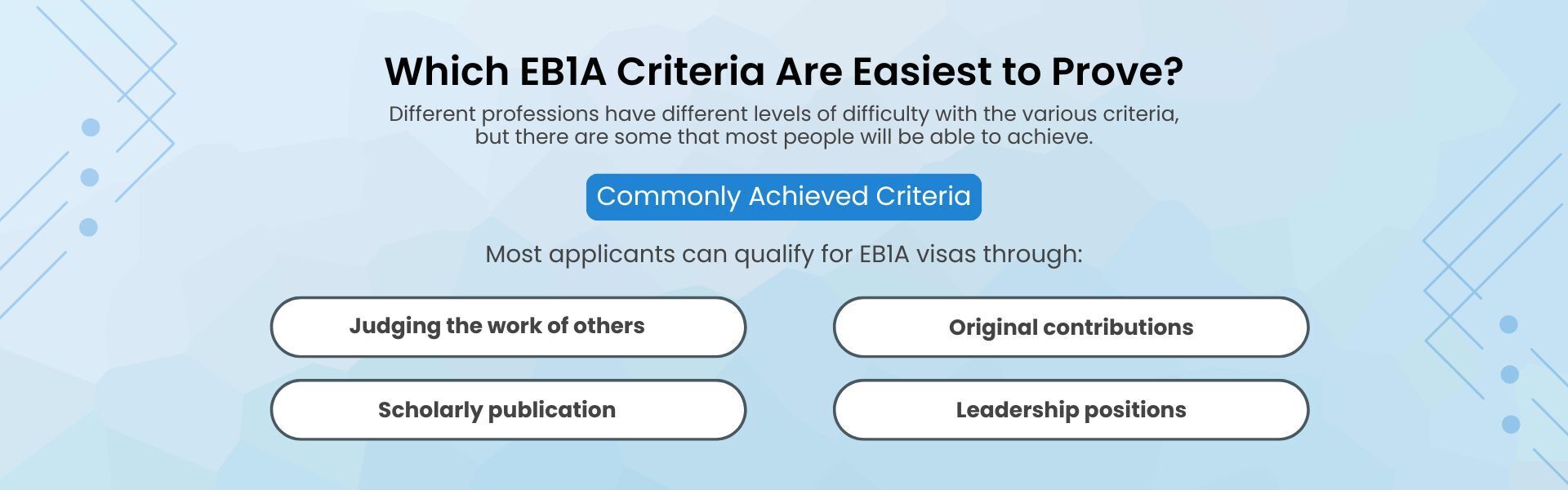
For software engineers, AI researchers, and technology founders, common qualifying criteria are:
Original Contributions to the field
Scholarly publications or Technical Articles
Judging hackathons and Reviewing Research
Leadership positions with Technology Companies
Commercial success of Products
Strong evidence might include proof of contributions such as GitHub Impact, patents, research citations,
product adoption metrics, or letters from experts.
5. Choosing the Right EB-1A Strategy
Your success on an EB-1A petition is not about checking all of the boxes but rather developing a
narrowly focused case with sufficient evidence to support it.
At EB1A Experts, we utilize our AI analysis system to examine your profile and provide you with a list
of 3 to 4 criteria where we believe your evidentiary strength is greatest, enabling you to create a
petition strategy with high impact.
This focused approach tends to lead to more successful applications and a higher likelihood of approval.
6. FAQs
1. How many criteria do I need to qualify for EB1A?
Applicants do not need to meet all ten EB1A criteria. USCIS requires evidence for at least three
criteria. However, the strength, credibility, and documentation of achievements are critical. Strong
petitions clearly demonstrate sustained national or international recognition within the applicant’s
field.
2. Does USCIS prioritize any specific EB1A criterion?
No single EB1A criterion is officially prioritized by USCIS. Officers evaluate the overall strength and
credibility of evidence presented. What matters most is how clearly the documentation demonstrates
industry recognition, measurable impact, and sustained professional achievements within the applicant’s
field.
3. Can multiple achievements count toward the same EB1A criterion?
Yes, multiple achievements can strengthen a single criterion. For example, several awards, publications,
or judging roles may reinforce that category. While diversity across criteria is helpful, strong
evidence within a few criteria can still build a compelling EB1A petition.
4. What kind of evidence is typically required for EB1A petitions?
EB1A petitions require documented evidence such as awards, published research, media coverage,
leadership roles, judging activities, or proof of original contributions. Strong petitions combine
objective documentation with clear explanations that demonstrate industry impact and recognition.
5. How can professionals determine if they qualify for EB1A?
Many professionals begin by evaluating their achievements against the EB1A criteria. A structured
profile review can help identify strengths and gaps in documentation. Platforms such as LevelUp provide
eligibility assessments that help professionals understand their potential qualification for EB1A
immigration.





 March 12, 2026
 3 min read